


.png)


 NEWS
NEWSThe MLSPA recently release the 2025 MLS player salaries.
Full rankings: https://www.spotrac.com/mls/rankings/player/_/year/2025/sort/cash_total
Here are the Top 10 highest paid MLS players:


 ATL Atlanta UnitedAtlanta United FC
 MTL MontrealCF Montreal
 CLT CharlotteCharlotte FC
 CHI FireChicago Fire
 CLB Columbus CrewColumbus Crew
 DC UnitedD.C. United
 CIN CincinnatiFC Cincinnati
 MIA Inter MiamiInter Miami CF
 NSH NashvilleNashville SC
 NE RevolutionNew England Revolution
 NYC New York CityNew York City FC
 RBNY Red BullsNew York Red Bulls
 ORL Orlando CityOrlando City
 PHI UnionPhiladelphia Union
 TOR TorontoToronto FC
 ATX AustinAustin FC
 COL RapidsColorado Rapids
 DAL DallasFC Dallas
 HOU DynamoHouston Dynamo
 LA GalaxyLA Galaxy
 LAFC Los AngelesLos Angeles FC
 MIN MinnesotaMinnesota United FC
 POR TimbersPortland Timbers
 RSL Real Salt LakeReal Salt Lake
 SD San Diego FCSan Diego FC
 SJ EarthquakesSan Jose Earthquakes
 SEA SoundersSeattle Sounders FC
 SKC Kansas CitySporting Kansas City
 STL St. Louis CITYSt. Louis CITY SC
 VAN WhitecapsVancouver Whitecaps FC
 ACFC Angel City FCAngel City FC
 BFC Bay FCBay FC
 BOS Boston Legacy FCBoston Legacy FC
 CHI Chicago Stars FCChicago Stars FC
 DEN Denver Summit FCDenver Summit FC
 HOU Houston DashHouston Dash
 KC Kansas City CurrentKansas City Current
 GFC NJ/NY Gotham FCNJ/NY Gotham FC
 NC North Carolina CourageNorth Carolina Courage
 ORL Orlando PrideOrlando Pride
 POR Portland Thorns FCPortland Thorns FC
 LOU Racing Louisville FCRacing Louisville FC
 SD San Diego Wave FCSan Diego Wave FC
 SEA Seattle Reign FCSeattle Reign FC
 UTA Utah Royals FCUtah Royals FC
 WAS Washington SpiritWashington Spirit ATL Atlanta UnitedAtlanta United FC MTL MontrealCF Montreal CLT CharlotteCharlotte FC CHI FireChicago Fire CLB Columbus CrewColumbus Crew DC UnitedD.C. United CIN CincinnatiFC Cincinnati MIA Inter MiamiInter Miami CF NSH NashvilleNashville SC NE RevolutionNew England Revolution NYC New York CityNew York City FC RBNY Red BullsNew York Red Bulls ORL Orlando CityOrlando City PHI UnionPhiladelphia Union TOR TorontoToronto FC ATX AustinAustin FC COL RapidsColorado Rapids DAL DallasFC Dallas HOU DynamoHouston Dynamo LA GalaxyLA Galaxy LAFC Los AngelesLos Angeles FC MIN MinnesotaMinnesota United FC POR TimbersPortland Timbers RSL Real Salt LakeReal Salt Lake SD San Diego FCSan Diego FC SJ EarthquakesSan Jose Earthquakes SEA SoundersSeattle Sounders FC SKC Kansas CitySporting Kansas City STL St. Louis CITYSt. Louis CITY SC VAN WhitecapsVancouver Whitecaps FC ACFC Angel City FCAngel City FC BFC Bay FCBay FC BOS Boston Legacy FCBoston Legacy FC CHI Chicago Stars FCChicago Stars FC DEN Denver Summit FCDenver Summit FC HOU Houston DashHouston Dash KC Kansas City CurrentKansas City Current GFC NJ/NY Gotham FCNJ/NY Gotham FC NC North Carolina CourageNorth Carolina Courage ORL Orlando PrideOrlando Pride POR Portland Thorns FCPortland Thorns FC LOU Racing Louisville FCRacing Louisville FC SD San Diego Wave FCSan Diego Wave FC SEA Seattle Reign FCSeattle Reign FC UTA Utah Royals FCUtah Royals FC WAS Washington SpiritWashington Spirit
The MLSPA recently release the 2025 MLS player salaries.
Full rankings: https://www.spotrac.com/mls/rankings/player/_/year/2025/sort/cash_total
Here are the Top 10 highest paid MLS players:
 © USA Today Sports
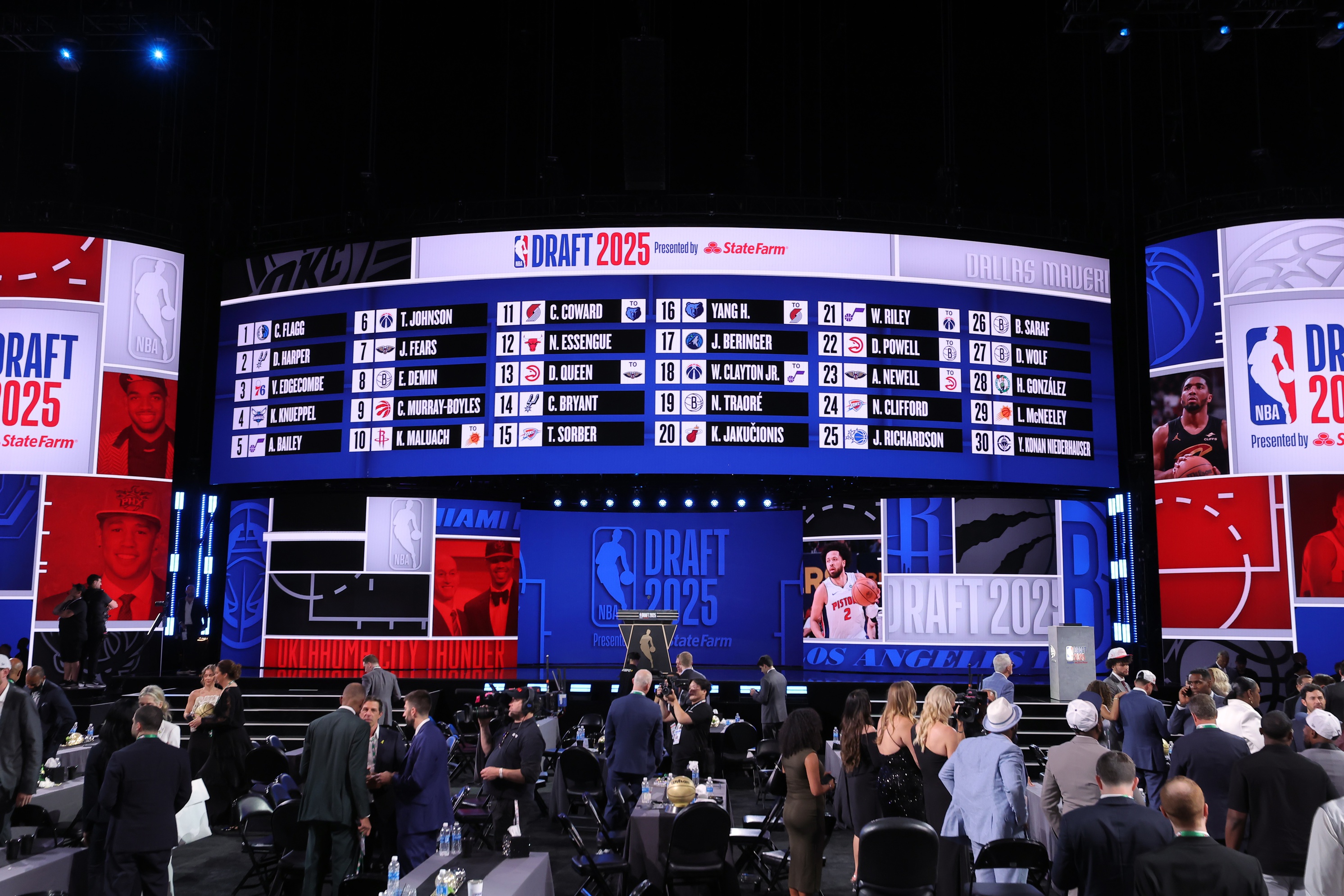
There were six trades made during the first round of the 2025 NBA Draft. In a departure from previous seasons, very few of these deals involved established NBA players. We’re going to break down each deal here by looking at both immediate and long-term impacts.
Phoenix Suns acquire: Mark Williams
Charlotte Hornets acquire: Vasilije Micic, draft rights for Liam McNeeley (2025 29th pick), 2029 least favorable of Cavaliers, Timberwolves 6-30 and Jazz first-round pick
Let’s dive in!
Incoming salary: $6.3 million in 2025-26
Outgoing salary: $10.9 million in 2025-26
The Phoenix Suns came into the draft looking to add a center. They came away with two of them, after acquiring Mark Williams and drafting Khaman Maluach with the 10th pick they received in the Kevin Durant trade. Those two will team with holdover Nick Richards and Oso Ighodaro to give Phoenix solid center depth.
That said, this is a weird trade for the Suns.
Maluach is still a very raw prospect. He needs a year to two to develop, even if he’s overflowing with potential. But he could have done that while playing with Richards and Ighodaro. Adding Williams just overcomplicates things in the Suns center rotation. None of those guys are really fours, so there aren’t even really options to play them in frontcourt pairings.
In addition, Williams is extension-eligible this summer. That means Phoenix has to figure out what to do there before next season starts. Given that Williams career-high in games played is 44, and he was already part of a rescinded trade, there’s risk in locking into a long-term deal with him. And there’s even more risk, given Maluach should be seen as the team center of the future.
Lastly, the Suns don’t have a lot of draft capital to trade, especially in the form of first-round picks. Giving up one of the few they do have to fill a spot that wasn’t really a major need is an odd use of their limited assets. Not to mention that the team took on money in this trade, because Phoenix could have declined their team option for Vasilije Micic to let him return to Europe.
Incoming salary: $10.9 million in 2025-26
Outgoing salary: $6.3 million in 2025-26
The Charlotte Hornets and Mark Williams seemed destined for a breakup, considering the team traded him once already. They all talked a good game about welcoming him back into the fold, but it was clear both sides were ready to part ways.
Now, Charlotte doesn’t have to deal with any sort of awkwardness with extension talks that neither party really wanted. The Hornets are shorthanded up front, but that’s something they can deal with when free agency opens.
In a weird twist of fate, Vasilije Micic returns to Charlotte after spending some time there a year ago. His stay may be short, as Micic reportedly has several standing offers from top EuroLeague teams. This will likely result in a buyout, as Micic’s team option was only picked up to make the salary-matching work.
The real gets here for the Hornets are Liam McNeeley, who was selected with the 29th overall pick and a future first-round pick. McNeeley dropped in the draft, but will team with Kon Knueppel, who was drafted fourth overall by Charlotte, to give the team some much needed perimeter shooting and scoring with good size.
The 2029 first-rounder the Hornets added is also a nice pickup. It’s the worst pick out of the Cleveland Cavaliers, Minnesota Timberwolves and Utah Jazz. It probably won’t be too juicy of a pick, but we have no idea what those teams will be in four years.
Memphis Grizzlies acquire: draft rights for Cedric Coward (2025 11th pick)
Portland Trail Blazers acquire: draft rights for Hansen Yang (2025 16th pick), 2028 Magic first-round pick, two future second-round picks
Let’s dive in!
Incoming salary: $5.7 million in 2025-26
Outgoing salary: $4.4 million in 2025-26
This trade is all about upside for both teams. Cedric Coward has six games of high-level NCAA experience under his belt, because he had a shoulder injury last year for Washington State. He was one of the highest risers in the pre-draft process, going from a second-round pick to a late first-round pick to being picked in the lottery.
If Coward hits, this is a great get for Memphis. They can plug him and Jaylen Wells in as 3&D-plus players around Ja Morant and Jaren Jackson Jr. That’s big for a team that is retooling their roster around the two stars.
The issue is that Coward is a bit of an unknown, because of the lack of action. Considering Memphis didn’t give up too much to make this move, it’s hard to take much issue with it. Maybe they could have waited to see if Coward would drop to them, but at the expense of an extra first-rounder from the Magic (which projects to be a pick in the 20s), it’s not any kind of massive overpay. If you feel like Coward is your guy, it’s best to make the move.
Incoming salary: $4.4 million in 2025-26
Outgoing salary: $5.7 million in 2025-26
This was the most shocking pick of the draft. It’s one of the most shocking first-round picks in years. Hansen Yang rapidly went from moderately unknown and a projected undrafted to player to a potential high second-round pick during the pre-draft process. The Portland Trail Blazers taking him 16th overall threw the entire NBA for a loop.
Yang’s numbers in China, both offensively and defensively, are impressive. That’s true even if you have to take stats put up in the CBA with a grain of salt, because the style of play leads to inflated stats.
Yang also just turned 20 years old, so he’s far from a finished prospect. He’s a good passer, solid finisher, decent rebounder and good rim protector. There’s a lot to like, even when you factor in the level of competition.
All of that said, this is a weird fit in Portland.
The Trail Blazers just drafted Donovan Clingan to be the center of the future a year ago. Nothing that happened in Clingan’s rookie season should have changed that assessment. It doesn’t look like Portland will be able to create lineups where Clingan and Yang will be able to play together, as both are pure fives.
In addition, but less worrisome, is that the Blazers still have Deandre Ayton and Robert Williams III. The two vets are on expiring contracts, and both are trade chips, so there’s no long-term worries there. It’s just an immediate logjam, but given Yang doesn’t seem likely to be ready for NBA minutes right away, it’s fine.
The main issue here is the value of picking Yang so high. There’s something to be said for believing in your board and selecting your guy when you have the chance. But given how many teams were trading around in the 20s in this draft, Portland should have had an opportunity to trade back further, pick up more assets, and still draft Yang.
Flipping back to the positive side, getting an additional first-round pick is good work. That pick projects to be in the 20s, but that’s fine. The Blazers now have an additional draft asset, plus two incoming second-round picks too, to work with down the line. Not a bad haul for only moving back five picks.
Atlanta Hawks acquire: draft rights for Asa Newell (2025 23rd pick), 2026 more favorable Bucks or Pelicans first-round pick
New Orleans Pelicans acquire: draft rights for Derik Queen (2025 13th pick)
Let’s dive in!
Incoming salary: $3.2 million in 2025-26
Outgoing salary: $5.1 million in 2025-26
The Atlanta Hawks continued an impressive run of transactions with this trade. In moving back 10 picks, the Hawks saved some money, got a player who fills a need for frontcourt depth and picked up a potentially extremely valuable first-round pick in next year’s draft.
The Hawks have plenty of room under the luxury tax to re-sign Caris LeVert and to continue to retool their bench. The $1.9 million in savings might not seem like much, but it could be the difference between using the full Non-Taxpayer MLE, or a large chunk of Atlanta’s $25.3 million TPE.
Newell will fit in nicely in Atlanta’s frontcourt rotation right away. He plays with a ton of energy as a bouncy, athletic forward. The shot is a work in progress, but Newell’s form looks good and he’s a good free shooter. There are shades of Jaden McDaniels in his game, and that would be a terrific outcome for Newell and the Hawks.
As nice as it is to get Newell now, the real asset in this deal is getting that unprotected 2026 first-round pick that will be the best of the Pelicans or Bucks. There’s no guarantee that New Orleans will be able to climb up the Western Conference standings, and things are still fairly uncertain in Milwaukee, even if they don’t trade Giannis Antetokounmpo. Having that pick has major upside for the Hawks.
Incoming salary: $5.1 million in 2025-26
Outgoing salary: $3.2 million in 2025-26
Derik Queen is a really nice center prospect for the Pelicans. He can form a nice offense-defense pairing with Yves Missi at the center spot. If the shot comes along for either Queen or Missi, there are even lineup constructions where the two young bigs could play together.
The issue is the fit is a little weird. If Queen is seen as the immediate starting center, he’s not a great fit next to Zion Williamson. Queen is a ground-bound big man and not a great defender. Williamson is obviously uber-athletic, but he’s not a good defender either. And, as referenced above, Missi is there already and was a bright spot for the Pelicans last year.
But that stuff will all sort itself out. Queen and Missi have potential, and Williamson’s future in New Orleans has never been more uncertain. The Pels have some options up front now.
The issue is that New Orleans gave up an unprotected first-round pick in what projects to be a pretty good draft. And this team has no guarantee of being a playoff team next season. If that pick ends up landing in the top-five, the value becomes so slanted towards Atlanta that Queen would have to be a multi-time All-Star for things to even out.
This is the kind of short-term, “gotta get our guy” stuff that can get teams in trouble. We praised others for making moves for a player they believe in, but this feels like a fairly large overpay because of the potential of that 2026 pick.
Utah Jazz acquire: draft rights for Walter Clayton Jr. (2025 18th pick)
Washington Wizards acquire: draft rights for Will Riley (2025 21st pick), 2025 43rd pick, two future second-round picks
Let’s dive in!
Incoming salary: $3.9 million in 2025-26
Outgoing salary: $3.5 million in 2025-26
This space is a big fan of Walter Clayton Jr. The stereotypical definition for Clayton is that he’s a “winner”. Normally, that’s fluff and hyperbole, but it fits in Clayton’s case. He’s tough, he’s hyper-competitive and he makes clutch plays. You can’t ask for a whole lot more.
Clayton also comes in fairly NBA-ready. He’s an older player, and he’ll be ready to play Day 1. The Jazz can put Clayton in their rotation immediately and he’ll hold his own.
The above is important, because the Jazz’s other first-round pick, Ace Bailey, has some well-reported immaturity issues. Bailey isn’t a bad kid, he’s just a typical 19-year-old that has to figure out a lot of things. Having Clayton to be his first-year running mate will help Bailey transition to the NBA.
The only real issue here is that Utah has a bunch of guards on the roster already. Keyonte George and Isaiah Collier were recent first-round picks. Veterans Jordan Clarkson and Collin Sexton are both around too. That’s something that Austin Ainge will have to sort out.
Giving up three second-round picks to move up a handful of spots would normally be a little questionable. But Utah is swimming in extra draft picks. They can afford to overpay a bit to go up and get the guy they want.
Mostly, this pick and the Bailey pick say that Ainge is in charge of building up the Jazz. Both overlap with other young players on Utah’s roster, but this Ainge didn’t make those picks. He’s going to build this roster his way moving forward.
Incoming salary: $3.5 million in 2025-26
Outgoing salary: $3.9 million in 2025-26
This move continues a string of smart moves by the Wizards front office. They moved back a few picks, got a good player and added to their draft treasure chest. Given the ties the Washington front office has to the Oklahoma City Thunder, it’s no real surprise to see them following the Sam Presti playbook.
Will Riley gives Washington another offensive player with upside. Riley didn’t shoot well in his lone year at Illinois, but he’s got a knack for scoring. At 6-foot-8, he’s got good size for a perimeter player too. There’s some overlap with Tre Johnson (who was drafted sixth) and returnees Bilal Coulibaly, Corey Kispert and Kyshawn Geroge. But the Wizards are in talent-collection mode. They can figure out fit issues later.
And, of course, getting a few additional second-round picks is pretty good work. It’s all about collecting assets and taking as many bites as the apple as it takes until you find players who work. Washington is well on their way to building a team that can have sustainable success.
Oklahoma City Thunder acquire: 2027 top-16 protected Spurs first-round pick
Sacramento Kings acquire: draft rights for Nique Clifford (2025 24th pick)
Let’s dive in!
Incoming salary: $0.0 million in 2025-26
Outgoing salary: $3.1 million in 2025-26
This one is really simple: The Oklahoma City Thunder have a real roster crunch this season. They have 13 players under contracts, team options for two players they like and they had two incoming first-round draft picks. That’s two players too many.
So, to make life easier, the Thunder kicked the can down the road a couple of years. Given the Spurs are building a nice young team, that pick will probably convey as a first. If it doesn’t, Oklahoma City will get a couple of second-round picks instead. Pretty good work to solve what could have been a potential issue with roster spots.
Incoming salary: $3.1 million in 2025-26
Outgoing salary: $0.0 million in 2025-26
The Sacramento Kings did well here to get a really helpful player in Nique Clifford. In a sense, Sacramento traded a pick with low upside to acquire a player they had obviously targeted. That’s a smart, aggressive move.
Clifford is really solid all-around. He can shoot, dribble and pass. He’s a pretty good rebounder for a wing and his defense is above-average. The Kings have a lot of guys who excel in specific skills, adding an all-round wing like Clifford will help them build a more versatile roster.
Sacramento did take on some money, which makes their situation under the tax line one to monitor. But unless things get crazy with Keon Ellis (who the Kings should decline their team option for then re-sign as a restricted free agent), they should be fine.
Indiana Pacers acquire: 2025 38th pick
San Antonio Spurs acquire: future second round pick, cash considerations
Let’s dive in!
Incoming salary: $0.0 million in 2025-26
Outgoing salary: $0.0 million in 2025-26
After trading their first-round pick in this year’s draft to the New Orleans Pelicans to get back their 2026 first-round pick, the Pacers found themselves with just a late second-round pick. Now, Indiana can add a little bit of depth to the backend of their roster after acquiring this pick from the Spurs.
The only really interesting item to note, as we don’t yet know who the Pacers are selecting with the 38th pick, is that Indiana sent cash to San Antonio in this trade. That will trigger a second-apron hard cap for the Pacers for next season. They are currently about $39.8 million under the second apron with four open roster spots.
That should be more than enough to re-sign Myles Turner, as the Pacers have said that they’ll go into the tax, but they aren’t likely to push so far in that the second apron becomes an issue. But it does put a cap on just how much Indiana can re-sign Turner for, while still filling out their roster.
Incoming salary: $0.0 million in 2025-26
Outgoing salary: $0.0 million in 2025-26
We’ll keep this really simple: The San Antonio Spurs went into the first-round knowing they were probably drafting two rookies. The team doesn’t want to trend overly young, so they move off a second-rounder this year for a later one. And they made a little bit of money to do so.
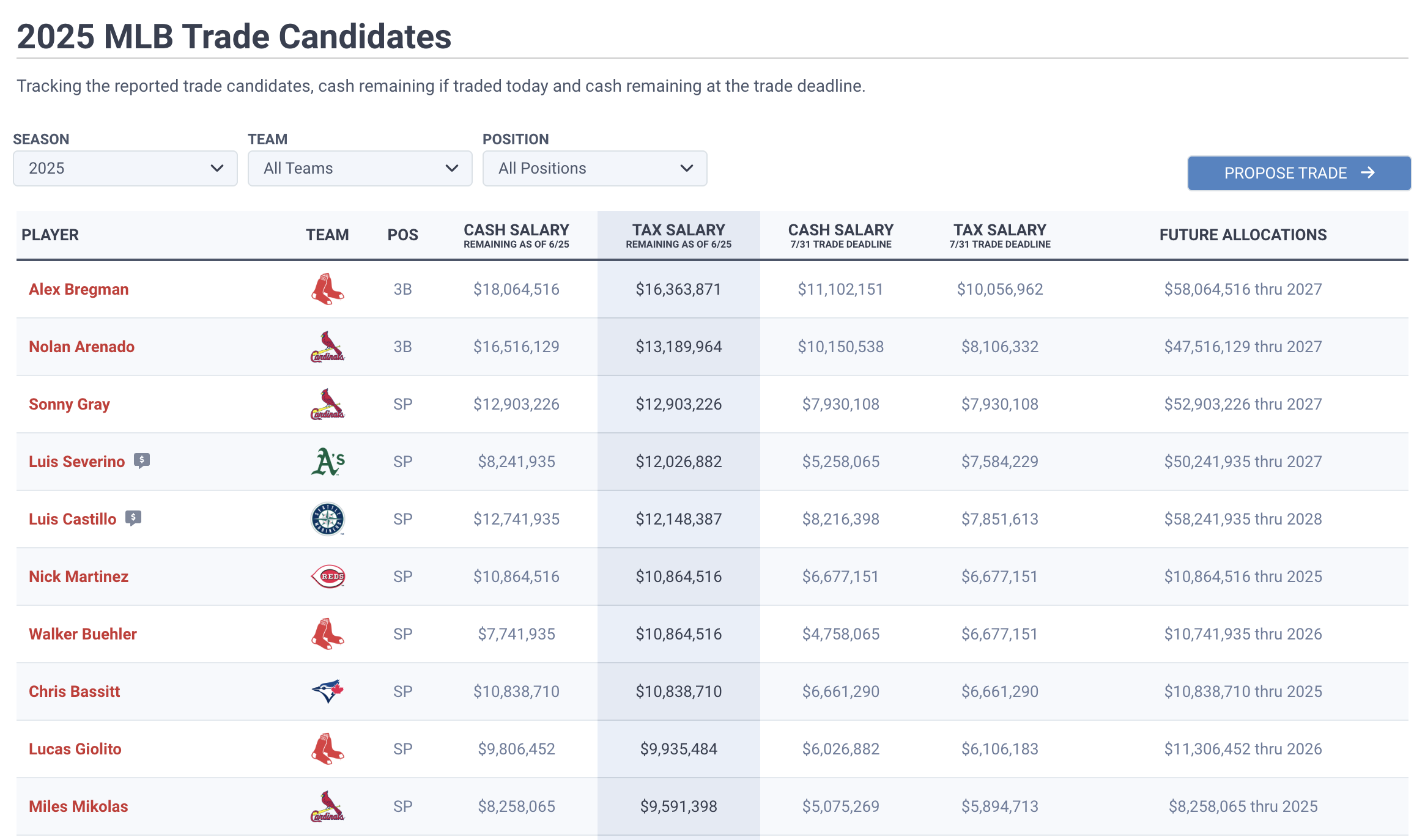
Spotrac announces the launch of two tools associated with upcoming July 31st MLB Trade Deadline.
This view is tracking over 100 players reportedly on the trade block this summer, including salary remaining today and at the actual deadline for each.
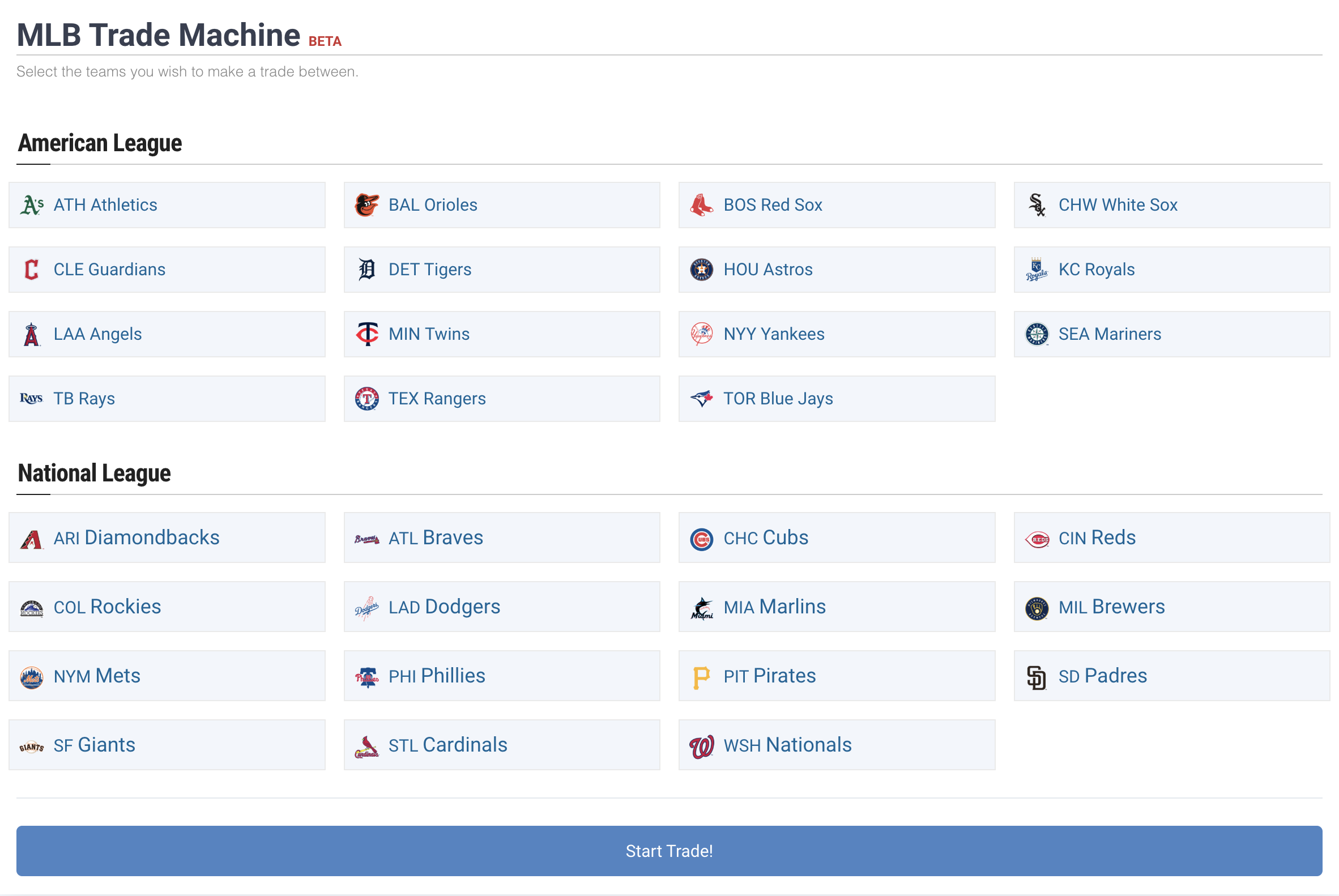
Use this tool to propose actual trades, including retained salary, compensatory draft picks, top prospects, and all of the financial ramifications.
 © USA Today Sports
Run it back
-$33.3 million
-$32.2 million
$3.6 million
Alex Caruso
Ousmane Dieng
Lu Dort
Shai Gilgeous-Alexander
Isaiah Hartenstein
Chet Holmgren
Isaiah Joe
Dillon Jones
Nikola Topic
Cason Wallace
Aaron Wiggins
Jalen Williams
Kenrich Williams
Branden Carlson (restricted – two-way)
Alex Ducas (restricted – two-way)
Adam Flagler (restricted – two-way)
Ajay Mitchell (restricted – team option)
Jaylin Williams (restricted – team option)
None
Non-Taxpayer MLE ($14.1 million)
Bi-Annual Exception ($5.1 million)
None
#15
#24
Ousmane Dieng (rookie scale extension)
Lu Dort (veteran extension)
Shai Gilgeous-Alexander (veteran extension)
Chet Holmgren (rookie scale extension)
Jalen Williams (rookie scale extension)
Jaylin Williams (veteran extension)
Kenrich Williams (veteran extension)
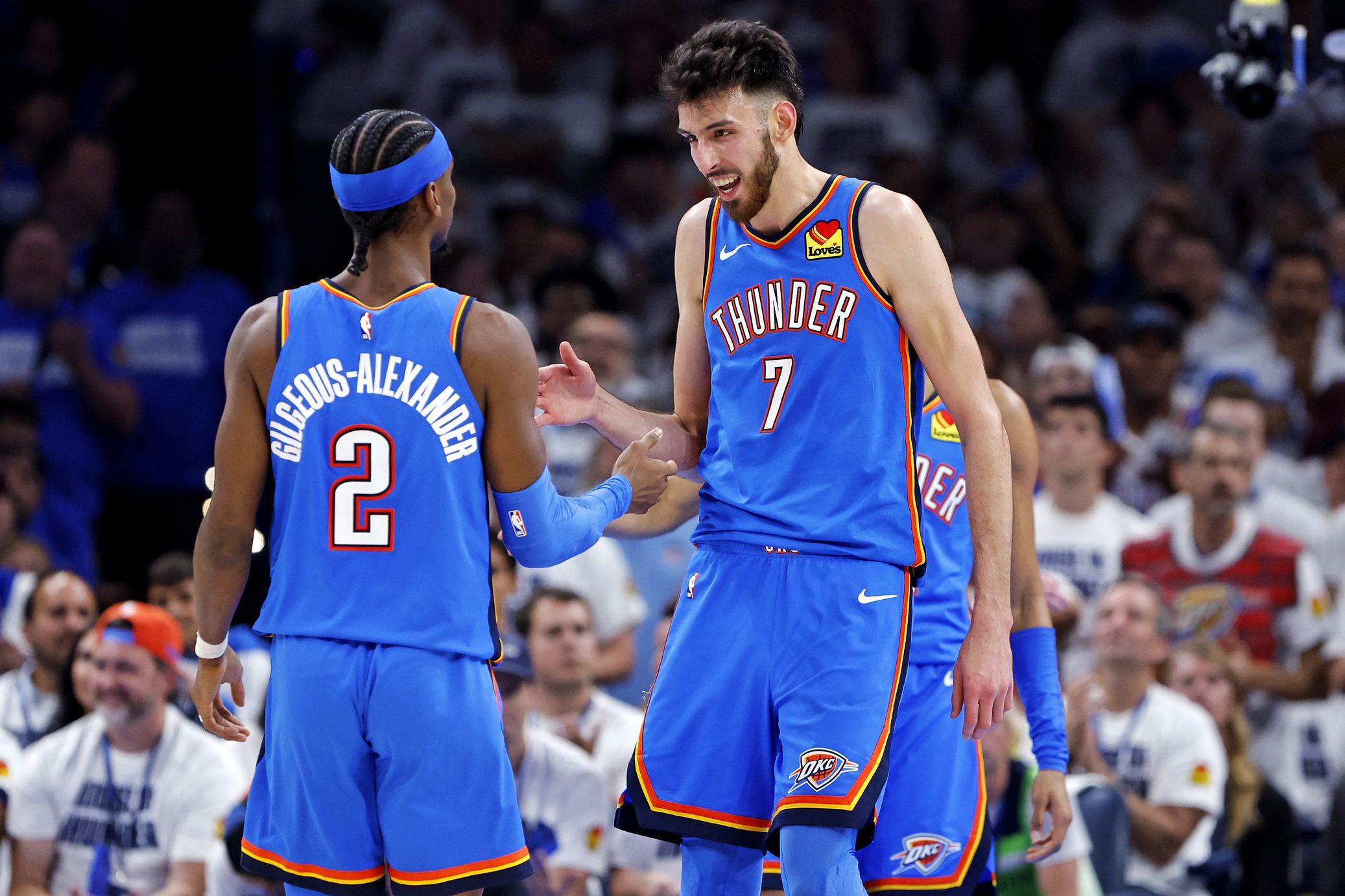
After one of the quickest, and most successful, full rebuilds we’ve ever seen the Oklahoma City Thunder are the 2025 NBA champions. A deep, versatile roster led by MVP Shai Gilgeous-Alexander finished off a dominant run to the title with a hard-fought seven-game victory over the Indiana Pacers.
The scary thing for the rest of the NBA? The Thunder aren’t going away anytime soon.
Oklahoma City has a whopping 13 players under contract for next season already. They also have full control over the free agency process for their five pending free agents. That means that the Thunder could literally run it back with the exact same team as next season, accounting for Nikola Topic being healthy and ready to play this time around.
That’s probably not going to be how it goes. The Thunder have been here before with too many players for too few roster spots. That’s led to trading away some of the young guys who never quite cracked the rotation. That’s probably how this is going to play out again.
Sam Presti also is sitting on two first-round picks at the 2025 NBA Draft, because of course he is. Expect one of those picks to get moved, probably in a deal that returns even more future picks, because that’s what Presti does better than anyone else in the NBA. The team doesn’t really have room for two rookies, so why not kick the can down the road with at least one pick?
Free agency is probably going to be relatively non-descript for the Thunder. As referenced above, the team is out of roster spots. But the Thunder do like Ajay Mitchell and Jaylin Williams quite a bit. They could pick up team options for both, then figure out the roster issues as they go. They could also decline their team options for either player, make them restricted free agents, and work out long-term deals. Either way, OKC can control this process.
The two-way free agents could all be back in the fold next year too, because the Thunder have seen all of them flash at various times. Expect that to be things at least start out, with potential for some movement later in the offseason or during training camp.
If the team does need a roster spot to fit in a 2025 first-rounder, it might mean moving on from Ousmane Dieng. Doing so would also clear up one of the team’s three rookie scale extensions that need handled this offseason. Dieng may still have some untapped potential, but he looks like one of those guys who might not get there while with OKC. The playing time simply isn’t there for him. The Thunder are also unlikely to extend Dieng, as the terms would have to be so team-friendly that Dieng would be best to bet on himself.
Nothing will probably happen with Lu Dort, Kenrich Williams or Jaylin Williams (if the team picks up his option) as far as extensions go. By now you probably get that roster spots are an issue, so that impacts both Kenrich and Jaylin Williams long-term. Dort still has two years left on his deal, so the Thunder don’t need to extend him yet, and can handle that next offseason. Or even later this season, if they decline Dort’s team option for 2026-27.
But three major extensions still loom. Shai Gilgeous-Alexander is super max eligible after winning MVP this season. This summer, Gilgeous-Alexander could sign a projected four-year, $293 million extension. That deal would start with the 2027-28 season as Gilgeous-Alexander is under contract through the 2026-27 season without any options. The Year 1 salary in that four-year extension would be a projected $65.5 million, with a final year salary in 2030-31 of $81.2 million.
Yeah…we’re closing in on the first single-season $100 million player.
If Gilgeous-Alexander wants to fully cash in on the longest and largest extension possible, he could delay and sign that deal in the summer of 2026. That would be a five-year, $379.8 million deal. The starting salary would be the same, but in 2031-32, that contract would finish up at $86.5 million.
Bet on the MVP cashing in now. There’s no reason to not take that incredible long-term, generational security now. Plus, SGA should command a player option on the final year, which would allow him to cash in one more time before his age-32 season.
The other two big extensions coming for Oklahoma City are for Chet Holmgren and Jalen Williams. The easy answer is to give both players max deals. Williams has certainly earned a max extension. Coming off an All-NBA nod, expect Williams’ extension to also include Designated Player language, so he can bump up to 30% of the cap in his new deal.
Holmgren’s situation is a little different. His potential is so great that you probably don’t balk at giving him a max deal. Holding firm at a 25% of the cap max for Holmgren is probably fair, given he’s building a somewhat serious injury history already.
The other option is to pitch that building a team around three max guys, especially given Gilgeous-Alexander will be on a 35% max, and Williams could easily jump to a 30% max, is going to cost the Thunder down the line. Would one, or more, of the trio sacrifice a little bit to help keep this team together longer? We haven’t really seen that for players this young, but this OKC group is so tight-knit and feels a bit different than other situations.
If max deals are a must, the Thunder are still set up better to handle that than most teams. As they get increasingly expensive, they’ll have to move off some future salary. But Presti is still sitting on up to 11 first-round picks over the next six drafts after this one. And don’t be surprised if he adds a few more to that mix. That plethora of picks will allow Oklahoma City to replace outgoing talent in a way that other teams can’t match, even as the team nudges up against the aprons in the future.
The Oklahoma City Thunder are now beginning the process of being the defending champions. No one has repeated in the NBA since the 2018 Golden State Warriors. The Thunder are going to get really expensive, but that’s not coming until 2026-27 at the earliest. There might not be a ton of roster movement this offseason, even if a lot of spending gets locked in for the future. But this team doesn’t really need a whole lot. Everything is set up for run at back-to-back titles in Oklahoma City.
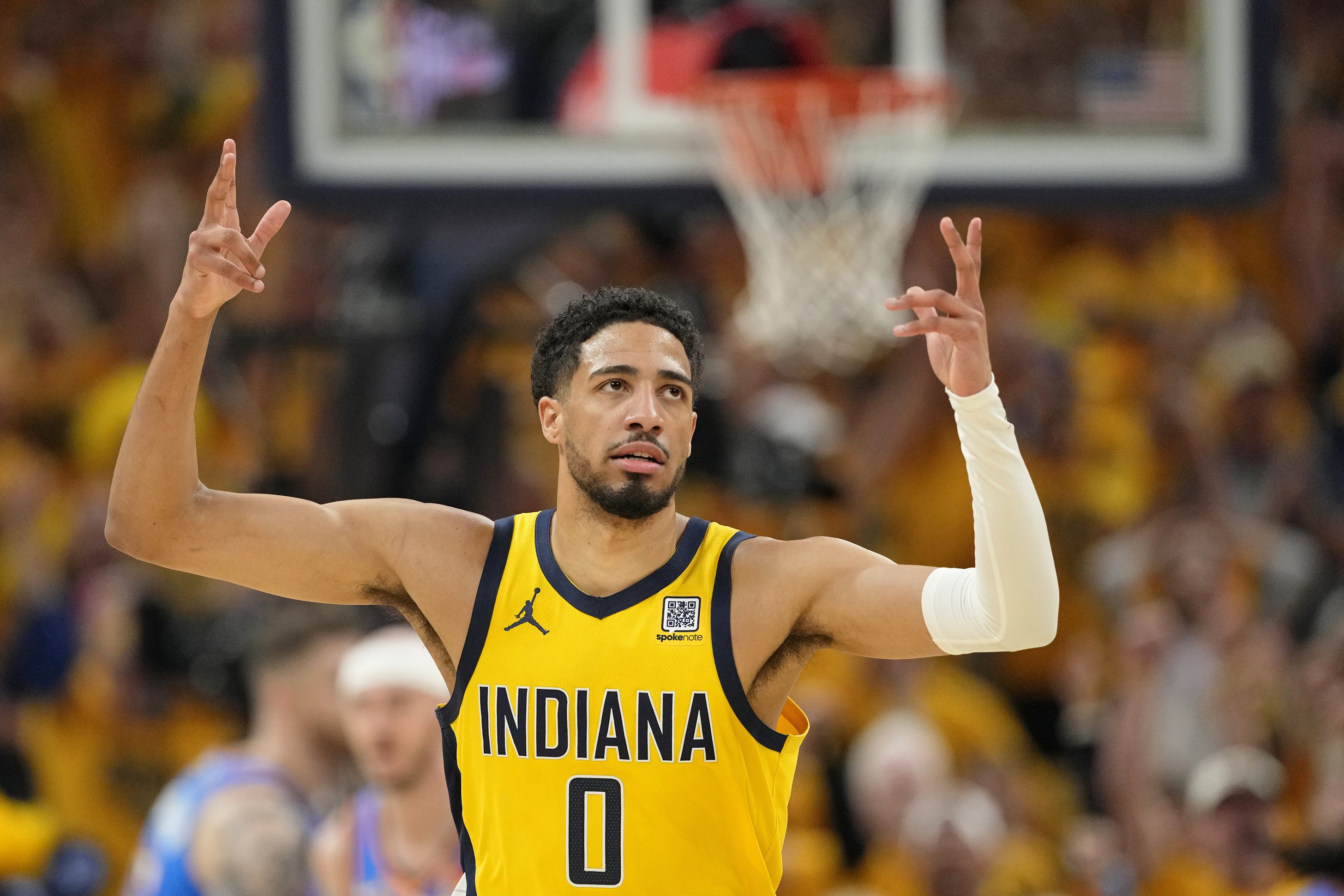 © USA Today Sports
Sign Myles Turner and run it back
-$62.5 million
-$63.1 million
$19.9 million
RayJ Dennis (two-way)
Johnny Furphy
Tyrese Haliburton
Bennedict Mathurin
T.J. McConnell
Andrew Nembhard
Aaron Nesmith
Ben Sheppard
Pascal Siakam
Obi Toppin
Jarace Walker
Tony Bradley (unrestricted – team option)
Thomas Bryant (unrestricted)
Enrique Freeman (restricted – two-way)
Isaiah Jackson (restricted)
Quenton Jackson (restricted – two-way)
James Johnson (unrestricted)
Myles Turner (unrestricted)
None
Taxpayer MLE ($5.7 million)
None
#23
Bennedict Mathurin (rookie scale extension)
Aaron Nesmith (veteran extension – as of October 1)
The Indiana Pacers were right there. If Tyrese Haliburton doesn’t tear his Achilles’ seven minutes into Game 7, Indianapolis might have hosted a championship parade. As it is, we’ll never know. But what shouldn’t get lost is what a fun, magical ride the Pacers took all of us on in these playoffs.
And there’s no reason the fun can’t continue for Indiana.
Yes, the Pacers will be without Tyrese Haliburton next season. That’s a brutal blow for one of the league’s best point guards and the conductor of the NBA’s most fun offense. But Indiana has plenty of depth to weather that injury and still be a really good team.
Free agency is pretty simple for Indiana. It’s all about re-signing Myles Turner. After a decade of trade rumors, Turner is still with the only NBA team he’s ever known. The Pacers have indicated that they’ll go into the luxury tax to keep their starting center.
The real question doesn’t seem to be if Turner will be back in Indiana. It’s how much will it cost the Pacers? Despite struggling in the NBA Finals, Turner is coming off a really strong season. He’ll turn 30 years old next season, but Turner is showing no signs of slowing down, and his game should age fine.
The Pacers are roughly $20 million under the luxury tax line and $28 million under the first apron. That’s with 11 players on the roster. If we pencil in minimum contracts for the final few roster spots, the Pacers will be $13 million under the tax and $21.1 million under the first apron before re-signing Turner.
Turner isn’t likely to re-sign for anything under $25 million a year, but he may not push much north of $30 million AAV either. The way the Pacers can probably keep costs down some is by offering Turner a fifth year, which no other team can match. Would five years and $125 million be enough? If so, that’s probably a good deal for both sides.
Beyond bringing back Turner, the Pacers offseason should be relatively uneventful. They traded this year’s first-round pick to get back next year’s first-rounder. That gives Indiana some savings in the immediate, and a relatively young roster doesn’t really need another player jumping in the mix next season.
The Pacers will probably apply for a $14.1 million Disabled Player Exception for Haliburton, but that’s more about having that tool in the toolbox in case you need it down the line. Given the looming first-apron status, and the few open roster spots, Indiana probably won’t be a real player in free agency.
There’s a good chance that either, or maybe both, of Tony Bradley and Thomas Bryant are back next season. The two paired together to give Rick Carlisle pretty good minutes behind Turner. For minimum deals, it makes sense to keep at least one of the backup centers, if not both of them.
Isaiah Jackson’s status is likely tied to his health after his own early-season torn Achilles’. If Jackson is recovering well, the Pacers could probably get him back on a fairly reasonable contract, given they can make him a restricted free agent. This might be a one-year, prove-it deal, where Jackson shows he’s healthy and Indiana uses his Bird rights in 2026 to sign him long-term.
If James Johnson wants to come back, his spot in the locker room and on the bench will be there for him.
Enrique Freeman is worth working with on another two-way deal. He has real potential. Quenton Jackson has one more year of two-way eligibility and the Pacers seem to like him. He could be back for one more run too.
As far as extensions go, Indiana will want to try to get one hammered out with Bennedict Mathurin. He’s still somewhat inconsistent, but Mathurin’s scoring is needed. The real question is if he’s going to push for a starting spot. That may be there next season, with Haliburton out, but starting long-term might not be in Mathurin’s future in Indiana.
That will impact extension talks to some degree. An extension in the range of $100 million over five years makes sense for Indiana. That protects the team if Mathurin doesn’t graduate beyond being a sixth man, albeit a very good one.
It could be too team-friendly for the young guard, however. Mathurin may need more than $20 million AAV. Indiana has to be careful here. Locking in too much money long-term could see them butting up against the second apron in the future. That’s not where they want to be.
If worse comes to worse, the Pacers and Mathurin can let things play out to restricted free agency in 2026. By then, both sides should have a clearer picture of where things are at for both the team and the player.
Aaron Nesmith is also extension-eligible this summer. His situation is a little weird, as his contract isn’t really big enough to extend off at any kind of sizable number. On the flip side, Nesmith isn’t likely to command a huge extension either. He’s a very good role player for the Pacers as a 3&D guy, but he’s not pushing any kind of major salary either. Nesmith and Indiana will probably delay this conversation and readdress it next summer.
There’s no other way to put it but that it sucks that the Indiana Pacers won’t have Tyrese Haliburton next season. But this is a deep team, especially at point guard. The Pacers will re-sign Myles Turner and they’ll get back after it. If the 2025 NBA Playoffs didn’t teach us the lesson, Indiana will be more than happy to remind us to count them out at our own risk.
 © USA Today Sports
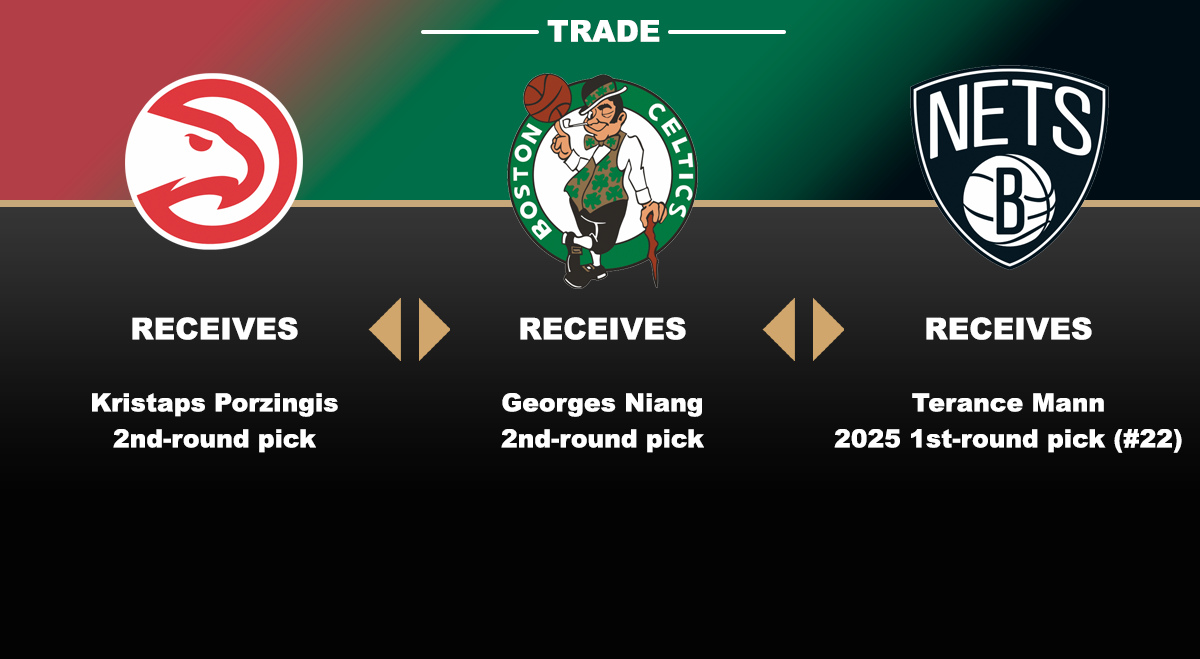
The Boston Celtics got themselves under the dreaded second apron, while picking up a helpful frontcourt reserve. The Atlanta Hawks made a big bet that Kristaps Porzingis will help them take the next step. The Brooklyn Nets got a good wing on a good contract, while picking up yet another 2025 first-round pick.
Here are the particulars:
Atlanta Hawks acquire: Kristaps Porzingis, future second-round pick
Boston Celtics acquire: Georges Niang, future second-round pick
Brooklyn Nets acquire: Terance Mann, 2025 #22 first-round pick
Let’s dive in!
(Note: We’re going to look forward starting with 2025-26 salaries for the analysis of the deal.)
Incoming salary: $30.7 million in 2025-26
Outgoing salary: $23.7 million in 2025-26
The Atlanta Hawks are making a bet that they can get Kristaps Porzingis to stay moderately healthy for next season. If so, the Hawks will go into the year with a very solid rotation, despite giving up two rotation players in this trade.
When healthy for the Celtics over the last two seasons, Porzingis was terrific. He was a force on offense, with his ability to space the floor, finish at the rim and to punish mismatches in the midrange game. On defense, Porzingis was able to impact games with his excellent rim protection, while also holding his own on perimeter switches.
Sadly, the Celtics only got that version of Porzingis for about half of his time in Boston. In Year 1 in green, Porzingis missed time with various maladies, including a serious ankle injury that required surgery after the 2024 NBA Finals. Year 2 saw the big man beset with a mysterious illness that persisted for months, on top of missing the first part of the season while recovering from the aforementioned ankle surgery.
The 2025 Playoffs were not kind to Porzingis, as he really struggled to find his rhythm. It got to the point that Joe Mazzulla resorted to bringing him off the bench, as Porzingis continued to battle the illness.
If healthy, the Hawks will get one of the more unique weapons in the NBA. Porzingis is a floor spacing big man to the extreme. He doesn’t just spot up behind the arc, he regularly spots up five feet behind the arc. He can also be a ferocious finisher at the rim. And if you put a small on him, Porzingis is content to work his way to 10-15 feet and shoot over his man with ease. And all of that comes with some solid rim protection on the other end of the floor.
How Quin Snyder approaches lineups will be interesting. The Hawks have a pretty good starting group with Trae Young, Dyson Daniels, Zaccharie Risacher, Jalen Johnson and Onyeka Okongwu. The early assumption here is that Porzingis will come off the bench. That gives Snyder the ability to go with Porzingis behind Okongwu, but to also play them together a lot too. And by bringing Porzingis off the bench, Atlanta should be able to manage his minutes and hopefully keep him on the floor for more games.
To take this gamble on Porzingis, Atlanta had to give up Terance Mann, who is a solid wing player. But the Hawks were dealing from a position of strength here. Johnson, Risacher and Daniels are going to play a lot as wings. Mann would have helped in the rotation, but Atlanta still has enough room to use the full Non-Taxpayer MLE. That’s $14.1 million to spend, and this offseason there are a lot of veteran wings available for backup spots. Georges Niang was traded in this deal too, but his role is effectively being replaced by Porzingis, so there’s no form of downgrade there, minus availability-wise.
The Hawks also gave up a first-round pick in this trade, but they retained the better of their two picks by keeping the 13th overall pick. That’s also a spot where Atlanta could add a wing.
This is a major gamble for the Atlanta Hawks. There’s no guarantee that Kristaps Porzingis will be healthy. If he is, Atlanta will push themselves into the mix for a top-six seed and a guaranteed playoff spot. But even if Porzingis isn’t healthy, the Hawks have an expiring $30.7 million salary to move by the trade deadline to patch roster holes.
Incoming salary: $8.2 million in 2025-26
Outgoing salary: $30.7 million in 2025-26
This trade for the Boston Celtics was about getting under the second apron. Mission accomplished. And they got a potentially helpful backup forward too, which is a nice bonus.
Much like it stung to trade Jrue Holiday, this deal stings too. Despite all of his absences, Kristaps Porzingis was a huge part of Boston winning the 2024 NBA title. It’s not easy to say goodbye to guys who were part of a title team.
But in order to get under the second apron, and to start the process of “thawing” out their frozen 2032 draft pick, the Celtics had to get off a lot of money. In the Holiday and Porzingis trades combined, Boston shed over $27 million in salary, which is enough to get them to about $4.5 million under the second apron. In addition, in terms of real dollars in salary plus tax penalties, the Celtics saved roughly $200 million. That’s nothing to sneeze at, considering this team isn’t a title contender while Jayson Tatum rehabs.
Does this trade weaken the Celtics on the court? Yes. When healthy, Porzingis is a lot better than Georges Niang. He’s a far more dynamic offensive player and has a far greater impact defensively. The challenge is you don’t know how often Porzingis would be healthy.
Niang is a pretty rugged and reliable guy. He rarely misses games and Niang is a 40% three-point shooter for his career. That fits in well in Boston’s five-out, bombs-away offense. He’s also a pretty good ball-mover and decent screener. Niang isn’t going to offer any rim protection, but he’s an ok positional defender.
Even with Kristaps Porzingis’ unreliability factored in, this is a big downgrade on-court for the Boston Celtics. But this trade wasn’t really about that. By getting under the second apron, the Celtics have now created considerably more flexibility for themselves this year, and moving forward. That was the goal, and Brad Stevens and the front office met it.
Incoming salary: $15.5 million in 2025-26
Outgoing salary: $0.0 million in 2025-26
The Brooklyn Nets picked up a helpful wing in Terance Mann, while renting out some of their 2025 cap space for yet another 2025 first-round pick. This is Sean Marks playing the game the way he did when he rebuilt the Nets the first time around.
Mann is a good player, and he’ll help a Nets team that is very much in transition. As it stands right now, Mann would very likely be a starter. He’s a pretty solid defensive player and decent playmaker. Mann has also become a good outside shooter and very good finisher inside the arc. He uses his size to get to his spots quite well, and has improved as a spot-up shooter too.
Most importantly for the Nets, as they rebuild: Mann is on a very movable contract. It’s pretty unlikely the veteran wing will play out the three years he has left on his deal while in Brooklyn. If a contender in need of a wing comes calling, the Nets will be able to move Mann’s fair-value deal with ease. That could mean getting a pick for him coming in, while also getting a pick for him going out. That’s the kind of smart move you have to make when you are starting over as a franchise.
Brooklyn picked up the 22nd pick in the 2025 NBA Draft in this deal to take on Mann’s contract. That gives Marks five selections in the first-round of this draft. There’s no chance that the Nets make all five of those selections for themselves. Look for Brooklyn to be very active in moving up the draft board, and possibly out with some of the picks, while picking up future selections.
As it stands right now, the Brooklyn Nets still have over $37.5 million in projected cap space available this offseason. That means that Sean Marks is nowhere near done retooling this roster. The Nets will be one of the most active teams this summer, as they’ll be a part of more trades, both at the draft and when free agency opens in next week.
 © USA Today Sports
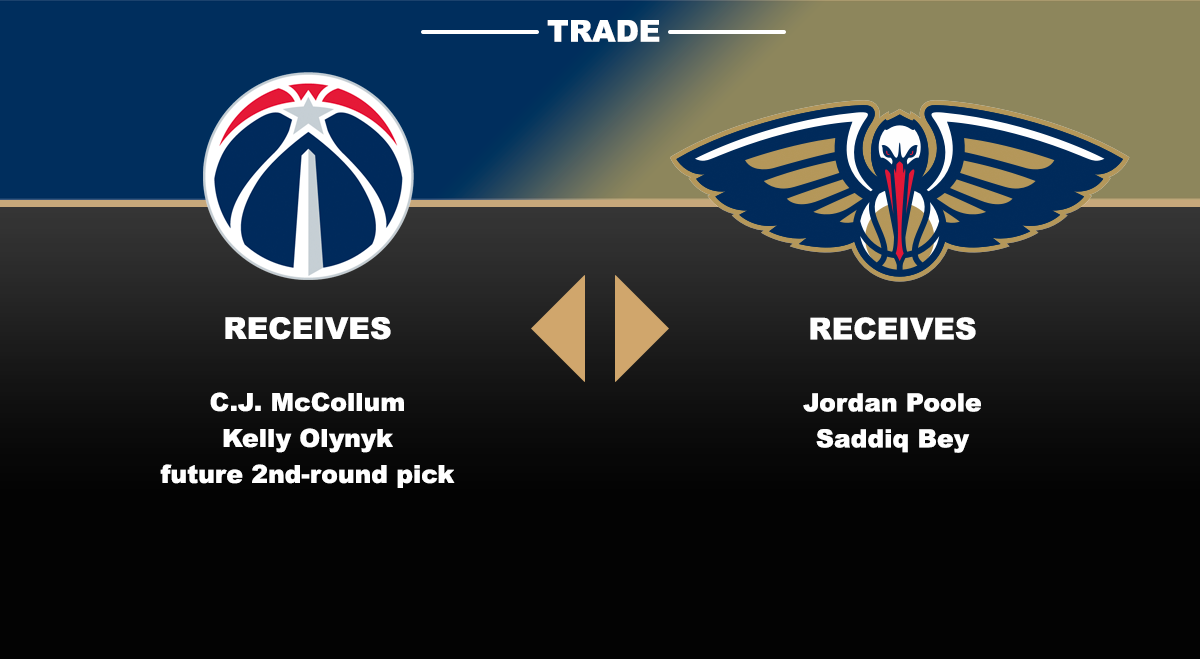
The New Orleans Pelicans created a lot of wiggle room under the luxury tax and apron, and picked up two helpful perimeter players. The Washington Wizards cleared out some long-term salary, as they continue their full-scale rebuild.
Here are the particulars:
Washington Wizards acquire: C.J. McCollum, Kelly Olynyk, future second-round pick
New Orleans Pelicans acquire: Jordan Poole, Saddiq Bey, 2025 #40 second-round pick
Let’s dive in!
(Note: We’re going to look forward starting with 2025-26 salaries for the analysis of the deal.)
Incoming salary: $44.1 million in 2025-26
Outgoing salary: $37.9 million in 2025-26
The Washington Wizards front office was brutally honest about a year ago when asked for an assessment of where the team was. They said at that time that the team was still in the teardown phase of their rebuild. That candidness has driven everything for Washington throughout this process. They owned just how rough things were, while also admitting it would take a while to dig out from under the mess and to move forward.
This trade is a continuation of that process. However, acquiring expiring contracts for players who have multiple years remaining signals that the Wizards may be starting to turn the corner towards building back up.
In this deal, Washington took on just over $6 million in salary for next year. That’s fine, as the team is $12.6 million under the luxury tax with 16 players on standard contracts. That’s more than enough wiggle room to do whatever else the Wizards need to do this offseason and into the regular season.
This trade was really about the summer of 2026 and beyond. Next year, the Wizards will have one player on a fully guaranteed deal that isn’t also on a rookie scale contract. Washington could be looking at over $100 million in cap space. That’s incredible flexibility for a team that was buried under miles of bad contracts only a couple of seasons ago.
On-court this season, things should be about the same for Washington. They aren’t likely to be a playoff team, despite adding C.J. McCollum and Kelly Olynyk to holdover veterans Khris Middleton, Marcus Smart and Corey Kispert. The Wizards are still going to make sure that their group of kids (Alex Sarr, Bilal Coulibaly, Bub Carrington, Kyshawn George and two 2025 first-round picks), plays plenty. Those guys are the future in Washington. They’ll see all the minutes they can handle.
That said, McCollum offers the team a good scoring combo guard to replace Jordan Poole. He’ll play alongside Carrington and Smart in the revamped backcourt. McCollum’s steady presence and shot-making will help the young players improve.
Washington is also being careful to not overload Sarr. Last year they had Jonas Valanciunas to back him up and play alongside Sarr some. That’s the role Olynyk will take on. He’s more of a floor-spacer than Valanciunas is, but the idea is to play Sarr a lot without overextending him. Olynyk will help with that.
Of course, we’d be remiss to note that McCollum, Olynyk, Middleton and Smart are all on expiring contracts. None of them are making an untradable amount of money either. There’s a good chance by the time we hit the trade deadline, that the Wizards will have moved at least a couple, if not all, of the vets in deals for more assets. They might even take on a little money into next season, as spending $100 million-plus in cap space sounds fun, but is easier said than done.
The Washington Wizards are taking a very Oklahoma City Thunder-like approach to their rebuild. Patience, taking on contracts for assets, and keeping the runway clear for their young players worked out pretty well for the Thunder. The Wizards have a long way to go to match that kind of championship production, but they’re on their way. That’s a whole lot better than the directionless, stuck-in-the-middle group they were for more than a decade.
Incoming salary: $37.9 million in 2025-26
Outgoing salary: $44.1 million in 2025-26
For a couple of years now, the New Orleans Pelicans have operated very close to the luxury tax line. Two years in a row, trade deadline moves have gotten the Pelicans out of the tax. That’s playing a potentially dangerous game and hoping a deal will materialize when you need one.
Now, the Pelicans should have more than enough wiggle room that it won’t be an issue for next season.
New Orleans is about $13.5 million under the tax line for next season as a result of this trade. That’s with a projected 13 players on the roster. That gives Joe Dumars the flexibility to make more moves this summer, as he retools the roster.
Down the line, this trade swapped out two expiring contracts for two players who have money left on their deals in Jordan Poole and Saddiq Bey. It’s not really ideal, as the Pels could have maybe finagled some cap space next offseason. But it’s not the end of the world either.
The perception of Jordan Poole as one of the Clown Princes of the NBA is way off. Poole toned his on-court silliness in Washington. A lot of people just missed it because the Wizards weren’t very good. This past season, Poole was pretty effective, as he averaged 20.5 points on 59.1% true shooting. That’s really good efficiency, considering Poole played a lot of minutes surrounded by very young players.
Is he worth $34 million in 2026-27? We’ll see. In part because of all their injuries, the Pelicans offense was pretty poor last season. McCollum was fairly solid himself, but he’s also nearly eight years older than Poole. If Poole can play for New Orleans like he did for Washington, surrounded by better talent, then his contract is fine and he’ll help the Pels a lot.
Bey is probably being seen as a throw-in in this trade, but that’s unfair. A little over a year ago, before tearing his ACL, Bey was someone a lot of teams liked. He’s not the most efficient guy, and the Pelicans have a very crowded group at the forward spot, but for $12.5 million over two years, Bey will give the Pels some solid depth. He’s also on a contract that can be pretty easily moved if necessary.
The New Orleans Pelicans now have the flexibility to keep making moves without risk of running afoul of the luxury tax, never mind the aprons. There’s probably more to come, as this roster currently slants too heavily towards perimeter-based wings. The Pelicans have two picks in the first-round and they probably aren’t done trading either. Before we make a final judgement, we need to see more of the final product, which is still a few moves away.
 © USA Today Sports
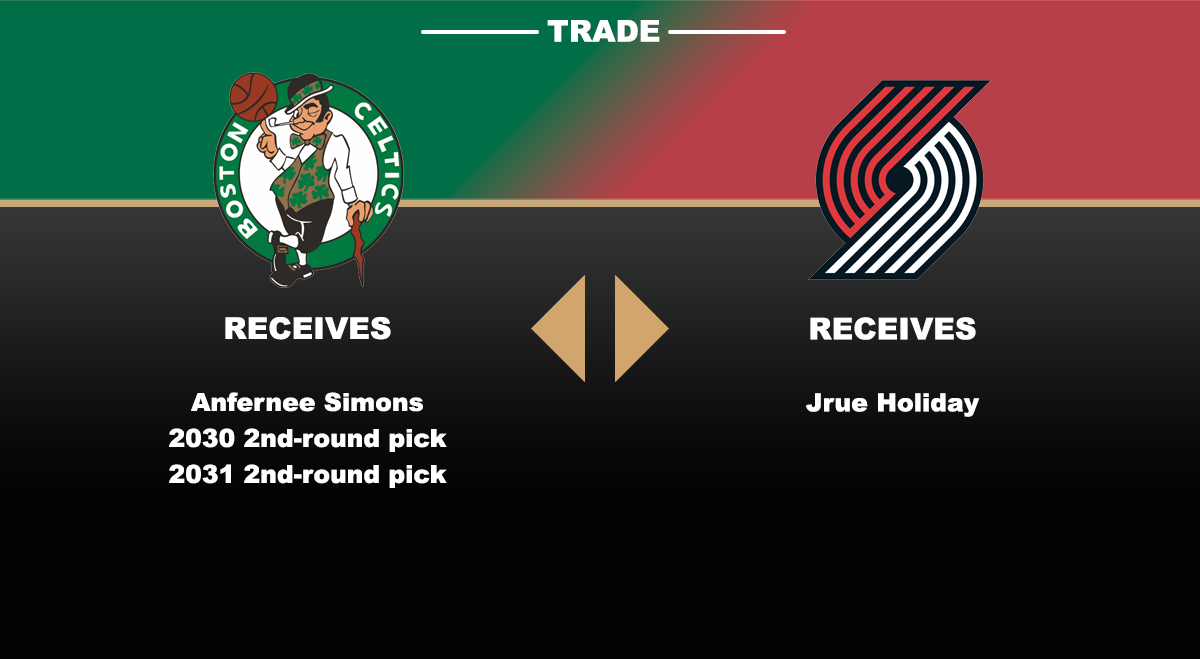
At this time a year ago, the Boston Celtics were still basking in the glow of winning their record-setting 18th NBA championship. Now, Boston is beginning to break up that title team by shipping Jrue Holiday off to the upstart Portland Trail Blazers for Anfernee Simons.
Here are the particulars:
Boston Celtics acquire: Anfernee Simons, 2030 Knicks second-round pick, 2031 Trail Blazers second-round pick
Portland Trail Blazers acquire: Jrue Holiday
Let’s dive in!
(Note: This trade is legal as part of the 2024-25 league year, but we’re going to look forward starting with 2025-26 for the analysis of the deal.)
Incoming salary: $27.7 million in 2025-26
Outgoing salary: $32.4 million in 2025-26
The Boston Celtics were always going to face the challenges of being a second-apron team eventually. If they were coming off back-to-back titles, Boston probably would have mostly kept this team together and dealt with the roster restrictions, frozen picks and enormous tax bills to chase a third straight championship.
As it is, the team lost in the second round and superstar forward Jayson Tatum is likely to miss all, or at least most, of next season. That meant making changes to lessen their tax burden, while pursuing getting under the second apron entirely, were going to happen sooner, rather than later.
The Celtics have now started that process by trading Jrue Holiday.
In this deal, Boston saved about $4.7 million dollars on the cap sheet and towards their apron amount of over $20 million. In terms of real dollars saved, as a very expensive, tax repeater, Boston knocked about $40 million off their tax bill.
As none of us are writing the luxury tax check, the key figure to focus on here is the second apron amount. This trade didn’t get Boston under the apron in one fell swoop, but that was never likely to happen. Moving salaries in excess of $30 million was always going to happen with some money coming back onto the books. But chipping away at the apron is a good thing. Boston is now $18 million away from getting under the second apron.
Why is that so important? The Celtics don’t want to be saddled with the various restrictions that come with being a second-apron team. Crucially, the team has already seen their 2032 first-round pick become frozen, meaning that it can’t be traded and it will drop to the end of the first round of that year’s draft. They don’t want the same to be true of their 2033 pick. Also, if Boston can dodge the second apron this year, it will begin the multi-year “thawing” process of unfreezing that 2032 pick. And, they’ll have far more flexibility to operate with their roster in the immediate.
In addition to the savings this year, Boston lopped off the $72 million owed to Holiday through the 2027-28 season. Some of that money will come back on the books, as the Celtics re-sign other players (perhaps the one they just acquired). But that long-term savings is significant for a team that is carrying a lot of long-term money.
Being very realistic, this trade (and others the Celtics are likely to make this offseason) was about the second apron. It was only sort of about actual on-court basketball. But there are actual basketball reasons for this trade too.
It can’t be understated how important Jrue Holiday was to Boston winning the 2024 title. He was everything they needed to complete that team, and he put together a very good first season in green. Last season, Holiday’s play did slip some. That meant that the combination of age, ability and contract status made him one of the most likely Celtics to be traded this offseason.
In his place, Boston adds a very different, but still effective player in Anfernee Simons. Holiday is an impactful, switchable, versatile defender. Simons…well…to be kind…isn’t that kind of defender. That means the Celtics defense takes hit, but that was always likely to happen with Tatum out and others on the trade block.
This upcoming season, Boston is likely to play a lot faster, with more of an offensive focus. That’s where Simons will fit in quite well.
Over the last four seasons, the 6-foot-3 combo guard has become a starter and taken on a bigger role for Portland’s offense. During that time, Simons has averaged 19.9 points on 44/38/90 shooting splits. A stat that will make Celtics coach Joe Mazzulla smile: Simons hit that 38% from deep on 8.5 three-point attempts per game.
The last two seasons, without Damian Lillard leading the offense, have taught us that Simons has some on-ball playmaking chops too. However, he’s not really a point guard. Without Lillard around, Simons’ efficiency has suffered some.
In his last two seasons playing off Lillard, Simons had an effective FG% of 55.1%. In the two seasons without Lillard, that’s dipped to 52.2%. That, combined with an uptick in turnovers, tells us that Simons is a good second or, ideally, third option, but not a great number one option.
Here's the good news: Boston doesn’t need him to be the lead guy on offense. This season, Simons will get to play off Jaylen Brown and Derrick White, who will handle the bulk of the on-ball playmaking. Should Simons stick around past this year, he’ll slot in behind those two, plus Tatum. That will put Simons in his ideal role as the second or third option in most lineups, and often as a very overqualified fourth option.
Given how much offense the Celtics will lose with Tatum out, getting someone like Simons is huge. Yes, the defense takes a real hit, but the offense should be better than expected, even if it will look quite a bit different.
Thinking long-term, Simons is extension-eligible throughout the upcoming season. In the immediate, Boston could offer Simons an extension worth up to $104.6 million from 2026-27 through 2028-29. That’s an AAV of nearly $35 million. It’s unlikely the Celtics would go quite that high, given one of the goals here was to clean up the cap sheet moving forward.
After six months, Boston will be able to offer Simons even more in an extension, but that’s also unlikely to come into play. Expect things to play out on-court a bit before an extension is broached. The Celtics have been aggressive in extending their own players in recent years, but they’re living in a different world now. There’s no reason to rush into another big money deal with Simons before seeing how he looks in green first.
The Boston Celtics were always going to have to break up their 2024 title. It’s happening earlier than most expected, but it is happening. This is just the first in a series of moves Brad Stevens will make over the next year to get the books in line. Getting players like Anfernee Simons, who can play and fill a need, while also netting savings is huge. In addition, the Celtics somehow got two future second-round picks in this deal. Those could come into play as trade chips or for adding talent down the line. While it hurts to see Jrue Holiday go, this is a pretty solid return in what was essentially a “must-trade” situation.
Incoming salary: $32.4 million in 2025-26
Outgoing salary: $27.7 million in 2025-26
It probably got missed by most, because the Portland Trail Blazers were a bad team toiling in the relative obscurity of the Pacific Northwest, but they played pretty good ball in the second half of the season. Over the final 41 games, the Blazers went 23-18. That’s given the team confidence that this group is turning the corner towards playoff contention.
That second-half success is part of what landed GM Joe Cronin and head coach Chauncey Billups contract extensions. It’s also why the team is willing to add Jrue Holiday to continue that push toward being a playoff team.
Holiday immediately becomes the best defensive guard on the Portland roster (Matisse Thybulle is expect to pick up his player option, but he’s a wing and not a true guard). That’s not saying a whole lot, as both Shaedon Sharpe and Scoot Henderson heavily lean towards the offensive side of the ball, as most young guards do. But Holiday will help shore things up on that end of the floor. Now Billups can deploy extremely switchable, versatile defensive lineups that include Holiday, Toumani Camara, Deni Avdija and Jerami Grant, with Donovan Clingan protecting the rim behind them. That group will be pretty tough to score on.
In addition to improving the defense, this was about helping the Blazers mature a bit. They’ve got an odd mix of mid-career vets, but had a lot of young players in key on-ball roles. Now, things can rebalance a bit, with Holiday helping to settle them down. Look at this trade as similar to the addition the Houston Rockets made by adding Fred VanVleet. That trade brought composure and normalcy to a Rockets team that was often frantic and scattered on offense. Portland hopes Holiday will do the same for them.
Of course, since it happened once already, we need to note that the Trail Blazers could flip Holiday in a subsequent trade. However, initial intel is that the team plans to keep Holiday for themselves this time around. If they do seek to trade the veteran guard, there were several teams interested before Boston sent Holiday to Portland.
On the cap sheet, this deal adds about $4.7 million to the Blazers books. They’re still about $6.6 million under the luxury tax and $14.7 million under the first apron. That’s with 14 roster spots accounted for. That means Cronin has plenty of wiggle room to shape the roster with further trades, and possibly to use the MLE (either the $14.1 million Non-Taxpayer or the $5.7 million Taxpayer variety) to round out his roster even more.
Long-term, Portland gave up some spending power. There was a world where the Trail Blazers could have hit the summer of 2026 with north of $70 million in cap space. Now, they’ll probably operate as an over-the-cap team, pending what happens with extension talks for Sharpe.
That’s not the end of the world for the Blazers. They’ve got solid pieces in place, and a handful of their veterans are on expiring contracts. This roster doesn’t feel finished with this one trade. Expect Cronin to continue tweaking it, especially in an overstuffed frontcourt. Something has to give with Deandre Ayton or Robert Williams III (both are on expiring deals), as Clingan is the hopeful long-term answer at center.
It’s also important to note that sacrificing future spending power for Holiday is essentially a trade-off from what Simons would have gotten in his next deal. He probably would have gotten somewhere in the range of what Holiday is set to make to stay in Portland. Letting Simons just walk for cap space wasn’t likely to be the play, as he’s too good for that. So, there’s probably not realistically all that much flexibility given up by acquiring Holiday now.
The Portland Trail Blazers are betting that they are even better than the team they showed in the second half of last season. They’ll need to be, because cracking the Western Conference postseason picture is quite the task. Trading for Jrue Holiday should make the Blazers better for next season. Enough better to jump several teams for even a spot in the Play-In Tournament? Let’s see what Portland does next before we answer that question.
 © USA Today Sports
Retooling depth to push for the NBA Finals
-$65.3 million
-$63.4 million
-$11.8 million
OG Anunoby
Mikal Bridges
Jalen Brunson
Pacome Dadiet
Josh Hart
Tyler Kolek
Miles McBride
Mitchell Robinson
Karl-Anthony Towns
Precious Achiuwa (unrestricted)
MarJon Beauchamp (unrestricted – two-way)
Ariel Hukporti (restricted – team option)
Kevin McCullar Jr. (restricted – two-way)
Cameron Payne (unrestricted)
Landry Shamet (unrestricted)
P.J. Tucker (unrestricted – team option)
Anton Watson (restricted – two-way)
Delon Wright (unrestricted)
None
Taxpayer MLE ($5.7 million)
None
None
Mikal Bridges (veteran extension)
Mitchell Robinson (veteran extension)
Karl-Anthony Towns (veteran extension)
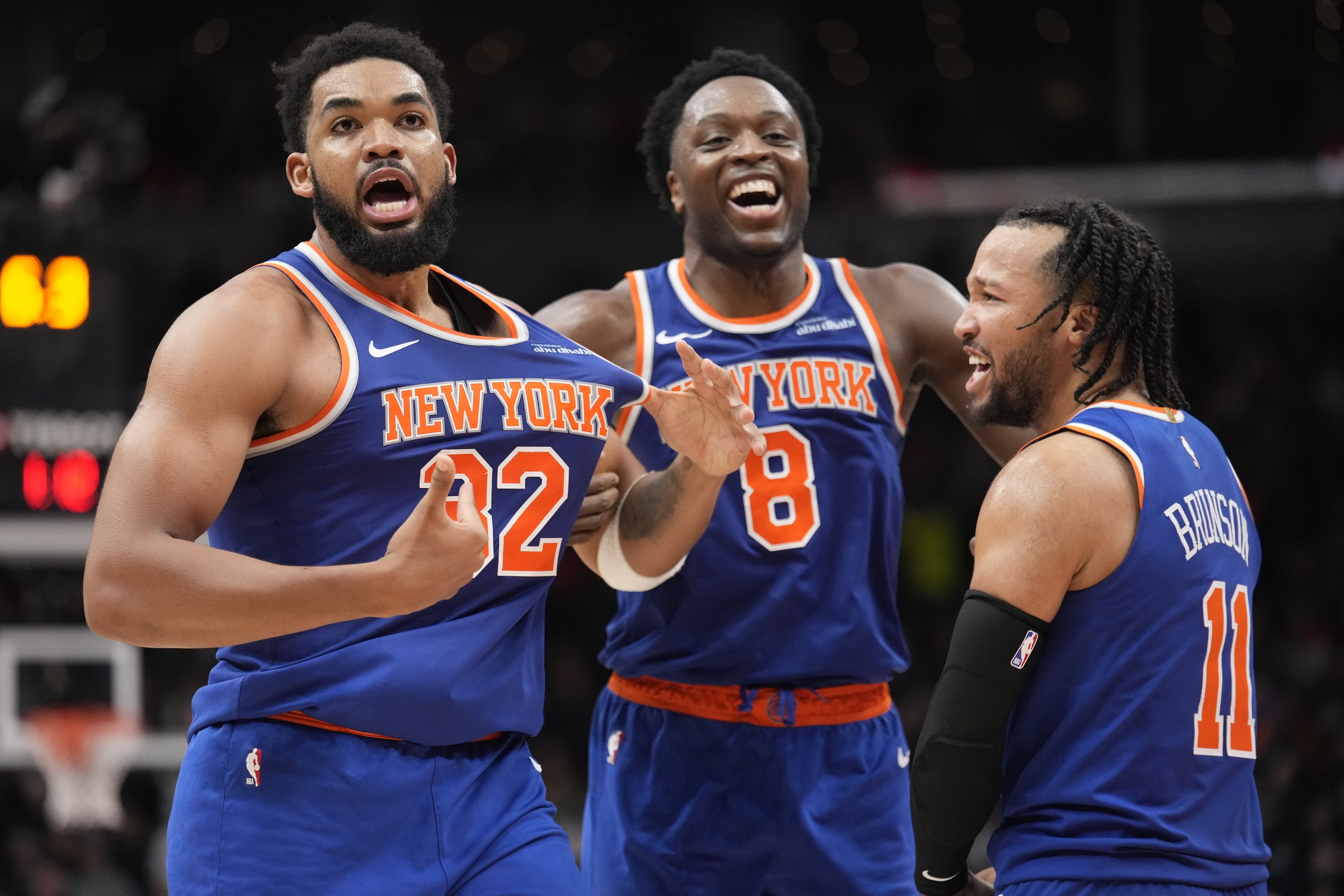
The New York Knicks had their best season in decades. Yet, there was a feeling of incompleteness, because there is a sense this group could have won the title. That usually means that a team will look to shake things up to take the next step. Instead, the Knicks should stand pat, add some depth and get back after it.
Simply through injury attrition in the playoffs, the Eastern Conference has been significantly weakened. As things stand today, the Knicks would enter the regular season as at least co-favorites with the Cleveland Cavaliers. Injuries to Damian Lillard, Jayson Tatum and Tyrese Haliburton have knocked their teams down enough that New York should feel good about where they are.
That doesn’t mean that there isn’t work to do. The Knicks have somewhat limited flexibility this summer. They’re only about $8 million under the second apron. That’s without re-signing a single free agent. That figure could grow to about $11.5 million under the second apron if New York didn’t pick up their $3.5 million team option for P.J. Tucker.
Even at $11.5 million, but with three to four roster spots to fill, that’s tight to the second apron if using the Taxpayer MLE. Using the Taxpayer MLE hard-caps a team at the second apron. That means that the Knicks wouldn’t have enough space under the second apron to fill out their roster taking this path. Fucntionally, New York is limited to re-signing their own free agents, minimum contracts and making trades where they send out more money than they take back.
Of their own free agents, Landry Shamet seems a decent bet to return. He was solid for New York and could see a bigger role if the next head coach expands his rotation. Shamet is someone the Knicks can likely re-sign for the minimum too, which helps the bottom line.
The team should pick up their $1.9 million option for Ariel Hukporti too. He’s got a ton of potential, and that’s a great salary-figure for a development center. Tucker’s team option is for more than he’s worth at this point, but if the Knicks can stay under the second apron (which would allow them to aggregate salaries in trades), Tucker’s $3.5 million is a nice chunk of salary-matching. For that reason, and the fact that his deal doesn’t become fully guaranteed until January, means New York should pick up the option.
Precious Achiuwa could be back, but he’s not getting more than the $6 million he played for last season. Cameron Payne could return as a backup guard, or he could seek a bigger role elsewhere, since he’s looking a veteran minimum deal either way. Delon Wright is in the same situation as Payne.
Of the two-way players, the Knicks should have interest in bringing back all three of MarJon Beauchamp, Kevin McCullar Jr. and Anton Watson. All three have shown enough potential that they are worth working with for another year in the G League.
Signing outside talent is probably limited to minimum deals. That’s not the worst thing in this situation however. When a player is signing a minimum deal, they factor in three things: role, contending and location. The Knicks can check all three boxes. They have some rotation minutes available. They’re certainly a contender. And it’s New York. Check. Check. And check.
Who could be available for the minimum that could help New York? We’ll skip point guards, as the team seems set there. For wings, the Knicks could look at Luke Kennard, Gary Harris, Jae’Sean Tate, Ziaire Williams, Taurean Prince, Amir Coffey, or Dante Exum. Frontcourt players that could be available on a minimum deal include Trey Lyles, Bol Bol, Trendon Watford, Doug McDermott or Marvin Bagley III. None of those players are going to set off a celebration in the streets of Gotham, but all could be helpful for depth purposes.
On the trade front, unless the Knicks are making a blockbuster move, they’re looking at trading Mitchell Robinson or Josh Hart. Unless New York is making a significant upgrade over either, it’s unlikely they’d trade such important players.
Whenever the Knicks land on a new head coach, whoever it is will have a really good returning group to work with. If New York keeps Hart and Robinson, you add them to the core group of Jalen Brunson, Karl-Anthony Towns, OG Anunoby and Mikal Bridges, along with Miles McBride, and you have ready-made contender.
In many ways, that means the most interesting transactions this summer for the Knicks could come via extension decisions. All three of Bridges, Towns and Robinson are extension-eligible this offseason. Bridges and Robinson are the most pressing of that trio, because they are entering their final years under contract.
By all accounts, when Brunson signed an under-market extension to create flexibility for New York, it set the expectation that Bridges would do the same. Using that as our framework, a deal that averages in the range of $35 to $37 million seems in order. Don’t be surprised if Bridges signs a slightly shorter extension too. A three-year deal with a player option on Year 3 would align his deal with both Brunson’s and Anunoby’s. That’s likely appealing to both player and team. Let’s mark down something around three years and $111 million ($37 million AAV) with a player option on Year 3 as the baseline for Bridges.
Robinson’s situation is a lot trickier. He could start, with Hart shifting to a super-sub role. Or Robinson could continue to play in a high-intensity backup role. If Robinson is seen as an important backup, but a backup nonetheless, that will limit how far New York will go in an extension. Given the uncertainty in his role, but his importance to the team, a deal around $48 million over three years makes sense. That’s $16 million AAV, and the length would align with the Knicks other long-term deals.
As for Towns, the Knicks could sign him to a four-year extension this summer (if he declines his 2027-28 player option) or a three-year extension (if Towns picks up his 2027-28 player option). At the very least, New York has Towns under contract for two more seasons. That makes this a far less pressing issue. Unless Towns is adamant about locking in long-term security, the Knicks should wait and address an extension with the big man a year from now.
The New York Knicks are right there as Eastern Conference favorites. That’s without doing anything. Making another major trade, after a string of them over the last two seasons, could upset the good thing New York has built. Simply by retooling their depth around a terrific starting group, and nailing the head coach hire, the Knicks will be contenders. Doing more is always enticing, but it’s not really necessary for this team to take the next step. They’re already there.
Keegan Bradley wins the Travelers Championship. Bradley earns $3.6 million bringing his 2025 on-course earnings to $7.0 million and his career earnings to $61.4 million.
