Taylor VincentJune 09, 2025
© USA Today Sports

In the NWSL’s 12 years, 2025 marks the first time a secondary transfer window has been over 31 days long, and starting July 1st, it will be open for 55 days. The trend over the last few years has shown how much impact these mid-season(ish) additions can make leading to increased signings and player trades, year-over-year. 

Looking Back

The inaugural season of the NWSL back in 2013, didn’t actually have official transfer/signing windows but instead there was simply a roster freeze day which signified when rosters had to be finalized. 

As more teams joined the league, the number of games in the regular season generally increased and the season got longer—going from a 140 day season in 2013 to a 253 day season in 2025. Part of the season length does come down to the fact that in the past few years there has also been a shift to try to avoid scheduling regular season matches during FIFA windows. 

Regardless of season length, until 2025 the secondary transfer window for the league averaged 29.7 days, with the low-side of 27 in 2023 and max’ing out with 31 in 2015 and 2021. In 2022, the NWSL actually decided to completely switch the windows, so the secondary transfer was only open for the month of March (31 days), and the 83-day primary window was actually in the summer. 


Moving Forward

Part of the new collective-bargaining agreement (CBA) which was ratified mid-last season was the addition of language to potentially move the NWSL toward alignment with the traditionally european season which runs from August/September to June. 

On average, between the primary and secondary window, the NWSL has an average of 113 days every season with transfer windows open. The window setup in 2025 has basically split the total windows days evenly between the primary and secondary windows for the first time, with 56 in the primary and 55 in the secondary. 

As a reminder, when players are moving between leagues in different countries, they require the acceptance of an International Transfer Certificate (or ITC). Players can leave the NWSL at any time but in order to go to a league outside of the U.S., the league they wish to go to needs an open transfer window in order to officially accept the ITC. Until the ITC is accepted, said player cannot play. 

Regardless of if the league does eventually make this move, shifting the transfer windows to align more with a large number of the major leagues will help the NWSL in terms of adding talent. Having a better alignment with other league windows when trying to get players loaned or transferred in and out of the NWSL should help the league in its drive for increasing global competitiveness. 


Reference Data:

Regular Season Start

Primary Window Start

Primary Window End

Length

Secondary Window Start

Secondary Window End

Length

Roster Freeze

NWSL Championship

Season Length

3/14/2025

1/28/2025

3/25/2025

56

7/1/2025

8/25/2025

55

10/9/2025

11/22/2025

253

3/16/2024

1/29/2024

4/22/2024

84

8/1/2024

8/30/2024

29

10/10/2024

11/23/2024

252

3/25/2023

2/3/2023

4/27/2023

83

6/28/2023

7/25/2023

27

9/22/2023

11/11/2023

231

4/29/2022

3/1/2022

3/31/2022

30

6/1/2022

8/23/2022

83

8/26/2022

10/29/2022

183

5/15/2021

3/24/2021

6/15/2021

83

7/5/2021

8/5/2021

31

9/30/2021

11/20/2021

189

4/13/2019

3/1/2019

5/23/2019

83

6/25/2019

7/24/2019

29

9/10/2019

10/27/2019

197

3/24/2018

2/7/2018

5/1/2018

83

5/21/2018

6/20/2018

30

8/7/2018

9/22/2018

182

4/15/2017

3/9/2017

5/31/2017

83

6/5/2017

7/5/2017

30

8/29/2017

10/14/2017

182

4/16/2016

2/10/2016

5/11/2016

91

6/15/2016

7/14/2016

29

8/30/2016

10/9/2016

176

4/10/2015

2/18/2015

5/12/2015

83

6/5/2015

7/6/2015

31

9/1/2015

10/1/2015

174

4/12/2014

2/18/2014

5/12/2014

83

5/19/2014

6/18/2014

30

7/31/2014

8/30/2014

140

4/13/2013


1/31/2013


No Official Window

No Official Window


7/31/2013

8/31/2013

140


Keith SmithJune 07, 2025
© USA Today Sports

Offseason Approach

Find a center and add depth for a title push

Actual Cap Space

-$65.3 million

Practical Cap Space

-$59.1 million

Projected Luxury Tax Space

$48.9 million

Under Contract (10)

Luka Doncic
Rui Hachimura
Bronny James
Trey Jemison III (two-way)
Maxi Kleber
Dalton Knecht
Shake Milton (non-guaranteed)
Austin Reaves
Jarred Vanderbilt
Gabe Vincent

View Roster

Potential Free Agents (7)

Dorian Finney-Smith (unrestricted – player option)
Jordan Goodwin (unrestricted – team option)
Jaxson Hayes (unrestricted)
LeBron James (unrestricted – player option)
Christian Koloko (restricted – two-way)
Alex Len (unrestricted)
Markieff Morris (unrestricted)

View Free Agents

Dead Cap (0)

None

Projected Signing Exceptions

Taxpayer MLE ($5.7 million)

Notable Trade Exceptions

None

First Round Draft Picks

None

Notable Extension Candidates

Luka Doncic (veteran extension – as of August 2)
Dorian Finney-Smith (veteran extension)
Rui Hachimura (veteran extension)
Maxi Kleber (veteran extension)
Austin Reaves (veteran extension)
Gabe Vincent (veteran extension)

Analysis

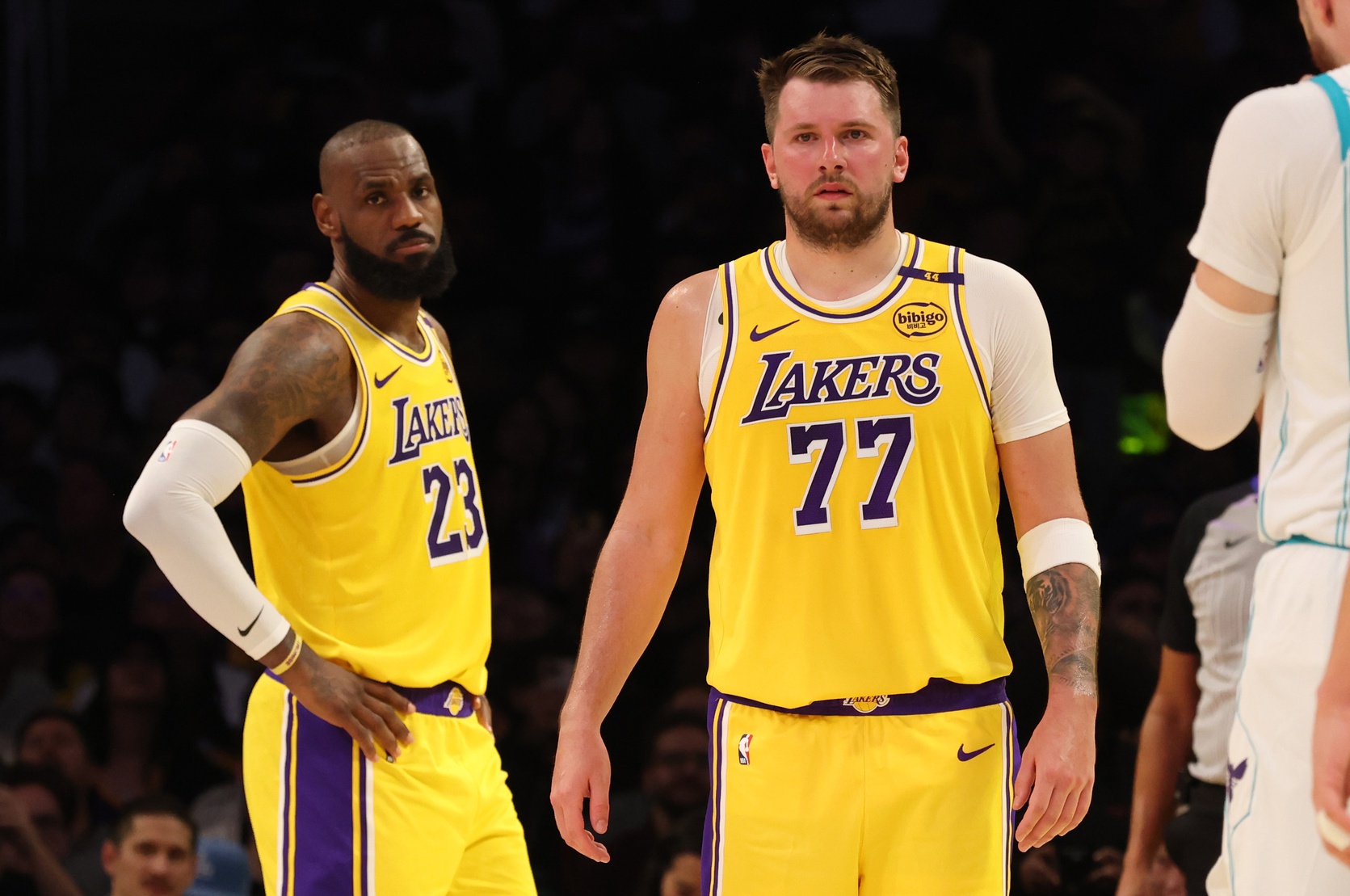
When the Los Angeles Lakers stunned everyone by trading for Luka Doncic, visions of a title started dancing in the heads of Lakers fans. The team ended falling well short of that goal. But the pieces are in place to gear up for another run this year.

Everything will start with LeBron James this offseason. He’s not leaving the Lakers, but how he continues with the team is an interesting situation. Will James simply opt in for $52.6 million? Or will the 22-year veteran superstar opt out and sign another one-plus-one deal?

If James does opt out, don’t expect a similar offer to take less money, as he was open to last offseason. That seems to have been a one-time deal. James will be back for $50 million or more next year.

From there, Dorian Finney-Smith is next up on the priority list. He’s got a $15.4 million player option for next season, but that’s less of a lock to be picked up. No one expects Finney-Smith to leave Los Angeles, but he may opt out and sign a long-term deal. That could benefit the Lakers, especially if Finney-Smith is willing to bring his salary down some for the upcoming season. Something in the range of $48 million over four years feels like a good middle ground for the 32-year-old forward and the Lakers.

After that, the Lakers have to add quality size this summer. Jaxson Hayes could be back, but it would have to be in a backup role. Hayes has performed well, but he’s not a starting level center for a team with championship aspirations.

The good news for the Lakers is that there are lot of centers available in free agency, and even more are expected to be available on the trade market.

Given that Los Angeles will, at best, have the $5.7 million Taxpayer MLE to offer, they need to be realistic about free agent center options. Players like Myles Turner, Naz Reid and Brook Lopez are probably out of the Lakers price range. But Clint Capela or Luke Kornet make sense. Both players are good around the rim on offense, which is a key with Doncic and James keying the offense. And both players can protect the rim and rebound on the defensive end. Getting either player for the Taxpayer MLE would be a steal for the Lakers.

Day’Ron Sharpe would offer similar production, but as he’s a restricted free agent, he’d have to be a sign-and-trade candidate. That gets tough for Rob Pelinka to pull off, given the Lakers are very likely to be a first apron team. Teams over the first apron can’t acquire a player via sign-and-trade. Santi Aldama would give Los Angeles a different look at the center position, but the same sign-and-trade restrictions exist.

That means the path towards adding a starting center could be via a standard trade. The good news for the Lakers? They have quite a bit of tradable salary available this summer. Before we touch core rotation players, Los Angeles could get up to $40 million outgoing salary. If they are open to moving Austin Reaves or Rui Hachimura, that’s up to $32 million more in matching salary.

Who could the Lakers have eyes on trading for to fill the center spot? Nic Claxton has been long-rumored to be a target. Jakob Poeltl fills a lot of needs. Wendell Carter Jr. and Jonas Valanciunas have been rumored targets in the past too. Jarrett Allen could be available too, if the Cavs pivot and break up their core group. He’ll cost the most of this group, but is also the best all-around player in this group too.

Different options, but more expensive in the immediate (in terms of salary), could include Nikola Vucevic or Deandre Ayton. Those guys don’t fit the rim-running, rim-protecting mode, but they are productive starting centers.

If the Lakers wanted to go with more cost-effective (at least in the immediate) options, they could look at Robert Williams III, Kelly Olynyk, Goga Bitadze, Zach Collins or Jalen Smith.

Without dragging this out forever, it should be clear that Los Angeles has a lot of options for acquiring a starting center this summer. Some are better than others, but the path is there to acquire any of the options listed above.

The Lakers will also be looking to add more shooting around Doncic and James. This free agent class is a bit light on affordable 3&D options, but there is shooting available. Some available 3&D options include Gary Trent Jr., Gary Harris and Dante Exum. Sam Merrill, Landry Shamet or Luke Kennard would make a lot of sense for Los Angeles as pure shooters on the guard line. Shooters with size include old friend Taurean Prince, Trey Lyles or Doug McDermott. All of these players should be available for a contract ranging from the veteran minimum to the Taxpayer MLE.

Beyond acquiring a starting center and adding shooting, look for Pelinka to aim for another veteran point guard. Could Chris Paul finally land with the Lakers on a minimum deal to finish his career at home in Los Angeles? Other options include Tyus Jones, Tre Jones, Monte Morries, Jared Butler, Cameron Payne and Cory Joseph.

Because Los Angeles has minimal spending power this summer, they’ll be active in the trade market. As referenced above, the Lakers have Rui Hachimura ($18.3 million), Gabe Vincent ($11.5 million) and Maxi Kleber ($11 million) as expiring salaries to offer in trades. Austin Reaves ($13.9 million), Jarred Vanderbilt ($11.6 million) and Dalton Knecht ($4 million on Year 2 of his Rookie Scale deal) are all on affordable longer-term contracts.

Trading Reaves would be a difficult decision for the Lakers. They aren’t going to give him up in a deal that doesn’t bring back a major upgrade for the frontcourt. Reaves is really good, and despite not being a good defensive fit with James and Doncic, he is an outstanding offensive fit with them. He’s also on a great contract for at least one more year, before it’s very likely that Reaves opts out in 2026. Keeping it really simple: If Reaves is traded, it’s because the Lakers are making an attempt at a blockbuster type of acquisition.

As for extensions, keep an eye on Doncic and Reaves. There’s a good chance that Doncic signs the same kind of shorter-term extension that Donovan Mitchell inked with the Cleveland Cavaliers. Because he’s no longer eligible for a super max extension, Doncic can do a shorter deal that is designed to allow him to sign for the 35% max when he hits 10 years of service in 2028. That’s the most likely path here for Los Angeles’ new superstar.

The other extension candidate is Reaves, if the Lakers don’t move him in a trade. He’ll be looking to cash in far bigger than the last deal he signed. Something in the range of $25 million per season makes sense, given Reaves ability to be a primary playmaker and scorer, even if that’s not always his role with Los Angeles. Locking up Reaves, alongside Doncic, would give the Lakers additional post-LeBron James security too.

The Los Angeles Lakers won’t sit pat this offseason. They’ve invested too much in LeBron James and Luka Doncic. It’s unclear how much longer James will continue to play, so it’s imperative to make the most of his remaining years. Doncic wants to win at a high level too. Look for the Lakers to add a quality center, some shooting and probably a veteran point guard. That would put them in the mix to challenge for a spot near the top of the Western Conference.


Keith SmithJune 07, 2025
© USA Today Sports

Spotrac’s Free Agent by Position Series

Point Guards   |   Shooting Guards   |   Small Forwards   |   Power Forwards   |   Centers

2025 NBA free agency is right around the corner. This year’s class is considered a fairly weak one in terms of top-end talent. However, there are still several impact players available. In these rankings, we took a similar approach to the one many teams use when it comes to ranking available players. Each position was broken down into tiers. The tiers are:

  • All-Star: These aren’t all necessarily All-Stars, but they have the ability to be an All-Star
  • Starters: These players are either starters or they produce at a starter-level of impact
  • Rotation: These are solid players that should be in a team’s regular season rotation
  • Fringe: These are players at the end of the bench or Two-Way players playing mostly in the G League

Players were then ranked within their tiers. All potential free agents have been ranked, including those with pending options.

ALL-STAR TIER

  1. LeBron James – Los Angeles Lakers (UFA – PLAYER OPTION)
    James remains a dominant force, even at his advanced age. We’re seeing him do things no one else has ever come close to at even a similar point in their career. While self-admitting that the end is closing in, James still has at least one more season left in him. He’ll be back with the Lakers, either by picking up his option or on another 1+1 deal.

  2. Julius Randle – Minnesota Timberwolves (UFA – PLAYER OPTION)
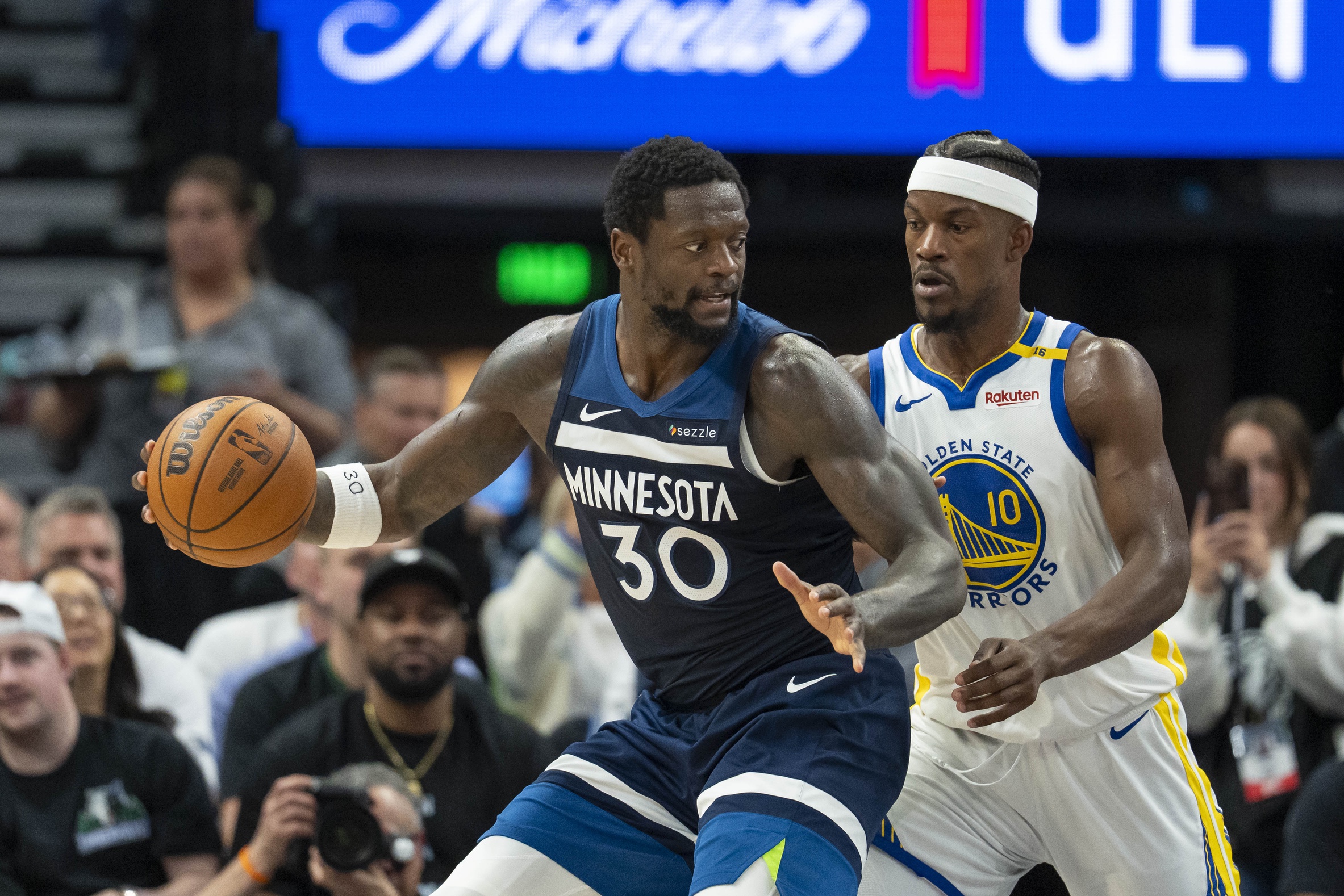
    It took Randle a little bit to find his footing in Minnesota. Once he did, Randle played like an All-Star. His play went up a level in the playoffs too. He’s far from a perfect player, but Randle is still a really good on-ball, playmaking four. The big question: Will he opt in? Or will Randle opt out and sign a long-term deal that brings his salary number down some for the upcoming season?

STARTER TIER

  1. John Collins – Utah Jazz (UFA – PLAYER OPTION)
    In a couple of messy years for the Jazz, Collins bounced back in a big way. He found his jumper again over the last couple of seasons. Collins remains a strong finisher in the paint, even if more shots are coming from floater range vs right at the rim. He’s also a good rebounder too. Collins will likely opt in, but then he’ll become a trade target for teams that need frontcourt help.

  2. Jonathan Kuminga – Golden State Warriors (RFA)
    Kuminga’s restricted free agency is kind of hard to figure out, much like where he’s at in his career. Unless the Brooklyn Nets want to get frisky with an offer sheet, Kuminga will have to work out a new deal with the Warriors or a sign-and-trade to a new team. He can really score, but the rest of Kuminga’s game hasn’t developed much. Scoring still has value though, so expect there to be sign-and-trade interest for the 22-year-old combo forward.

  3. Dorian Finney-Smith – Los Angeles Lakers (UFA – PLAYER OPTION)
    Finney-Smith will likely stick with the Lakers. There are two paths here. First is simple, by picking up his $15.4 million player option. That would keep Finney-Smith’s options open moving forward. He could also opt out and sign a long-term deal with Los Angeles. In that case, expect the Lakers to try to bring Finney-Smith’s salary down a bit for the upcoming season. That would increase their flexibility under the tax aprons.

  4. Bobby Portis – Milwaukee Bucks (UFA – PLAYER OPTION)
    If Giannis Antetokounmpo is back in Milwaukee, Portis will either opt in (and then possible extend) or opt out and sign a new long-term deal with the Bucks. If Antetokounmpo is leaving town, Portis could follow. Deals for the full non-taxpayer MLE might be on the table for Portis from a team that needs frontcourt depth.

  5. Guerschon Yabusele – Philadelphia 76ers (UFA)
    Yabusele’s return to the NBA went better than anyone could have expected. He was really good in a season where almost everything else went wrong for the Sixers. The challenge for Philadelphia is that Yabusele is coming off a veteran minimum deal and the team only has Non-Bird rights for him. That’s going to make giving him any kind of bump in a pay a potential challenge. That could open the door for another team to snag Yabusele in free agency.

ROTATION TIER

  1. Jake LaRavia – Sacramento Kings (UFA)
    The Grizzlies blew it by declining the fourth-year rookie scale option for LaRavia. That issue has now been passed onto the Kings, who can only sign LaRavia to a deal that starts at $5.2 million. That could see LaRavia move elsewhere. He’s a good shooter, has some on-ball creation ability, and LaRavia rebounds better than most realize. He’s a sneaky candidate to get a chunk of the MLE from a smart team looking for a combo forward.

  2. Nicolas Batum – LA Clippers (UFA – PLAYER OPTION)
    Batum is very likely to opt in. He’s in year-to-year mode, but was still really productive for the Clippers as a backup big man. Expect at least one more year of giving LA solid minutes off the bench.

  3. Chris Boucher – Toronto Raptors (UFA)
    Boucher was shut down late in the season by the Raptors, which actually seems to indicate that he’ll be back in Toronto. They like his combination of energy and shooting off the bench. Unless a rival team offers the full Non-Taxpayer MLE, expect Boucher to return to the Raptors.

  4. Trey Lyles – Sacramento Kings (UFA)
    After a couple of good seasons as the Kings primary backup big man, Lyles fell off this year. Now, his future in Sacramento is a lot more uncertain. He holds up fairly well defensively and on the boards. If Lyles can get back to being a solid shooter, he’s a nice stretch option as a backup big.

  5. Larry Nance Jr. – Atlanta Hawks (UFA)
    Nance didn’t play much for Atlanta early, after being a throw-in to make an offseason trade work salary-wise. Then he started getting minutes and played really well. Unfortunately, that was followed by a season-ending injury for the 10-year forward/center. Nance should be a target for teams that need affordable big man depth. He can be a third big in the rotation for a playoff team.

  1. Precious Achiuwa – New York Knicks (UFA)
    Achiuwa still brings great energy to the floor when he plays. Unfortunately, there’s not a whole lot else here. The shot never developed to make him more of an offensive threat. But the energy, rebounding and defense is enough to make Achiuwa worth signing as a bench big.

  1. Bol Bol – Phoenix Suns (UFA)
    Bol remains somewhat of an enigma. He’ll have moments where he looks like a rotation player, followed by long stretches where he barely looks like an NBA player. Bol is still often lost on defense, which makes it hard for a coach to trust him to play rotation minutes.

  2. Trendon Watford – Brooklyn Nets (UFA)
    Like a lot of Nets, Watford’s efficiency suffered because he had to self-create a lot of shots. But we have a big enough sample size to know that Watford can do lot of good things. He’s a decent shooter, better-than-you-think passer and solid on the boards. Watford is good enough to be a rotation big on a playoff team.

  3. Gui Santos – Golden State Warriors (RFA – TEAM OPTION)
    For a lot of the year, Santos looked like he was on the Warriors more for cap/tax reasons than basketball ones. Then he started getting some run and Santos showed he can play. He plays with great energy and has a high basketball IQ. If the shot was more consistent, he’d be higher on this list. As it is, expect him to be back with Golden State for at least one more year.

  4. Marvin Bagley – Memphis Grizzlies (UFA)
    We’re seven years in now and still trying to figure out Bagley. He has stretches of games where he looks like a passable rotation big man. Then there are times where you can see why Bagley has played for four teams already. He won’t get anything near the $12.5 million he made last year, but someone will give Bagley another deal and a shot at cracking their rotation.

  5. Dominick Barlow – Atlanta Hawks (RFA – TEAM OPTION)
    This one is all about potential. Barlow only just turned 22, despite having three years of NBA experience under his belt. He’s athletic and strong around the rim. The shot is still very much a work in progress. But there’s a ton of potential here. The Hawks should bring Barlow back for another year.

  6. Dario Saric – Denver Nuggets (UFA – PLAYER OPTION)
    This might be the biggest lock of all option decisions. Unless Saric really doesn’t want to spend another year at the end of the Nuggets bench, he should pick up his $5.4 million option. From there, Saric’s primary value to Denver is as salary-matching in a trade.

  7. Vlatko Cancar – Denver Nuggets (UFA)
    This one is kind of a bummer. In the summer of 2023, Cancar looked like he was becoming a rotation forward. After tearing his ACL, he missed a year, then spent last season working his way back. It’s not really clear where Cancar is at now. If he can find his form from a few years ago, someone should bring Cancar in for a rotation shot. If not, he’s probably best to head overseas to continue his career.

FRINGE TIER (UNRANKED AND PRESENTED IN ALPHABETICAL ORDER)

  1. Jae Crowder – Sacramento Kings (UFA)
    We’re probably closing in on the end for Crowder but 13 years is pretty damn good for a former second-round pick. The issue is that Crowder has to defend up now, and he doesn’t offer a consistent enough shot. Maybe another minimum deal comes his way, but we may be at the end of the line.

  2. Enrique Freeman – Indiana Pacers (RFA – TWO-WAY)
    Freeman didn’t play much in the NBA, but was terrific in the G League. He flashed a better all-around game than we saw in college. Freeman also remained a good rebounder and interior defender. Another year of seasoning on a two-way deal is probably the way forward for Freeman and the Pacers.

  3. Jeff Green – Houston Rockets (UFA)
    Green says he wants to play at least a couple more years. He’s fully in stay ready/veteran locker room presence mode in his career now. That means Green shouldn’t see more than minimum offers, but for a veteran mentor, teams could do a lot worse.

  4. James Johnson – Indiana Pacers (UFA)
    See Jeff Green, but substitute Johnson in for the Pacers. It’s really down to if Johnson wants to play another year and if Indiana has a roster spot for him.

  5. Isaac Jones – Sacramento Kings (RFA – TEAM OPTION)
    Jones didn’t do a lot in the NBA, but was good enough in the G League to earn his callup to Sacramento on a standard deal. The Kings should bring Jones back, either by picking up his option or declining it to work out a long-term deal.

  6. Kai Jones – Dallas Mavericks (UFA)
    Jones is only 24 years old and he played his best NBA minutes in his 12-game stint with the Mavs. Someone should bring Jones in for frontcourt depth. There’s still untapped talent here.

  7. E.J. Liddell – Chicago Bulls (RFA – TWO-WAY)
    Liddell showed improvement in the G League as a shooter and creator this past season. He needs another year on a two-way deal to continue to try to put it all together before a standard NBA deal.

  8. Doug McDermott – Sacramento Kings (UFA)
    The Kings really built a bench of wayward NBA vets last year. McDermott is still a good shooter. There’s just nothing else to his game. And, as he’s aged, McDermott has become more reliant on others to set him up for his shots. Still, playoff hopefuls who need designated shooting off the bench could bring in McDermott on a veteran minimum deal.

  9. Jack McVeigh – Houston Rockets (RFA – TWO-WAY)
    McVeigh was fine in the G League, but didn’t dominate. He’s also going to be 29 years old before next season. That makes another two-way deal less likely, as there’s not a lot of untapped potential here. McVeigh gave the NBA a run, but returning to Australia could be in the cards for next season.

  10. Markieff Morris – Los Angeles Lakers (UFA)
    Morris is in the same spot as Jeff Green and James Johnson. He’s a solid bench veteran to have around. If a team has a roster spot, a veteran minimum deal could come for Morris. Otherwise, a career in the media is looming for the vet big man.

  11. Drew Peterson – Boston Celtics (RFA – TWO-WAY)
    Peterson can really shoot. He’s also a sneaky-good rebounder and pretty good passer. If Boston moves on from Sam Hauser, they could bring in Peterson to take his place, alongside second-year player Baylor Scheierman.

  12. Jeremiah Robinson-Earl – New Orleans Pelicans (UFA)
    Robinson-Earl seems destined to start seasons at the end of the bench, before eventually becoming a part of the rotation. He’s a fairly rugged defender and rebounder. He’s improved as a ball-mover and screener too. If the shot was better, Robinson-Earl would have a clear rotation role on a bigger deal. As it is, he’s good as bench depth on a veteran minimum contract.

  13. J.T. Thor – Washington Wizards (RFA – TWO-WAY)
    Thor flashed at times with the Charlotte Hornets earlier in his career. Then he had some moments for South Sudan at the Olympics. But it’s never quite come together for him. He’s out of two-way eligibility, but someone might bring Thor in for forward depth on a minimum deal.

  14. P.J. Tucker – New York Knicks (UFA – TEAM OPTION)
    Tucker landed with the Knicks late in the season. He didn’t play much. If New York picks up Tucker’s $3.5 million option for next season, it’s probably for salary-matching purposes in a trade. There’s just not much on-court production left for the long-time vet.

Taylor VincentJune 05, 2025

The free agency signing window opens up July 1st, and the NWSL has announced the rules for Boston Legacy FC and Denver NWSL with the new CBA removing the expansion draft. Additionally, the league announced that intra-league loans, which are commonplace in other soccer leagues, will be allowed with player consent.

EXPANSION TEAM ROSTER-BUILDING ASSETS

The incoming 2026 expansion teams will have access to $1,065,000 in allocation money that they can begin spending once the 2026 Free Agency opens up on July 1st. Half of this funds will be provided by the league and both teams will have until December 31st, 2027 to use all funded allocation money. 

If the league salary cap increases past the expected increase in the new CBA, the available allocation money will also scale up. 

Both teams will be able to spend against the $605,000 transfer fee threshold in 2026, and will have an additional $968,000 valid from January 1st of this year through the end of the 2026 secondary transfer window (Summer 2026).  Any transfer fees spent in excess of these amounts will incur a 25 percent charge towards the team’s salary cap.

From January 1, 2025 to the start of the 2025 secondary transfer window (July 1st, 2025), the expansion teams will not be subject to a salary cap. Any players signed during this period must have a net zero salary cap impact and must be:

  • Loaned out with the loanee team picking up the full amount of salary and bonuses;
  • Qualify to be placed on SEI; or
  • The expansion team must use allocation money to cover the salary cap charge

Coinciding with the opening of the 2025 secondary transfer window, expansion teams may have a limited salary cap of $250,000 with the intent of signing college players or out-of-contract international players for the remainder of the calendar year.

Expansion teams are not required to meet the minimum roster size (22) in 2025 but may not exceed the maximum roster size (26 active players). Both Boston and Denver will be subject to the standard roster compliance dates in 2026.

INTRA-LEAGUE LOANS

Effective immediately, NWSL players may be loaned to other teams within the league with consent. All loans are subject to the following criteria:

All loans must be approved by the league and require the consent of the loaned player

  • Loaned players cannot be traded, transferred, or re-loaned to a third team
  • Loans may occur anytime during the season prior to the close of the Secondary International Transfer Window but must meet FIFA’s loan duration requirements.

A team may:

  • Loan in max 3 players from any single team
  • Loan out max 3 players to any single team
  • Have no more than 12 players (combined in/out) on loan at any given time.

The loaning team will receive salary cap relief up to the amount covered by the receiving team. Teams may negotiate the applicable salary cap relief for the duration of the loan period, but the following conditions must be met:

  • The receiving team must pay at least the equivalent of the league’s minimum salary on a daily rate basis; and
  • The player must receive their full contracted salary for the duration of the loan.
Keith SmithJune 05, 2025
© USA Today Sports

Offseason Approach

Time to move things forward towards contention

Actual Cap Space

-$67.9 million

Practical Cap Space

-$52.1 million

Projected Luxury Tax Space

-$15.4 million

Under Contract (12)

Cole Anthony
Paolo Banchero
Goga Bitadze
Anthony Black
Kentavious Caldwell-Pope
Wendell Carter Jr.
Tristan da Silva
Jett Howard
Jonathan Isaac
Jalen Suggs
Ethan Thompson (two-way)
Franz Wagner

View Roster

Potential Free Agents (6)

Gary Harris (unrestricted – team option)
Caleb Houston (restricted – team option)
Cory Joseph (unrestricted – team option)
Mac McClung (restricted – two-way)
Trevelin Queen (restricted – two-way)
Mortiz Wagner (unrestricted – team option)

View Free Agents

Dead Cap (0)

None

Projected Signing Exceptions

Taxpayer MLE ($5.7 million)

Notable Trade Exceptions

None

First Round Draft Picks

#16
#25

Notable Extension Candidates

Cole Anthony (veteran extension – as of October 1)
Paolo Banchero (rookie scale extension)
Caleb Houstan (veteran extension)

Analysis

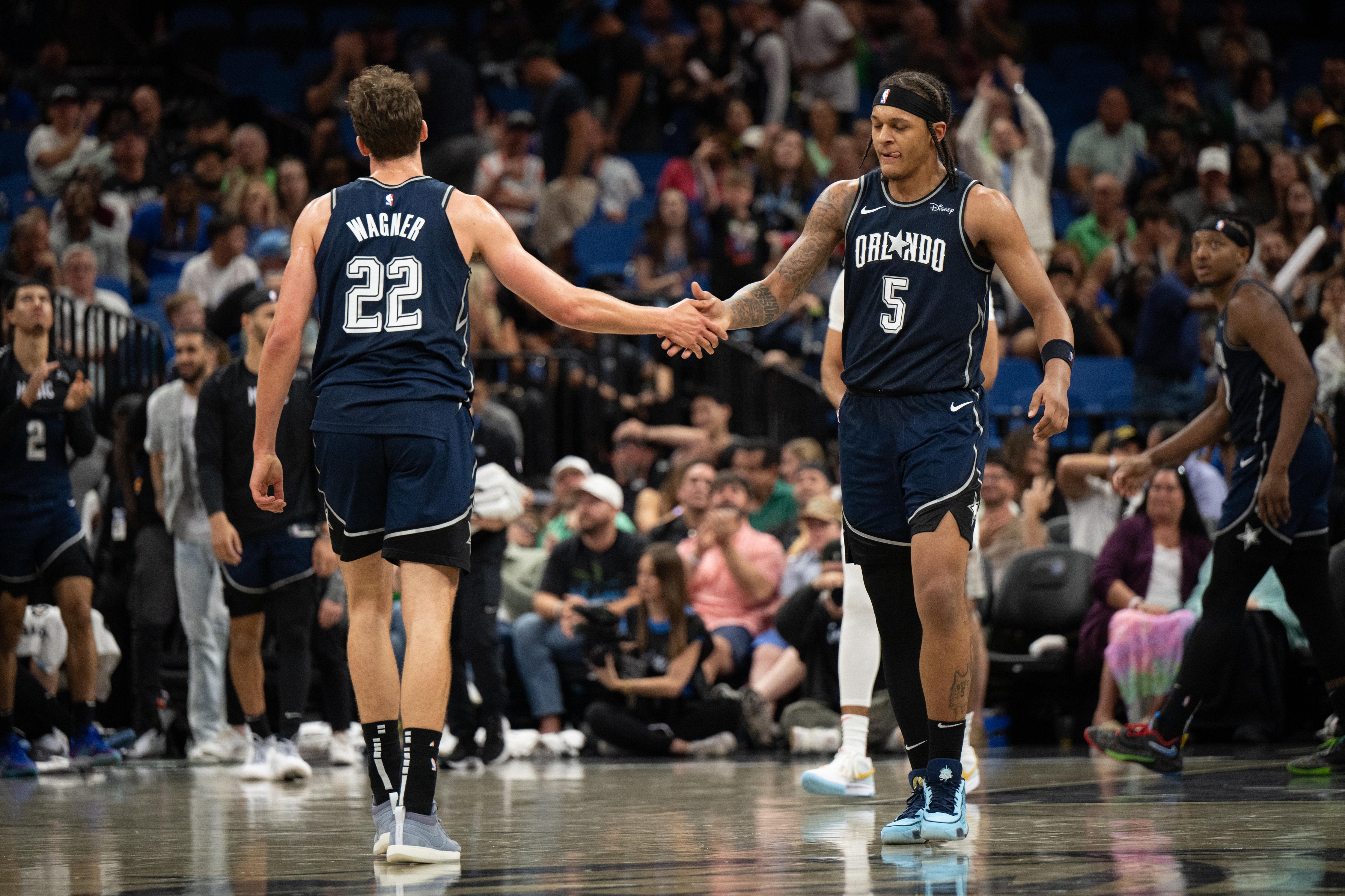
No better of a source than Orlando Magic president of basketball operations Jeff Weltman said it was time for the team to take steps forward. After patiently building up over several years, the Magic are fully in win-now mode. That doesn’t mean they’re going to make a blockbuster, all-in type of trade, but expect Orlando to be aggressive in upgrading the roster.

That’s a marked difference from Weltman’s slow-build approach to this point. But it’s time. Orlando is coming off back-to-back playoff appearances, the second one following an injury-marred season. Despite losing in the first round in both postseasons, Orlando pushed the Cleveland Cavaliers and Boston Celtics. It’s time to add to this core group.

However, that’s a lot easier said than done. With extensions kicking in for Franz Wagner and Jalen Suggs, combined with aggressively re-signing players over the years, Orlando is sitting around the first apron. That’s somewhat limiting in what they can do this summer. But the Magic have ways to free up flexibility to make a big move or two.

Orlando has been more conscientious than most teams to keep team control with the contracts that they sign. Because of that, the Magic have full control with all of their free agents. Orlando holds team options for Moritz Wagner, Gary Harris, Cory Joseph and Caleb Houstan.

Of that group, Wagner is the most likely to return. He should be ready to return from a torn ACL somewhere between the start of the season and Christmas. Wagner has been a key frontcourt reserve for the Magic over the last few seasons. But likely to return is different than Orlando picking up their option. $11 million is a little steep for Wagner. The Magic could decline this option, then work out a longer deal, but at a smaller figure. Something around three years and $24 million would make sense, given Wagner’s importance to the team.

Houstan is fairly easy to project. He’s shown potential for the Magic and he makes right around the veteran minimum. Orlando will likely pick up his option and guarantee his contract for wing depth.

Harris and Joseph are a bit trickier. Harris is still a rotation level guard, while Joseph helped to stabilize the backcourt when he took over as the starting point guard. The issue is that Orlando has Suggs, Kentavious Caldwell-Pope, Anthony Black and Cole Anthony under contract too. That’s a lot of guards to keep on one team.

Don’t expect Mac McClung or Trevelin Queen to return. They’ve run their course on two-way deals with Orlando and will look for more opportunity elsewhere, or could cash in on good deals to play bigger roles overseas.

Another good “problem” for the Magic is that they have two first-round picks in the 2025 NBA Draft. As you can tell, roster spots are starting to get pretty tight in Orlando. That means that the backcourt depth, plus the incoming draft picks, mean that Harris and Joseph will likely get squeezed out.

As for the rest of the offseason, part of what will decide things for Orlando is where they stand with the aprons. If they take the approach we laid out, the Magic will be about $3.1 million under the first apron. Factoring in that taking on salary in a trade will trigger a first-apron hard cap, that’s important to note.

If Orlando is making a major upgrade, it’ll probably come via trade. That $3.1 million, or something in that range, should give Weltman enough wiggle room to make a deal. The more important part for the Magic is that they have quite a bit of tradable salary to send out in deals.

Jonathan Isaac’s comeback to be a regular in the rotation should be applauded. But the issue for Orlando is that Isaac feels like a bit of a luxury. He can’t really play more than 20 minutes per game and he’s being paid $15 million. That’s a lot for a low-minutes backup, especially if Wagner is back in the fold.

Starting with Isaac’s $15 million salary (or $25 million salary if a trade is swung before the end of the current league year), combined with Anthony (who has become the team’s fourth or fifth guard) and his $13.1 million salary, Orlando can get in range of landing a major upgrade. If the team wanted to put in Caldwell-Pope or Wendell Carter Jr. too, there isn’t a salary they wouldn’t be able to match.

From there, Orlando has plenty of draft capital to plus-up their offers. The Magic own all of their own first-round picks, plus an extra in this year’s draft. They could also offer Black or Jett Howard as young players with potential in deals too.

If the Magic are swinging a big trade or two, there’s a good chance it’ll be an imbalanced deal. That could open up a roster spot for someone like Harris or Joseph to return down the line. There’s also a chance that Orlando knows they want to put Harris and his $7.5 million salary into a deal, which could lead to that option being picked up.

That same is true of having two first-round picks. The Magic could use them in trades or could kick one of them down the road bit, in an attempt to balance out the roster and cap sheet.

It’s hard to piece together exactly how the Magic will approach a trade. It’s safe to say that Paolo Banchero, Franz Wagner and Jalen Suggs aren’t going anywhere. Those are the players Orlando will be adding around this summer. Anyone else needs to be on the table in the right deal, and likely will be.

The Magic can’t afford to be too precious with their own guys. That’s how teams get stuck when they go from rebuilding to playoff team to contender. Orlando can continue to be a playoff team without making any changes. If they want to be contenders, they’re going to have to move some of their drafted-and-developed players. As the saying goes: You have to give something to get something.

This is an important offseason for Orlando. Next season Banchero will make $15.3 million on the last season of his rookie scale deal. In 2026-27, that will jump to at least $42.5 million, if not to the 30% max at $51 million. Combine that with Franz Wagner’s max deal and Suggs’ near-max deal, and this is the last offseason the Magic will have much flexibility under the aprons.

This team is ready for more. Banchero and Wagner proved they are ready to pull Orlando up another level, if they have the right pieces around them. This summer is the Magic’s best, and last for a bit, chance to add those right pieces. Jeff Weltman said himself that it’s time to make win-now moves. Now it’s up to him to make them.

Keith SmithJune 04, 2025
© USA Today Sports

Offseason Approach

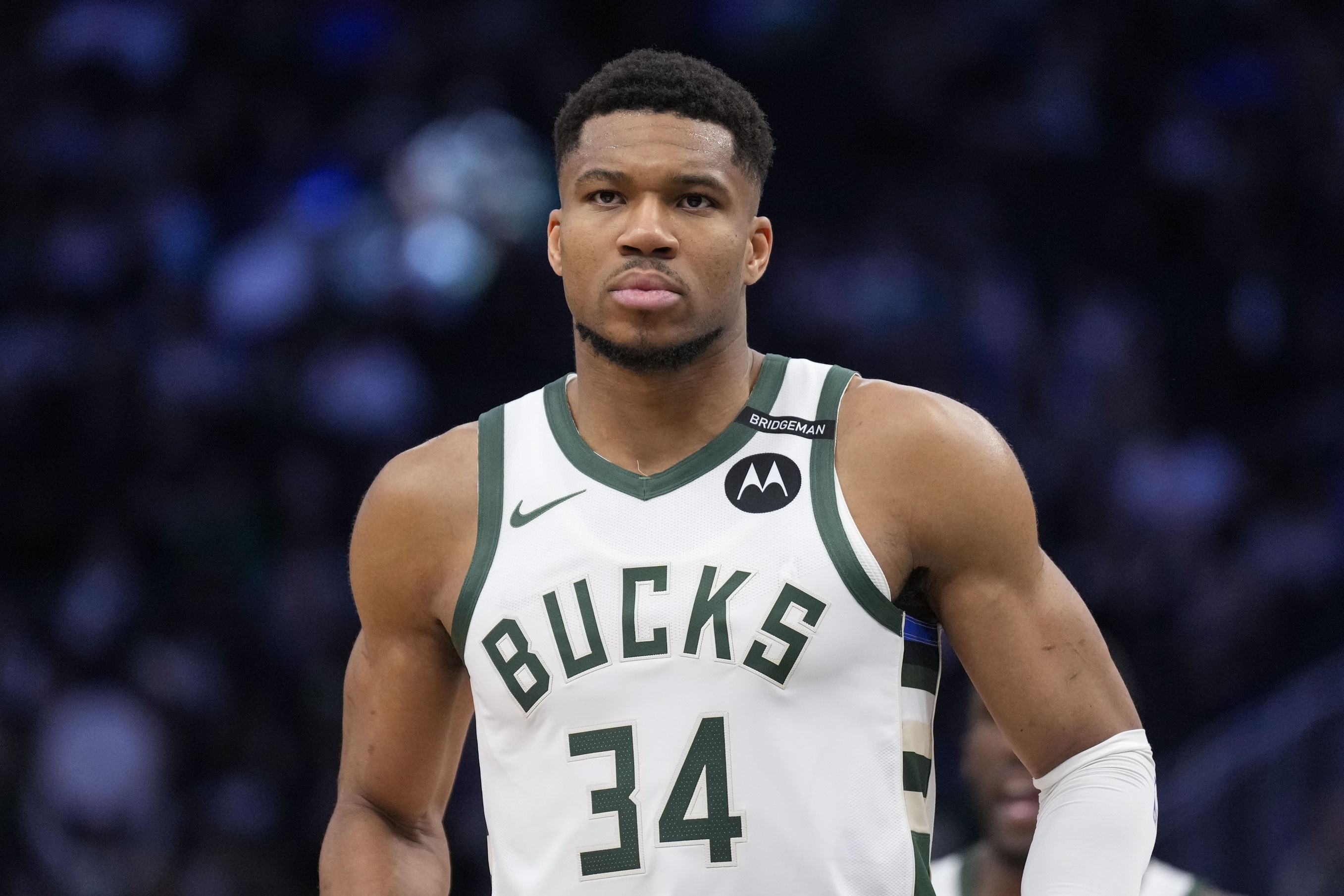
Is it time to trade Giannis Antetokounmpo?

Actual Cap Space

-$84.1 million

Practical Cap Space

-$69.9 million

Projected Luxury Tax Space

$25.6 million

Under Contract (9)

Giannis Antetokounmpo
Jamaree Bouyea (two-way)
A.J. Green (non-guaranteed)
Andre Jackson Jr. (non-guaranteed)
Kyle Kuzma
Damian Lillard
Chris Livingston (non-guaranteed)
Pete Nance (two-way)
Tyler Smith

View Roster

Potential Free Agents (9)

Pat Connaughton (unrestricted – player option)
Brook Lopez (unrestricted)
Kevin Porter Jr. (unrestricted – player option)
Bobby Portis (unrestricted – player option)
Taurean Prince (unrestricted)
Ryan Rollins (restricted)
Jericho Sims (unrestricted)
Gary Trent Jr. (unrestricted)
Stanley Umude (restricted – two-way)

View Free Agents

Dead Cap (0)

None

Projected Signing Exceptions

Non-Taxpayer MLE ($14.1 million)
Bi-Annual Exception ($5.1 million)

Notable Trade Exceptions

Khris Middleton ($7.2 million)

First Round Draft Picks

None

Notable Extension Candidates

Pat Connaughton (veteran extension)
A.J. Green (veteran extension)
Andre Jackson Jr. (veteran extension)
Kyle Kuzma (veteran extension)
Damian Lillard (veteran extension)
Chris Livingston (veteran extension)
Bobby Portis (veteran extension)

Analysis

Have we hit the point where Giannis Antetokounmpo tells the Milwaukee Bucks that he prefers a trade to another team? It feels like we are closer than ever.

We’ve been near this point twice before. Both times, Milwaukee was able to swing trades for veteran guards to stabilize things and Antetokounmpo remained in the fold.

That doesn’t feel very likely to happen for a third time. The Bucks are about out of tradable players and draft capital to land a star. If Antetokounmpo sticks around this time, it’s because he believes staying with Milwaukee, and in the Eastern Conference, still presents his best chance to win.

It’s that chance to win a title that is Antetokounmpo’s sole motivation here. There’s no credible reporting that the superstar has any form of personal issues with the Bucks. Antetokounmpo has professed his love for Milwaukee, which is the only city he’s made home in not just the NBA, but in the United States. But if the Bucks can’t give him a chance to contend, Antetokounmpo may be ready to move on.

In many ways, the Bucks front office, led by a recently extended Jon Horst, has to prepare for two offseasons. The first one is one where Antetokounmpo sticks around and Milwaukee has to retool the roster as best they can, with some key rotation players hitting free agency and Damian Lillard likely to miss most, if not all, of the upcoming season.

The second path is rebuilding in a post-Antetokounmpo world. Milwaukee will undoubtedly do well in a trade package for their franchise player, but they won’t be contenders on the other side. They probably won’t even be a playoff team. If that’s the path, then decisions on their own free agents will have a completely different tone and tenor as well.

To keep things simple, if Antetokounmpo asks for a trade, it makes little sense for Milwaukee to retain any of a group that includes Brook Lopez, Gary Trent Jr., Taurean Prince or Kevin Porter Jr. If the decision from Antetokounmpo comes early enough, it may even impact the player option decision for Bobby Portis. Pat Connaughton is a good bet to pick up his option either way, as he’s not likely to get offers anywhere close to the $9.4 million he’d make next season.

If Antetokounmpo is staying in Milwaukee, that changes things for the Bucks and their players when it comes to free agency. The team would be trying to get back into contention. That means re-signing any of the above group could be on the table.

Because a rebuild would be really hard to project beyond the Bucks playing a lot of younger players, while resetting their cap sheet, we’ll stick with the approach of retaining Antetokounmpo for the majority of our analysis here.

Lopez has been a pretty perfect fit alongside Antetokounmpo in Milwaukee’s frontcourt, while Portis has been very good as a third big in the rotation. Lopez has given no indication that he’s thinking about retirement, which makes sense as he’s still producing on a nightly basis. But a contract near the $23 million he made last season is probably too rich. Something in the range of $15 to $18 million per season over two years makes a lot of sense for Lopez. That keeps him fairly paid, while bringing his number down for Milwaukee. Creating additional salary flexibility is huge for the Bucks.

As for Portis, he could simply pick up his option and return at $13.4 million. That’s below the MLE, but it’s unlikely Portis would get anything more than MLE offers as a free agent. And, given teams recent stinginess with the MLE, Portis might not even get full MLE offers. That could lead him towards picking up his option, then hitting free agency in 2026, or working out a long-term extension with Milwaukee.

Trent, Prince and Porter were all on minimum deals last season. All three outplayed those deals, but with cap space and exceptions at a premium this summer, all three vets could be looking at minimum deals again. If that’s the case, the trio will have to weigh staying in Milwaukee vs jumping to a team that is more certain of contention. Roles and playing time will also be a factor.

The Bucks should be interested in retaining all three players. Trent isn’t the defender he once was, but he’s still a pretty good 3&D-plus guy. Prince has become a consistent shooter and he’s a nice player to have starting or coming off the bench. Porter is a wildcard, but with Lillard likely to miss next season, Milwaukee could use his on-ball juice as a scorer and playmaker.

Milwaukee’s other roster decisions are a lot more straight forward. All three of A.J. Green, Andre Jackson Jr. and Chris Livingston should be retained. Their deals are all around the veteran minimum amount, and that’s good for the Bucks.

Ryan Rollins should be re-signed to a team-friendly deal, likely at or just above the veteran minimum. He’s gotten his career on track in his two seasons in Milwaukee. Jerico Sims could be back, but he’s a minimum player and won’t impact offseason plans in a major way.

The Bucks don’t have a draft pick as it stands today. If they were to trade Antetokounmpo, that would likely change. That, combined with standard intel gathering practices, are why Horst and the front office are meeting with and working out lottery prospects. It’s best to prepared for what may come, not matter how likely it is to actually come.

That takes us to extensions. If free agency is hard to predict for Milwaukee, extensions are even trickier to nail down. We can safely take Connaughton and Kyle Kuzma off the list as extension candidates. Lillard won’t be extended at this point either, especially when his current extension is only just now kicking in.

Portis is in a weird spot. There’s a world where picking up his option and adding a couple of years makes sense. He could accomplish the same basic thing by opting out and re-signing too. Green and Jackson are interesting extension candidates, but that’s probably at least somewhat dependent on what happens with Antetokounmpo. If he’s sticking around, extending either of the wings makes more sense than if the Bucks star is moving on.

With that, we’ve come full circle. With all due respect to everyone else on the Milwaukee Bucks, the only player that matters in the immediate is Giannis Antetokounmpo. Everything the franchise has been for a decade has orbited around Antetokounmpo. If that changes, so does everything else. The Bucks would be rebuilding and that completely changes the roster-building approach. If Antetokounmpo stays, look for Jon Horst to package together salaries to make trades to upgrade a Damian Lillard-less roster for next season. But it’s all up in the air until Milwaukee knows what’s happening with their franchise player. Until then, the Bucks are preparing for two drastically different paths this offseason.


Michael GinnittiJune 03, 2025
© USA Today Sports

Before the dog days of summer get here, NFL teams will spend plenty of energy (and money) locking in core players. We’re identified a few notable names at each position group who are candidates for a new deal, laying out a current valuation and a prediction for each going forward.

Quarterbacks

Lamar Jackson

The 28-year-old 2-time MVP has 3 years, $147.5M remaining on his contract, but his cap figures jump to $74.5M each of the next two seasons in Baltimore. He carries a $68M per year valuation in our system.

Prediction: 2026 Offseason extension

Baker Mayfield

The 30-year-old enters Year 2 of a 3 year, $100M deal in Tampa Bay, but he’s producing like a Top 10 QB while getting paid like a middle of the road one, as is evident by Baker maxing out all 5 of his production incentives last season. He’s a near $61M per year player in our system right now.

Prediction: 2026 Offseason extension

Running Backs

James Cook

Cook has now put together back-to-back strong seasons in Buffalo, including 18 total touchdowns last season. But his struggles in the pass-blocking game has made him a 2-down back for the most part, making a long-term extension on an already expensive roster a very tough fit. He’s a $10M per year player in our system.

Prediction: Cook enters free agency in 2026 

Kyren Williams

Williams has been a productive 2-down back in LA for the better part of 2 seasons now, and saw his 2025 salary escalate to $5.3M in light of it. The 24-year-old carries a $10.5M valuation in our system, lining up for a 3 year, $31.5M extension.

Prediction: Williams signs a 3 year, $31M extension ($16M guaranteed) this summer

Wide Receivers

Terry McLaurin

The 29-year-old enters a contract year in 2025, set to earn $19.65M for the upcoming season. He’s a near $32M per year player in our system currently, and should benefit from DK Metcalf’s recent extension in Pittsburgh ($33M per year, $60M guaranteed).

Prediction: McLaurin signs a 3 year, $100M extension ($60M guaranteed)

Drake London

Better every year. That’s the motto London and his camp can bring to the negotiating table this summer. The 2022 1st-rounder secured 100 passes for 1,271 yards and 9 TDs last season, and is set up to be Michael Penix Jr. 's leading target for the foreseeable future. He’s a $24M player in our system, but getting ahead of Jaylen Waddle’s $28.25M APY is probably the floor.

Prediction: ATL strikes early, extending London at 3 years, $86M ($62M guaranteed) this summer

Garrett Wilson

Despite a mixed bag of QB play over his first three seasons, Wilson has improved steadily to begin his NFL career. The 24-year-old is now on a 2 year, $20M guarantee thanks to his 5th-year option being exercised, but the Jets appear poised to get something done sooner rather than later here. Wilson is a $24M player in our system currently, but getting ahead of Jaylen Waddle’s $28.25M APY is probably the floor.

Prediction: The Jets extend Wilson at 3 years, $86M ($62M guaranteed) this summer

Courtland Sutton

Sutton is entering a contract year in Denver, set to earn $14M for the upcoming season. He posted near-career numbers in 2024 as the Broncos offense took an about face with new QB Bo Nix, positioning Sutton to lock in a few more guaranteed seasons going forward. He’s a $26M+ player in our system currently.

Prediction: Sutton & the Broncos can't agree on terms sending him to free agency next March

Tight Ends

Isaiah Likely

Despite numerous opportunities to take over the TE1 reins in Baltimore, Likely remains a sidekick to Mark Andrews in the Ravens’ offense (at least for 1 more season). The 25-year-old is entering a contract year in 2025, set to earn $3.4M for the upcoming season. He carries a $10M valuation in our system currently.

Prediction: Likely enters free agency in 2026

Offensive Linemen

OT Rashawn Slater

The 2021 1st-rounder enters a contract year in 2025, set to earn a fully guaranteed $19M for the upcoming season. Coming off of a career year, Slater holds a $26M valuation in our system, but there’s plenty of case to be made that the 26-year-old eclipses Tristan Wirf’s $28M+ APY in the coming weeks.

Prediction: Slater signs a 4 year, $120M extension ($90M guaranteed) this summer

OT Zach Tom

Jordan Love’s right side protector has been one of the best overall tackles in the game across the past two seasons. He enters a contract year in 2025, set to earn $3.4M this season. Now carrying a $22M valuation in our system, the 26-year-old could be in for a massive raise soon.

Prediction: The Packers hand Tom a 4 year, $88M extension ($40M guaranteed) this summer

OT Bernhard Raimann

While the QB is largely in question in Indy, much of the offensive line is settling into a long-term core unit. Raimann enters a contract year in 2025, set to earn $3.9M this season. Christian Darrisaw’s $26M per year deal in Minnesota is absolutely on the table here.

Prediction: Indy tables this until next offseason

OT Kolton Miller

Miller has been rock-solid for the Raiders for the better part of 5 straight seasons now, and is set to earn $12.3M in the final year of his contract. Las Vegas owes him a course correction here, which probably comes with doubling his current $11.5M APY in the next go-around.

Prediction: Miller signs a 4 year, $100M extension ($75M guaranteed) this summer

C Tyler Linderbaum

The 2022 1st-rounder has been a top-flight center since he joined the league, and is now extension-eligible for the first time this offseason. The Ravens have a few other mouths to feed, but putting Linderbaum at or near the top of the center market will be a priority at some point.

Prediction: Baltimore tables this extension to next offseason

G Trey Smith

The Chiefs slapped a $23.4M franchise tag on Smith back in February, and he remains on that tender 4 months later. For all intents and purposes, that $23M pricepoint should remain a foundation for the APY on his looming extension.

Prediction: KC extends Smith to a 4 year, $92M ($55M guaranteed) extension this summer

G Tyler Smith

With Zack Martin now headed into retirement, Tyler Smith is now joined by 2025 1st round pick Tyler Booker as the interior linemen of the future in Dallas. Booker’s contractual value should be to Smith’s benefit in the coming months.

Prediction: Dallas tables this extension until the 2026 offseason

Edge Defenders

DE Aidan Hutchinson

A week 6 leg injury derailed Hutchinson’s 2024 season and placed a temporary roadblock in front of his extension window, but it does little to diminish just how as advertised he’s been through 2 ½ NFL seasons in Detroit. A deal in the $38-40M per year range, north of $100M guaranteed should be well within reach.

Prediction: Lions table this extension until the 2026 offseason

OLB T.J. Watt

Watt and the Steelers have both expressed interest in keeping this relationship afloat (despite question marks surrounding much of the roster), and extension discussions have been ongoing for the 30-year-old who holds 1 year, $21M remaining. He’s a 4 year, $147M player in our system.

Prediction: Watt agrees to a 4 year, $150M extension ($95M guaranteed) this summer

DE Trey Hendrickson

The understandably maligned 30-year-old is seeking a sizable raise from the 1 year, $16M (non-guaranteed) that he’s currently owed in Cincy. Doubling it, and guaranteeing it over the next two seasons might be the answer here.

Prediction: Hendrickson signs a 2 year, $65M fully guaranteed extension this summer

DE Micah Parsons

The next big payday in Dallas is right around the corner as Parsons (who has amassed 53 sacks in his first 63 games) is now entering a contract year in 2025 ($24M fully guaranteed salary). It’s not about will he reach Myles Garrett’s $40M per year, it’s how much past it will he go?

Prediction: Parsons signs a 4 year, $170M extension ($125M guaranteed) late this summer

Defensive Backs

CB Trent McDuffie

The 2022 1st-rounder has done all that’s been asked of him and more in KC across his first 3 NFL seasons, now finding himself extension-eligible for the first time this Spring. Derek Stingley Jr. ($30M), Jaycee Horn ($25M), & Patrick Surtain II ($24M) have already raised the financial bar here, and Ahmad Gardner could take things even higher in NY soon.

Prediction: The Chiefs table this extension until the 2026 offseason

CB Ahmad Gardner

Despite a new front office/coaching staff that is certain to make changes over the course of the next 12 months, Gardner appears to be very much in the long-term plans of the Jets. He’s looking to bank off a major reset at the top of the CB market ($30M per year, $89M guaranteed), and could very well be in that conversation when it’s all said and done.

Prediction: The Jets sign Sauce to a 3 year, $95M extension ($70M guaranteed) this summer

S Kyle Hamilton

Arguably the best safety in the league just 3 seasons into his NFL career, the formula is pretty simple for Hamilton and his camp in the coming months:  Exceed every top financial metric possible at the position and reset the market completely.

Prediction: Hamilton signs a 3 year, $75M extension ($50M guaranteed) this summer

Keith SmithJune 03, 2025
© USA Today Sports

Spotrac’s Free Agent by Position Series

Point Guards   |   Shooting Guards   |   Small Forwards   |   Power Forwards   |   Centers

2025 NBA free agency is right around the corner. This year’s class is considered a fairly weak one in terms of top-end talent. However, there are still several impact players available. In these rankings, we took a similar approach to the one many teams use when it comes to ranking available players. Each position was broken down into tiers. The tiers are:

  • All-Star: These aren’t all necessarily All-Stars, but they have the ability to be an All-Star
  • Starters: These players are either starters or they produce at a starter-level of impact
  • Rotation: These are solid players that should be in a team’s regular season rotation
  • Fringe: These are players at the end of the bench or Two-Way players playing mostly in the G League

Players were then ranked within their tiers. All potential free agents have been ranked, including those with pending options.

ALL-STAR TIER

None

STARTER TIER

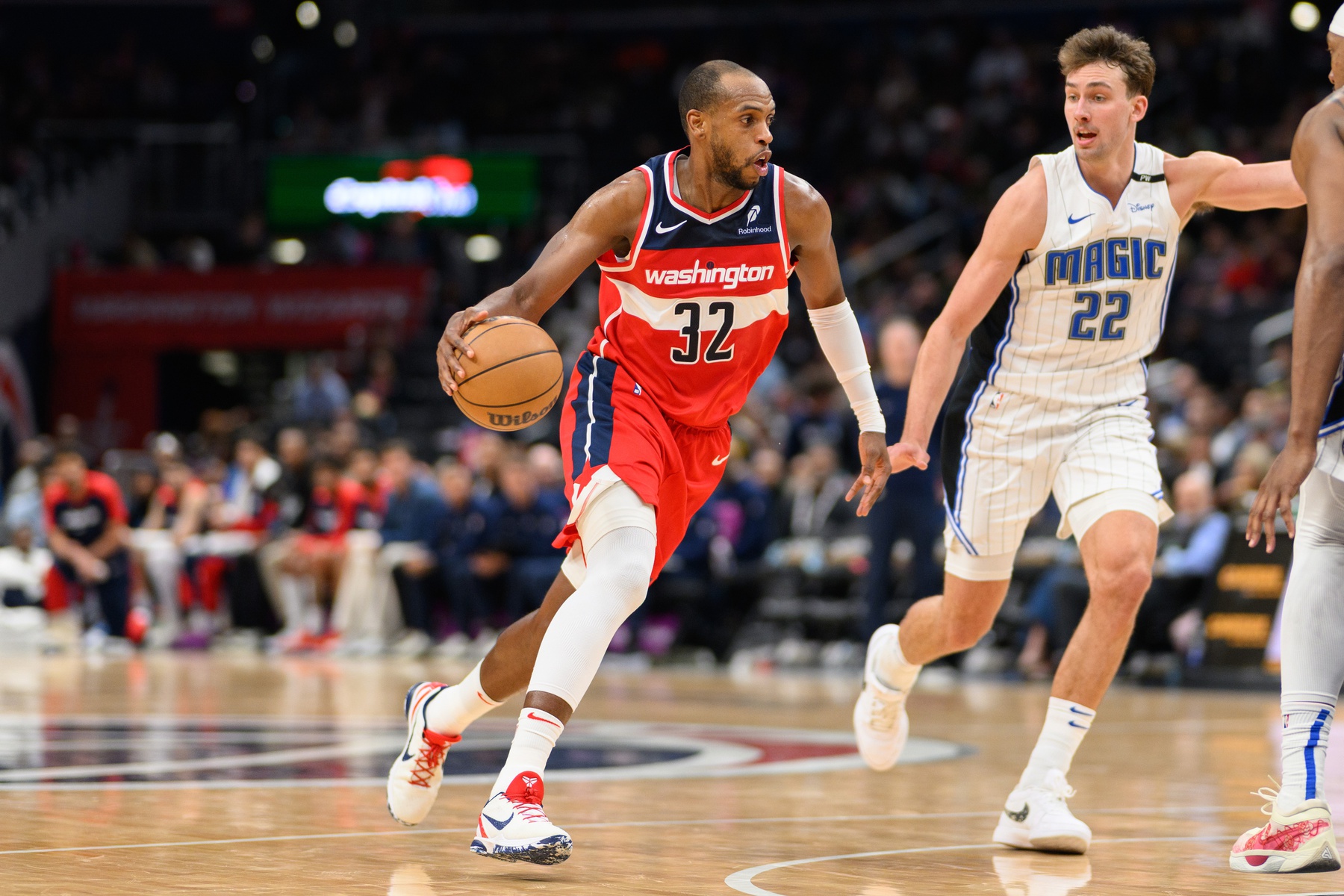
  1. Khris Middleton – Washington Wizards (UFA – PLAYER OPTION)
    Convention wisdom is that Middleton will opt in for next season at about $33 million. There is a world where Middleton opts out and re-signs with the Wizards at a lower salary, which would make him a lot more tradable. Expect Middleton to opt in and for Washington to shop him to teams that need veteran wing help.

  2. Kelly Oubre Jr. – Philadelphia 76ers (UFA – PLAYER OPTION)
    Oubre should be 50-50 on opting out. He might find another team willing to give him $8.4 million without much worry. But Oubre could also get squeezed fairly quickly. We’re projecting he opts in and gives Philadelphia a pretty solid wing scorer for another year.

  3. Justin Edwards – Philadelphia 76ers (RFA – TEAM OPTION)
    If finances are a concern, the Sixers could pick up this option and then have Edwards as a restricted free agent in 2026. If they want to lock up Edwards early, they could decline the option and re-sign the young wing now. Either way, Philadelphia should keep Edwards in the fold for next season. He’s better than most people realize.

  4. Taurean Prince – Milwaukee Bucks (UFA)
    Prince has become one of the more consistent shooting forwards in the league over the last several seasons. He’s a good bet to hit a bunch of threes and he can hold his own defending either forward spot, plus some bigger shooting guards. There just isn’t a lot else here. Still, a team could do a lot worse.

ROTATION TIER

  1. Matisse Thybulle – Portland Trail Blazers (UFA – PLAYER OPTION)
    Thybulle missed most of last season, but when he returned, he looked like himself. He’ll pick up his $11.55 million option. From there, Portland might be able to net a decent return in a trade for an improved-shooting, excellent-defending wing.

  2. Amir Coffey – LA Clippers (UFA)
    Coffey put together his best all-around regular season. His shooting has stabilized after a down season a couple of years ago. But after a late-season knee injury, he struggled to find his form again. Still, Coffey should be a sneaky target for a team that needs a rotation wing.

  3. Ziaire Williams – Brooklyn Nets (RFA)
    After a couple of injury-plagued seasons with the Grizzlies, Williams bounced back some with the Nets. This season showed that he’s never going to be a great self-creator of offense, but Williams can play well in a complementary role. His defense got back to the point where you can see signs of him being a good defender again. The Nets may not issue a qualifying offer, especially if they want to maximize their cap space.

  4. Jalen Wilson – Brooklyn Nets (RFA – TEAM OPTION)
    There’s some projecting here for Wilson. He struggled to shoot it consistently, but there was a lot of on-ball stuff, which wouldn’t be Wilson’s role on a good team. He’s alright defensively, and can do a little secondary playmaking. Having his option picked up by the Nets really comes down to exactly how much cap space Brooklyn needs.

  5. Jae’Sean Tate – Houston Rockets (UFA)
    Tate’s role shrunk in the Rockets crowded forward rotation. He was still good on defense and his shot looked somewhat improved. The prospect shine is off Tate, but he’s still a solid rotation player, and even more if the shot continues to trend upward.

  1. Jabari Walker – Portland Trail Blazers (RFA)
    Walker played a lot less this past season, but was far more efficient. Over the last two years, Walker has flashed a lot of potential. He’s still young enough to grow into a bigger role. As a restricted free agent, Portland should be able to bring him back on a reasonable deal.

  1. Torrey Craig – Boston Celtics (UFA)
    Craig is more of a 3/4 now than a 2/3. That limits his upside a bit. He still brings good energy and solid defense. He’s a solid spot-up shooter too. Unfortunately, Craig having to play up vs down means the 3&D tag is off him. Combo forwards just aren’t necessarily as valuable as true wings.

  1. Lamar Stevens – Memphis Grizzlies (UFA)
    Stevens is right on the edge of being a rotation guy. He can capably defend either forward spot. If he shot it even passably, Stevens would be a for-sure rotation guy. As it is, he’s a year away from being a fringe guy. Stevens is also a good candidate for a bigger role overseas than he’d have in the NBA.

FRINGE TIER (UNRANKED AND PRESENTED IN ALPHABETICAL ORDER)

  1. Emoni Bates – Cleveland Cavaliers (RFA – TWO-WAY)
    Everything looks like it is there for Bates to be an NBA rotation guy. Then you watch him play and it’s a lot of tough, contested shots that don’t go in a lot. Another year on a two-way deal is probably in his future, but it has to start to click this season.

  2. Kessler Edwards – Dallas Mavericks (RFA – TWO-WAY)
    Edwards battled his tail off in an injury-ravaged Dallas frontcourt. He also shot the ball fairly well, and showed that in a pinch he can even play some small-ball center. The challenge is that Edwards doesn’t do much on-ball and that limits his overall value.

  3. Caleb Houstan – Orlando Magic (RFA – TEAM OPTION)
    It’s been a slow burn for Houstan. This year was his best NBA season by a wide margin. Maybe it’s starting to come together and he’s a late-bloomer. The issue in Orlando is that roster spots are becoming an issue. That could put him on the bubble of returning for a fourth year.

  4. Chuma Okeke – Cleveland Cavaliers (UFA – TEAM OPTION)
    Okeke was pretty good in the G League this year. That earned him the chance at a couple of callups with the 76ers and Cavs. He flashed in those spots too. Cleveland will probably decline this option, but Okeke should get a chance to catch on somewhere with a camp deal.

  5. Keshad Johnson – Miami Heat (RFA – TEAM OPTION)
    Johnson was a solid defender and good finisher in the G League. He’s too athletic and strong for most opposing forwards at the minor league level. To stick in the NBA, he’ll need to shoot it better. But Johnson is the exact type of prospect Miami has developed in the past. Expect the Heat to pick up their option to keep working with Johnson.

  6. Jalen Bridges – Phoenix Suns (RFA – TWO-WAY)
    Bridges made no NBA impact, but put together a good G League season. He’s likely to be back with Phoenix on another two-way deal to continue developing in the G League.

  7. Keion Brooks Jr. – New Orleans Pelicans (RFA – TWO-WAY)
    Brooks put together a solid, if unspectacular G League season. He’s a good defender and strong rebounder. There’s just not much there offensively. Brooks’ age is also working against him a bit for continued developmental deals as a two-way player.

  8. Jamal Cain – New Orleans Pelicans (RFA – TWO-WAY)
    In first couple of years with the Heat, Cain looked like Miami’s next G League hit. Last year, things stagnated for Cain in New Orleans. Now, he may be best off to head overseas for a bigger role.

  9. Isaiah Crawford – Sacramento Kings (RFA – TWO-WAY)
    Crawford had a very strong G League season. He did a lot of everything, including shooting it well from deep. The Kings should bring him back on another two-way deal, with the idea of converting him to a standard contract down the line.

  10. Trentyn Flowers – LA Clippers (RFA – TWO-WAY)
    Flowers put together an encouraging year in the G League. He shot better than expected, and showed some on-ball creation skills too. Another two-way contract should be in the cards for the young wing.

  11. Joe Ingles – Minnesota Timberwolves (UFA)
    If you want a tremendous locker room presence, who can occasionally hit an open jumper, Ingles is your guy. He’s beloved everywhere he’s ever played. Ingles also stays ready when he’s asked to fill in. The end is near, but Ingles might have one more season in him.

  12. Harrison Ingram – San Antonio Spurs (RFA – TWO-WAY)
    Ingram’s rookie season was a disappointment. He didn’t do much offensively in the G League. Ingram is a solid rebounder, but he’s got to shot a lot more than rebounding to ever get a real NBA opportunity.

  13. Spencer Jones – Denver Nuggets (RFA – TWO-WAY)
    Jones should be in line for another two-way deal. He really shot it well in the G League. Jones also had a good defensive season. The Nuggets should keep working with him on a two-way contract, with the idea of a standard deal coming down the line.

  14. Braxton Key – Golden State Warriors (UFA)
    Key got a callup after really solid G League season. If he could shoot it from deep, Key would be a more interesting NBA prospect. As it stands, he’s a fringe guy and will likely be back in the G League or overseas next season.

  15. Kevin Knox II – Golden State Warriors (UFA)
    Like Key, Knox was called up after a strong run for the G League Warriors. The difference is that Knox has shown the ability to shoot it. He could find his way onto the backend of an NBA roster after a camp deal.

  16. Emanuel Miller – Chicago Bulls (RFA – TWO-WAY)
    Miller remains an interesting prospect. He’s got good size for a wing, and his all-around skillset is fairly solid. Another year on a two-way deal, while working to improve his shot, should be the path for Miller.

  17. Justin Minaya – Portland Trail Blazers (RFA – TWO-WAY)
    Minaya is really good defensively. He’s an NBA level guy on that end of the floor. The issue is that Minaya can’t shoot at all, and his scoring game is limited to scoring right at the rim. Unless that improves, he won’t make it past a two-way deal.

  18. Riley Minix – San Antonio Spurs (RFA – TWO-WAY)
    The season was abruptly ended for Minix on the first of the year due to a shoulder injury. Before that, Minix was showing out in the G League. He’ll probably have to start that process over, but there’s a lot to like with Minix. Keep an eye on him, even if he’s back on a two-way contract again next season.

  19. Josh Minott – Minnesota Timberwolves (RFA – TEAM OPTION)
    Minott has a lot of fans around the NBA. It’s all theoretical right now, but there’s a player in there somewhere. Minnesota will likely keep Minott around for at least one more year to keep working with him.

  20. Wendell Moore Jr. – Charlotte Hornets (RFA – TWO-WAY)
    Moore’s lack of a consistent outside shot is holding him back. He does a good job getting to his spots in the G League, but doesn’t have that ability at the NBA level. Until he shoots it better, Moore will be stuck in the minors.

  21. Jacob Toppin – Atlanta Hawks (RFA – TWO-WAY)
    Toppin had a really strong G League season. He defended, rebounded and shot it really well. There were a few flashes in the NBA too. One more year on a two-way, with eyes on an in-season callup to a standard deal is the path for Toppin.

  22. Luke Travers – Cleveland Cavaliers (RFA – TWO-WAY)
    In the G League, Travers is a do-everything wing. In the NBA, he’s a little too slow and a little too small. Travers also can’t shoot. Another year of work in the G League to improve, while on a two-way deal, makes a lot of sense for Travers and the Cavs.

  23. Anton Watson – New York Knicks (RFA – TWO-WAY)
    Watson didn’t show a whole lot in the G League this year. There’s talent there, because Watson was such a good college player. But he’s going to have to show a lot more to stick around on a two-way deal in the NBA. Heading overseas may be the best path forward for Watson.

Keith SmithJune 02, 2025
© USA Today Sports

Offseason Approach

Resetting the roster in the post-Butler era

Actual Cap Space

-$65.6 million

Practical Cap Space

-$56.0 million

Projected Luxury Tax Space

$5.7 million

Under Contract (11)

Bam Adebayo
Kyle Anderson
Tyler Herro
Haywood Highsmith
Jaime Jaquez Jr.
Nikola Jovic
Pelle Larsson ($978K guaranteed)
Kevin Love
Terry Rozier ($24.9M guaranteed)
Kel’el Ware
Andrew Wiggins

View Roster

Potential Free Agents (7)

Alec Burks (unrestricted)
Josh Christopher (unrestricted – two-way)
Keshad Johnson (restricted – team option)
Davion Mitchell (restricted)
Duncan Robinson (unrestricted – player option)
Dru Smith (restricted – two-way)
Isaiah Stevens (restricted – two-way)

View Free Agents

Dead Cap (0)

None

Projected Signing Exceptions

Non-Taxpayer MLE ($14.1 million)
Bi-Annual Exception ($5.1 million)

Notable Trade Exceptions

Jimmy Butler ($16.1 million)
Josh Richardson ($3.1 million)

First Round Draft Picks

#20

Notable Extension Candidates

Tyler Herro (veteran extension)
Nikola Jovic (rookie scale extension)
Duncan Robinson (veteran extension)
Terry Rozier (veteran extension)
Andrew Wiggins (veteran extension – as of October 1)

Analysis

The Miami Heat spent most of last season dealing with drama around the Jimmy Butler situation. Butler wanted to get traded, but played for a while. Then he became a distraction and the team suspended him. Then he came back for a bit, but got suspended again. Then Butler was finally traded.

All of swirl around Butler seemed to pull the Heat down as a team. Miami finished with a losing record for the first time since 2019. They did win two road games in the Play-In Tournament, but were blown out in a non-competitive sweep by the Cleveland Cavaliers in the first round.

Now, the Heat have to pick up the pieces in a way this franchise hasn’t had to for several years.

The cap sheet is carrying a couple of bloated deals, but it’s not as bad as it looks at first glance. Only Bam Adebayo has more than two guaranteed years remaining on his deal. Beyond that, only Tyler Herro is carrying a guaranteed contract larger than $10 million. Even if we assume Andrew Wiggins will pick up his $30.2 million player option for 2026-27, the Miami cap sheet isn’t in bad shape long-term.

Why are we looking out beyond this offseason for the Heat? Because the immediate future is a lot messier.

Duncan Robinson is very likely to pick up his $19.8 million player option for next season. His deal will then become guaranteed for $9.8 million for next season. That’s a decent amount of savings, but not really a game-changing amount for Miami to seriously consider waiving Robinson. The good news? Robinson’s deal doesn’t become fully guaranteed until July 8. That means that the Heat will have a great idea of where they are at with Robinson and the best path with his deal before it hits the guarantee date.

Unfortunately for Miami, no such flexibility exists with Terry Rozier’s contract. Rozier’s deal doesn’t become fully guaranteed until the league-wide guarantee date of January 10. That would be great, except that waiving Rozier would net the Heat a grand total of $1.7 million in savings.

Why are the guarantees for Robinson and Rozier so important? Their deals are primary salary-matching components of hypothetical trades to improve the roster. Even if we consider both contracts to essentially be fully guaranteed, they are then a combined $46.5 million in expiring salary. That’s huge in potential trades.

Miami has enough wiggle room under the second apron to be aggressive in trades. That’s in part because the team doesn’t have any big-money free agents due for new contracts. Because the Heat are who they are, expect them to be linked to any potential superstars that hit the market this summer.

As covered above, Miami is in good shape with tradable salary (and they can add even more with Herro and Wiggins as potential trade pieces). The Heat are also in good shape with tradable draft picks. They owe one more lottery-protected pick to the Charlotte Hornets in 2027 (flipping to unprotected in 2028), but that’s not a lot in terms of outgoing picks.

In free agency, the only major Heat free agent is Davion Mitchell. He was an excellent fit for Miami after being acquired at the trade deadline. Expect the Heat to re-sign Mitchell. A deal in the range of $12 million AAV makes sense for Mitchell. He won’t be a real target for MLE teams, nor are the Nets likely to tie up their cap space in an offer sheet. That should allow the Heat to re-sign Mitchell on a relatively team-friendly contract.

Of the team’s other free agents, Alec Burks is probably getting pushed out by a younger player. If he returns, it’ll be on another veteran minimum deal. Keshad Johnson is an interesting developmental prospect, especially given the Heat’s history with similar players. Look for Miami to pick up their team option for Johnson, because that will help keep costs down. The Heat can also make him a restricted free agent in 2026.

Dru Smith and Isaiah Stevens are good bets to be back on two-way contracts again. Josh Christopher is out of two-way eligibility, so he’ll probably move on. Don’t be surprised if Christopher lands a decently-sized deal to head overseas.

Miami will fully guarantee the contract for Pelle Larsson, as his deal is already half-guaranteed. Larsson is also well worth a deal that won’t yet reach the full veteran minimum amount.

That leaves extensions as the next chunk of contract work. We can remove Robinson and Rozier from extension consideration. Both are more likely to be traded than they are to extend. Wiggins is probably in the same boat, given how large his contract already is vs the production he provides. The Heat will let that one ride.

That leaves Herro for a veteran extension and Nikola Jovic for a rookie scale extension. We’ll tackle Jovic first.

Jovic has all kinds of potential. He’s shown major improvement the last two seasons, but Jovic has had to play around various injuries. That leaves his value fairly hard to project. If Miami could get him on a team-friendly extension (something around $40 million over four years), they’d probably do it in a flash. For Jovic, that would be tempting money to lock in for. He could also bet on himself and play things out to restricted free agency in 2026. If Miami has to go up to an MLE-equivalent deal, that’s as far as they should go to re-sign Jovic now.

Herro probably isn’t getting extend. First, he’s got two years left on his deal, with no options. That means that there is time for Miami to decide which direction they want to go with the veteran guard. Herro was a first-time All-Star last year, as he put together his best all-around season. He showed he can up his scoring, while maintaining his efficiency as the Heat’s primary offense initiator.

On the other end of the floor, Herro is a problem. In the last two playoffs, opponents have targeted Herro relentlessly. That’s something Miami has to plan around, given how important the All-Star is to the team’s offense.

A year from now is when extension talks will ramp up more heavily. That could also benefit Herro in a big way. If Herro could play himself onto an All-NBA team (probably won’t happen, but not a crazy idea), he would be eligible for a so-called super max extension. For the Heat, taking an extra year works in their favor. They’ll get to see how Herro holds up for another full season as the primary guy on offense. For Herro, he can potentially play himself into even more money, while knowing he’s established a pretty solid floor for future earnings already.

The Miami Heat have hit a crossroads. They can talk around it all they want, but the mythical Heat Culture took a hit throughout the Jimmy Butler saga. That’s something Miami has to work around a bit. In terms of far more practical matters, the Heat cap sheet is starting to clean up.

They could reasonably hit the summer of 2026 with $30 or $40 million in cap space, with the potential for even more. Obviously, if the Heat swing a star trade this offseason, that changes everything. Either way, they’re set up with pretty good flexibility no matter which direction they go.

That means this might be another down year. Given Miami owns their own first-round pick free and clear in the 2026 draft, it might not be a bad time to have a gap year. Then, the Heat can get back to work with cap space and a good pick in the summer of 2026. And we’ve seen before what Miami can do when they have the ability to be major player in free agency.


Michael GinnittiJune 02, 2025

With June upon us, a look at every NFL team’s top Dead Cap hit for the upcoming 2025 season, led by Deebo Samuel’s $34M+ hit in San Francisco per his trade to Washington, and Russell Wilson’s final $32M dent to the Broncos’ cap stemming from his 2024 release.

TEAM PLAYER 2025 DEAD HIT REASON
Arizona Cardinals D.J. Humphries $6,916,668 2024 Post 6/1 Release
Atlanta Falcons Grady Jarrett $4,125,000 2025 Release
Baltimore Ravens Odell Beckham, Jr. $8,301,000 2024 Post 6/1 Release
Buffalo Bills Von Miller $15,417,000 2025 Release
Carolina Panthers Jadeveon Clowney $6,000,000 2025 Release
Chicago Bears Nate Davis $2,000,000 2024 Release
Cincinnati Bengals Alex Cappa $2,250,000 2025 Release
Cleveland Browns Amari Cooper $22,584,000 2024 Trade
Dallas Cowboys Zack Martin $8,802,915 2025 Retirement
Denver Broncos Russell Wilson $32,000,000 2024 Post 6/1 Release
Detroit Lions Carlton Davis $9,823,449 2025 Contract Void
Green Bay Packers Preston Smith $9,881,000 2024 Trade
Houston Texans Stefon Diggs $16,644,000 2025 Contract Void
Indianapolis Colts Matt Gay $4,000,000 2025 Release
Jacksonville Jaguars Brandon Scherff $13,801,000 2025 Contract Void
Kansas City Chiefs Joe Thuney $10,971,713 2025 Trade
Las Vegas Raiders Davante Adams $15,700,000 2024 Trade
Los Angeles Chargers Joey Bosa $11,111,667 2025 Release
Los Angeles Rams Cooper Kupp $22,260,000 2025 Release
Miami Dolphins Xavien Howard $15,699,000 2024 Post 6/1 Release
Minnesota Vikings Sam Darnold $5,000,000 2025 Contract Void
New England Patriots Davon Godchaux $6,666,667 2025 Trade
New Orleans Saints Marshon Lattimore $31,661,837 2024 Trade
New York Giants Daniel Jones $22,210,000 2024 Release
New York Jets Aaron Rodgers $14,000,000 2025 Post 6/1 Release
Philadelphia Eagles Jason Kelce $16,438,000 2024 Retirement
Pittsburgh Steelers Larry Ogunjobi $3,533,334 2025 Release
San Francisco 49ers Deebo Samuel $34,106,705 2025 Trade
Seattle Seahawks D.K. Metcalf $21,000,000 2025 Trade
Tampa Bay Buccaneers Shaquil Barrett $17,401,000 2024 Post 6/1 Release
Tennessee Titans Harold Landry $13,100,000 2025 Release
Washington Commanders Jonathan Allen $6,000,000 2025 Release


Top