


.png)


 NEWS
NEWS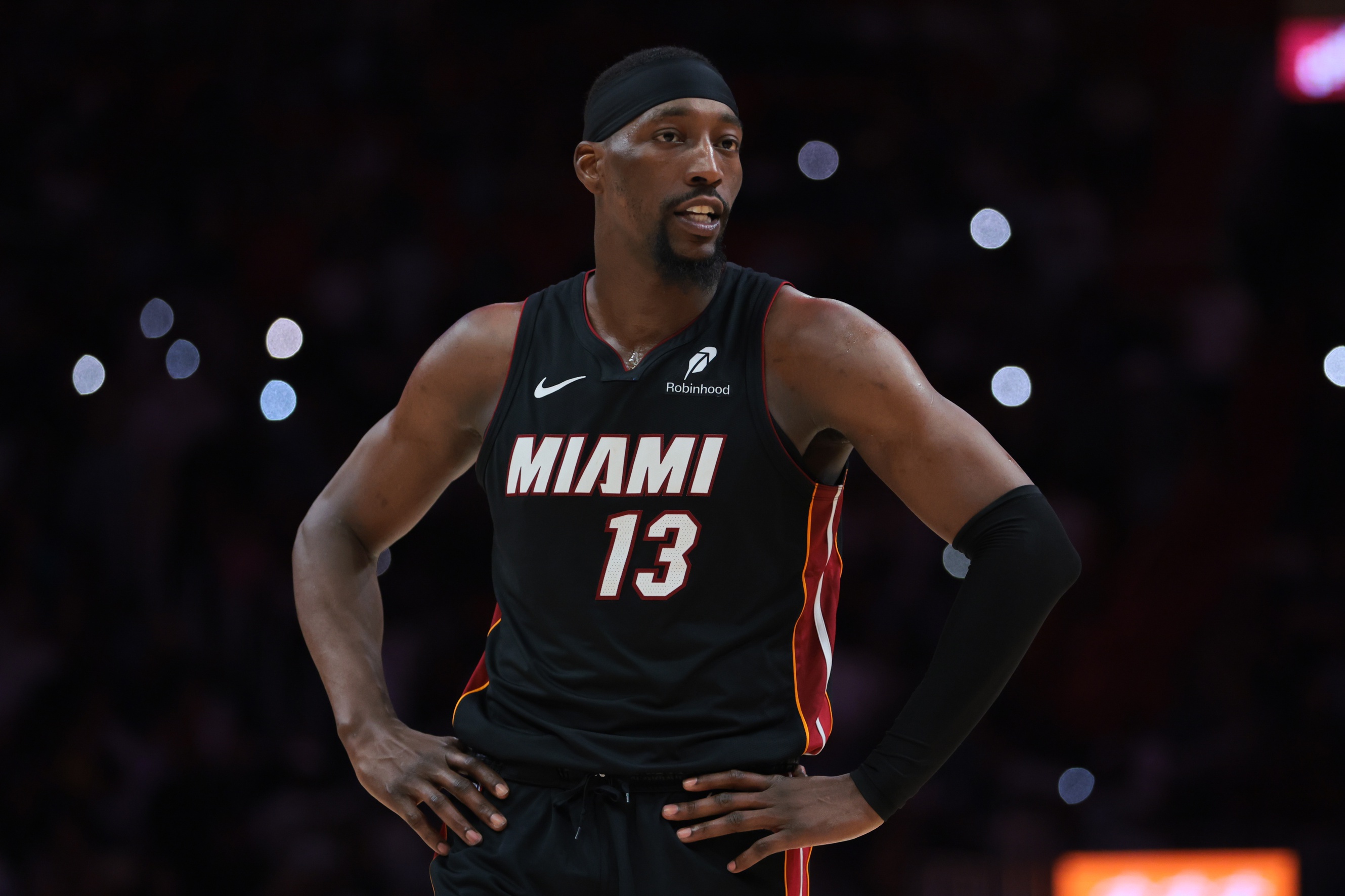 © USA Today Sports
Offseason Approach
Resetting the roster in the post-Butler era
Actual Cap Space
-$65.6 million
Practical Cap Space
-$56.0 million
Projected Luxury Tax Space
$5.7 million
Under Contract (11)
Bam Adebayo
Kyle Anderson
Tyler Herro
Haywood Highsmith
Jaime Jaquez Jr.
Nikola Jovic
Pelle Larsson ($978K guaranteed)
Kevin Love
Terry Rozier ($24.9M guaranteed)
Kel’el Ware
Andrew Wiggins
Potential Free Agents (7)
Alec Burks (unrestricted)
Josh Christopher (unrestricted – two-way)
Keshad Johnson (restricted – team option)
Davion Mitchell (restricted)
Duncan Robinson (unrestricted – player option)
Dru Smith (restricted – two-way)
Isaiah Stevens (restricted – two-way)
Dead Cap (0)
None
Projected Signing Exceptions
Non-Taxpayer MLE ($14.1 million)
Bi-Annual Exception ($5.1 million)
Notable Trade Exceptions
Jimmy Butler ($16.1 million)
Josh Richardson ($3.1 million)
First Round Draft Picks
#20
Notable Extension Candidates
Tyler Herro (veteran extension)
Nikola Jovic (rookie scale extension)
Duncan Robinson (veteran extension)
Terry Rozier (veteran extension)
Andrew Wiggins (veteran extension – as of October 1)
Analysis
The Miami Heat spent most of last season dealing with drama around the Jimmy Butler situation. Butler wanted to get traded, but played for a while. Then he became a distraction and the team suspended him. Then he came back for a bit, but got suspended again. Then Butler was finally traded.
All of swirl around Butler seemed to pull the Heat down as a team. Miami finished with a losing record for the first time since 2019. They did win two road games in the Play-In Tournament, but were blown out in a non-competitive sweep by the Cleveland Cavaliers in the first round.
Now, the Heat have to pick up the pieces in a way this franchise hasn’t had to for several years.
The cap sheet is carrying a couple of bloated deals, but it’s not as bad as it looks at first glance. Only Bam Adebayo has more than two guaranteed years remaining on his deal. Beyond that, only Tyler Herro is carrying a guaranteed contract larger than $10 million. Even if we assume Andrew Wiggins will pick up his $30.2 million player option for 2026-27, the Miami cap sheet isn’t in bad shape long-term.
Why are we looking out beyond this offseason for the Heat? Because the immediate future is a lot messier.
Duncan Robinson is very likely to pick up his $19.8 million player option for next season. His deal will then become guaranteed for $9.8 million for next season. That’s a decent amount of savings, but not really a game-changing amount for Miami to seriously consider waiving Robinson. The good news? Robinson’s deal doesn’t become fully guaranteed until July 8. That means that the Heat will have a great idea of where they are at with Robinson and the best path with his deal before it hits the guarantee date.
Unfortunately for Miami, no such flexibility exists with Terry Rozier’s contract. Rozier’s deal doesn’t become fully guaranteed until the league-wide guarantee date of January 10. That would be great, except that waiving Rozier would net the Heat a grand total of $1.7 million in savings.
Why are the guarantees for Robinson and Rozier so important? Their deals are primary salary-matching components of hypothetical trades to improve the roster. Even if we consider both contracts to essentially be fully guaranteed, they are then a combined $46.5 million in expiring salary. That’s huge in potential trades.
Miami has enough wiggle room under the second apron to be aggressive in trades. That’s in part because the team doesn’t have any big-money free agents due for new contracts. Because the Heat are who they are, expect them to be linked to any potential superstars that hit the market this summer.
As covered above, Miami is in good shape with tradable salary (and they can add even more with Herro and Wiggins as potential trade pieces). The Heat are also in good shape with tradable draft picks. They owe one more lottery-protected pick to the Charlotte Hornets in 2027 (flipping to unprotected in 2028), but that’s not a lot in terms of outgoing picks.
In free agency, the only major Heat free agent is Davion Mitchell. He was an excellent fit for Miami after being acquired at the trade deadline. Expect the Heat to re-sign Mitchell. A deal in the range of $12 million AAV makes sense for Mitchell. He won’t be a real target for MLE teams, nor are the Nets likely to tie up their cap space in an offer sheet. That should allow the Heat to re-sign Mitchell on a relatively team-friendly contract.
Of the team’s other free agents, Alec Burks is probably getting pushed out by a younger player. If he returns, it’ll be on another veteran minimum deal. Keshad Johnson is an interesting developmental prospect, especially given the Heat’s history with similar players. Look for Miami to pick up their team option for Johnson, because that will help keep costs down. The Heat can also make him a restricted free agent in 2026.
Dru Smith and Isaiah Stevens are good bets to be back on two-way contracts again. Josh Christopher is out of two-way eligibility, so he’ll probably move on. Don’t be surprised if Christopher lands a decently-sized deal to head overseas.
Miami will fully guarantee the contract for Pelle Larsson, as his deal is already half-guaranteed. Larsson is also well worth a deal that won’t yet reach the full veteran minimum amount.
That leaves extensions as the next chunk of contract work. We can remove Robinson and Rozier from extension consideration. Both are more likely to be traded than they are to extend. Wiggins is probably in the same boat, given how large his contract already is vs the production he provides. The Heat will let that one ride.
That leaves Herro for a veteran extension and Nikola Jovic for a rookie scale extension. We’ll tackle Jovic first.
Jovic has all kinds of potential. He’s shown major improvement the last two seasons, but Jovic has had to play around various injuries. That leaves his value fairly hard to project. If Miami could get him on a team-friendly extension (something around $40 million over four years), they’d probably do it in a flash. For Jovic, that would be tempting money to lock in for. He could also bet on himself and play things out to restricted free agency in 2026. If Miami has to go up to an MLE-equivalent deal, that’s as far as they should go to re-sign Jovic now.
Herro probably isn’t getting extend. First, he’s got two years left on his deal, with no options. That means that there is time for Miami to decide which direction they want to go with the veteran guard. Herro was a first-time All-Star last year, as he put together his best all-around season. He showed he can up his scoring, while maintaining his efficiency as the Heat’s primary offense initiator.
On the other end of the floor, Herro is a problem. In the last two playoffs, opponents have targeted Herro relentlessly. That’s something Miami has to plan around, given how important the All-Star is to the team’s offense.
A year from now is when extension talks will ramp up more heavily. That could also benefit Herro in a big way. If Herro could play himself onto an All-NBA team (probably won’t happen, but not a crazy idea), he would be eligible for a so-called super max extension. For the Heat, taking an extra year works in their favor. They’ll get to see how Herro holds up for another full season as the primary guy on offense. For Herro, he can potentially play himself into even more money, while knowing he’s established a pretty solid floor for future earnings already.
The Miami Heat have hit a crossroads. They can talk around it all they want, but the mythical Heat Culture took a hit throughout the Jimmy Butler saga. That’s something Miami has to work around a bit. In terms of far more practical matters, the Heat cap sheet is starting to clean up.
They could reasonably hit the summer of 2026 with $30 or $40 million in cap space, with the potential for even more. Obviously, if the Heat swing a star trade this offseason, that changes everything. Either way, they’re set up with pretty good flexibility no matter which direction they go.
That means this might be another down year. Given Miami owns their own first-round pick free and clear in the 2026 draft, it might not be a bad time to have a gap year. Then, the Heat can get back to work with cap space and a good pick in the summer of 2026. And we’ve seen before what Miami can do when they have the ability to be major player in free agency.