Keith SmithOctober 14, 2024
© USA Today Sports

NBA teams are fully in preseason mode, with the regular season about a week away.

NBA preseason doesn’t come with the excitement of NFL camp or MLB preseason. Nor does it come with the competition for roster spots. Smaller rosters and more guaranteed money mean that NBA squads are generally set when camp opens.

However, all across the league battles for rotation spots are playing out out. Incumbents are trying to hold off newcomers. Young players are trying to break through. Vets are trying to hang on for one more season. In some cases, there are roster spots up for grabs too.

We’re going to going team by team and look some of the most interesting battles to monitor as we close in on the regular season. We previously covered the Southwest DivisionNorthwest Division and Pacific Division. Now, we head east for the Southeast Division teams!

Atlanta Hawks

Wing Rotation

The Hawks aren’t really rebuilding, but resetting. And Atlanta is attempting to do so on the fly. Nowhere on the roster is more of a work in progress than the wing rotation.

It looks like De’Andre Hunter and Jalen Johnson will start at the two forward spots as interchangeable players. The shooting guard spot is a three-way competition between veteran Bogdan Bogdanovic, first overall pick Zaccharie Risacher and Dyson Daniels.

If those five guys aren’t enough, Vit Krejci is firmly in the mix for regular minutes, as is shooting specialist Garrison Mathews. And Larry Nance Jr. will figure into the four/five rotation, which may push down other players to more minutes at the three.

None of this is bad. The Hawks are in a good spot to have players earn their minutes. Johnson is the best of this bunch, as he’s already shown he’s a long-term part of Atlanta’s future. Bogdanovic is the next most proven. The question for him is if he should be coming off the bench or starting. As a reserve, Bogdanovic is a potential Sixth Man of the Year. It also should help Quin Snyder manage minutes for the veteran a bit more.

Risacher has looked better in the preseason than he did in Summer League, which is exciting. He’s got the potential for rapid improvement and he’s going to play plenty. Daniels gives the Hawks a nice big guard option alongside Trae Young, but his lack of a consistent jumper is still holding him back somewhat.

Snyder is going to have make some tough decisions as long as everyone is healthy. Bet on Johnson, Bogdanovic, Risacher, Hunter and Daniels all playing plenty. The others may have to wait until an injury, or a trade, opens up more minutes.

Charlotte Hornets

Wing/Guard Rotation

All of a sudden, the Hornets have an abundance of quality at the wing/guard positions. The emergence of young players, players returning to good health and acquisitions over the last year has given new head coach Charles Lee some rotation decisions to make.

LaMelo Ball and Brandon Miller are locks to start. They are Charlotte’s building blocks and both look ready to have big seasons. Around them, there are more questions, but instead of a bunch of not-great options, the Hornets have talented players to choose from.

Josh Green came over in a multi-team trade as a salary-dump this summer. Green can play though. If he can hit open shots and defend, Green could be in the mix to start in between Ball and Miller as a 3&D wing.

Off the bench, Cody Martin is hoping for a healthier season than last year. Unfortunately, a wrist and finger injury have him a bit behind as the regular season approaches. If he can get right, Martin will be a rotation player as a wing option.

Of true guards, Vasilije Micic has the inside track to be the backup point guard. The veteran is a stabilizing player for bench units, and a good option should Ball miss more time. Tre Mann got his career on track after last season’s trade to the Hornets. He’s an undersized scoring guard, but those players have long histories as productive bench players.

Rookie first-round Tidjane Salaun looks more ready to contribute right away than expected. He’s going to force his way into some regular wing minutes. Veteran guard Seth Curry is back for some bench shooting, while second-year guard Nick Smith Jr. faces an uphill battle for a rotation spot.

As a rookie head coach, Lee has some talented players to choose from in this group. This is still a rebuilding season for the Hornets, but they’re closer to the “push forward” side of the rebuild, as opposed to the “getting started” portion. This group is a big part of why Charlotte could potential compete for a spot in the Play-In Tournament this season.

Miami Heat

Backup Point Guard

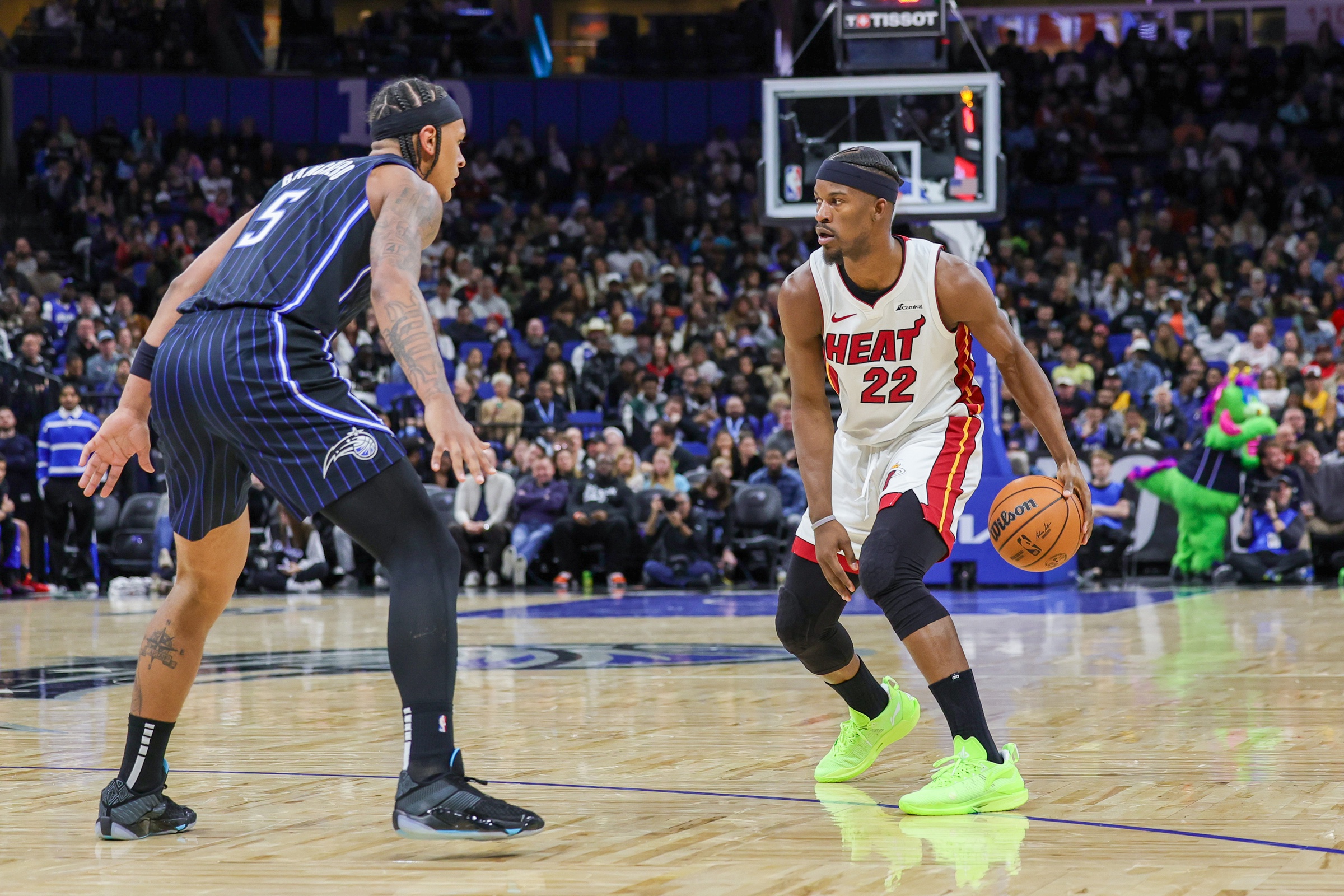
The Heat roster is fairly well settled. Well, so long as everyone is healthy. Jimmy Butler, Bam Adebayo, Tyler Herro, Terry Rozier III and Nikola Jovic seem likely to start. Duncan Robinson, Jaime Jaquez Jr, Haywood Highsmith, Kevin Love and rookie Kel’el Ware will see time off the bench.

That leaves the only uncertain spot as backup point guard. Josh Richardson will probably fill that role when he’s fully healthy. Richardson has been a bit hit or miss as the primary floor leader, but the Heat have enough other playmakers that it should be fine.

Veteran Alec Burks will probably figure into the mix, as well. Burks isn’t a traditional point guard, but he’s a solid enough ball-mover that he can fill the role. Again, like with Richardson, Miami should have other playmakers out there to ease that burden.

If the veterans aren’t working out, keep an eye on rookie Pelle Larsson. He’s got a knack for passing and he’s a pretty solid spot-up shooter too. Don’t be surprised if he breaks through late in the year.

Orlando Magic

Two-Way Spots

For a young team, the Magic have a lot of roster continuity. The only major rotation change is Kentavious Caldwell-Pope took the place of Markelle Fultz. That leaves Jamahl Mosley with a bit of a crowded guard group, but that will work itself out throughout the season.

With terrific frontcourt depth, and solid wing depth, there isn’t a whole lot up in the air for Orlando’s rotation right now. Where the intrigue comes in for the Magic is with their two-way spots.

Trevelin Queen has one spot locked in. The other two have been subject to a camp-long competition. Mac McClung could snag one, as he’s been wildly productive on the G League level. Jalen Slawson could grab the third spot, as he’s a wing with a little bit of size. Ethan Thompson and Robert Baker II are also in the mix, as Thompson is a big guard and Baker is a combo forward.

Despite not having competition for spots on the standard roster, Orlando has had a competitive camp with this two-way battle. That’s solid work by the Magic front office to manufacture some spirited play down the roster.

Washington Wizards

Play the Kids or Play the Vets?

The Wizards are still in “deconstruction phase” per general manager Will Dawkins. That means there’s still a lot of roster-tinkering to come in Washington.

Despite that, the Wizards aren’t going full youth movement yet. Kyle Kuzma and Jordan Poole are still around. And in the last year, the team added Malcolm Brogdon, Jonas Valanciunas and Marvin Bagley III. That’s a fairly solid veteran group to eat up a lot of regular season minutes.

Behind that group, there are a bunch of kids who are going to push for minutes. Bilal Coulibaly is hitting Year 2 looking like a starter. Corey Kispert is starting Year 4 as a regular rotation player. The 2024 NBA Draft brought Alex Sarr, Bub Carrington and Kyshawn George into the mix.

Brian Keefe is now the full-time head coach, after having the interim tag removed this summer. He’s not going to be challenged with winning games, at least not yet. But Keefe is going to have to find the balance of keeping the team competitive by playing the veterans, while developing the kids who are the Wizards future. At some point, the latter will become priority. The question is: How quickly will that happen?


Scott AllenOctober 14, 2024
© USA Today Sports

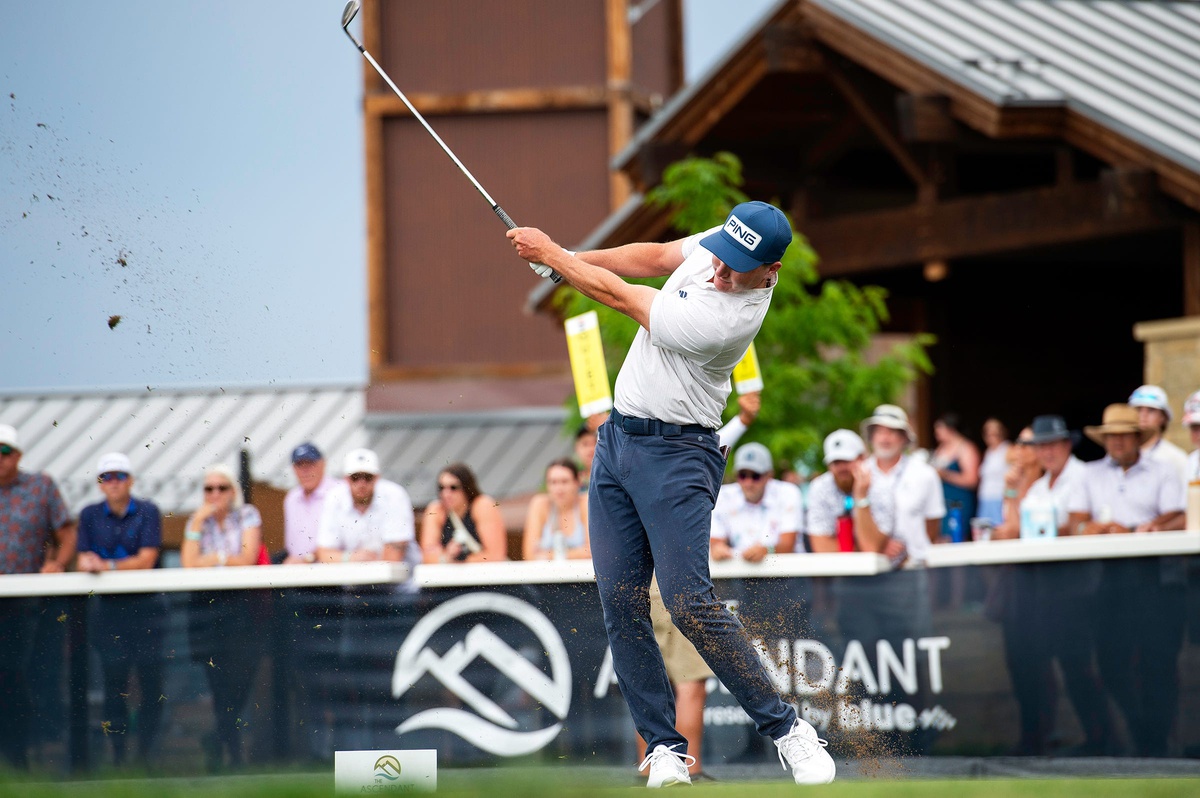
Matt McCarty wins the Black Desert Championship. McCarty earns $1.35 million bringing his 2024 on-course earnings to $1.37 million and his career on-course earnings to $1.37 million. 

Black Desert Championship Top 10 Payouts

Full Results

2024 Earnings Leaders Update

Full List

Taylor VincentOctober 10, 2024
© USA Today Sports

Back in April Spotrac highlighted both unrestricted and restricted free agents who were candidates for extensions and re-signing with their current clubs through the regular season. Here’s where things have settled with just three matches left in the regular season. 

Of the nine unrestricted free agents, there was one retirement (Alex Morgan), four extensions (Janine Beckie, Abby Dahlkemper, Denise O’Sullivan, Morgan Weaver), two were re-signed following the opening of free agency in September (Debinha, Alyssa Naeher), and two are currently 2025 free agents (Marta, Christen Press).

For the six restricted free agents, due to the new CBA that was agreed upon, restricted free agency is no longer a thing and they are all considered unrestricted free agents. Ahead of the 2025 Free Agency opening, two re-signed with their current clubs (Alana Cook and Jordyn Huitema), one re-signed following the Free Agency opening (Michelle Alozie), and three remain free agents (Elyse Bennett, Kerolin, Delanie Sheehan).

9 Unrestricted Free Agents to Watch

1. Janine Beckie (Portland Thorns → Racing Louisville)

Original Contract: Through 2024
Current Status: Through 2026

August 21st, Beckie was traded from Portland to Louisville, and upon signing immediately signed a two year extension keeping her in Louisville through 2026. 

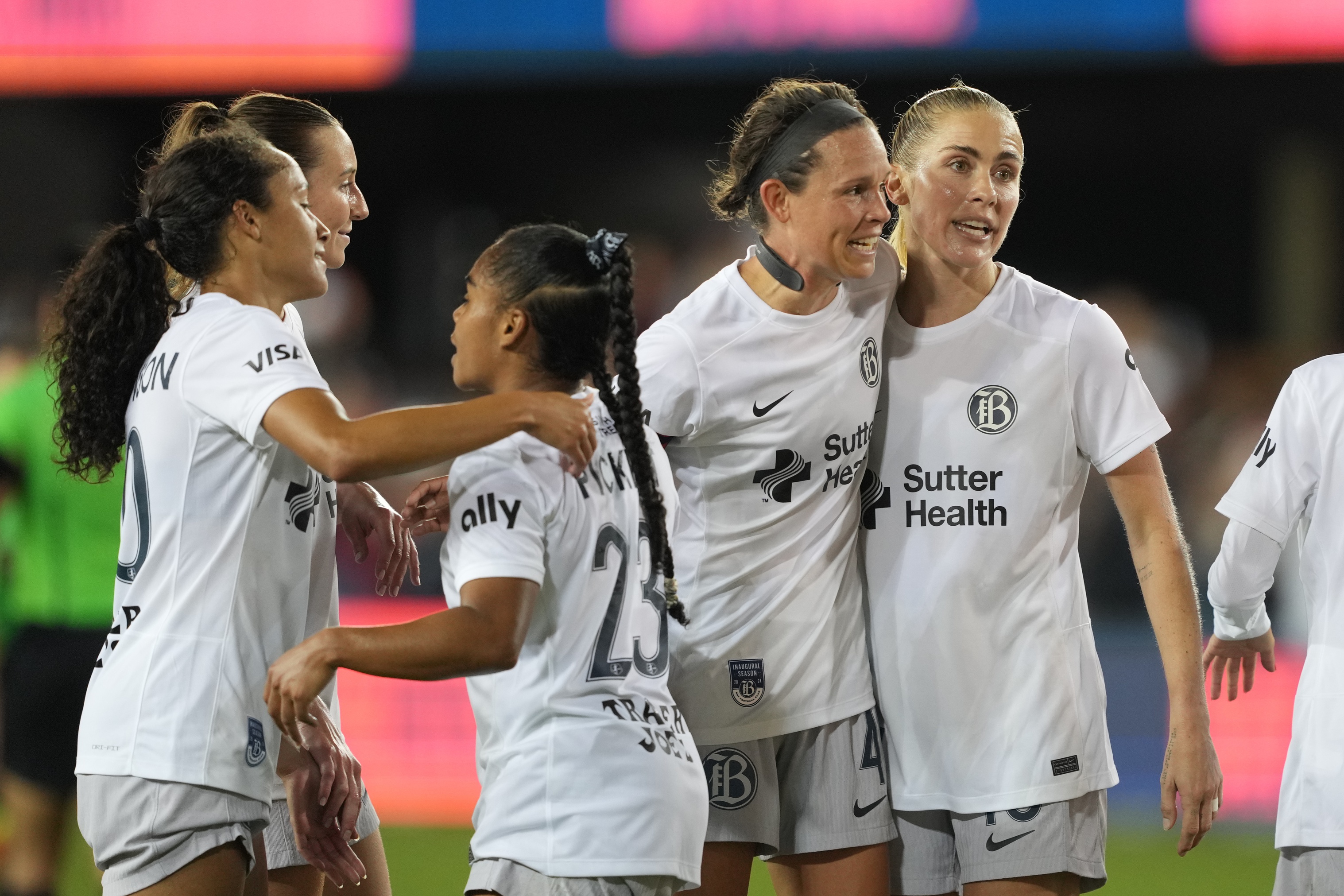
2. Abby Dahlkemper (San Diego Wave → Bay FC)

Original Contract: Through 2024
Current Status: Through 2026 with a 2027 Mutual Option

August 26th, Dahlkemper was traded from San Diego to Bay FC, and upon signing immediately signed a two year extension with a third year option to keep her in the Bay. 

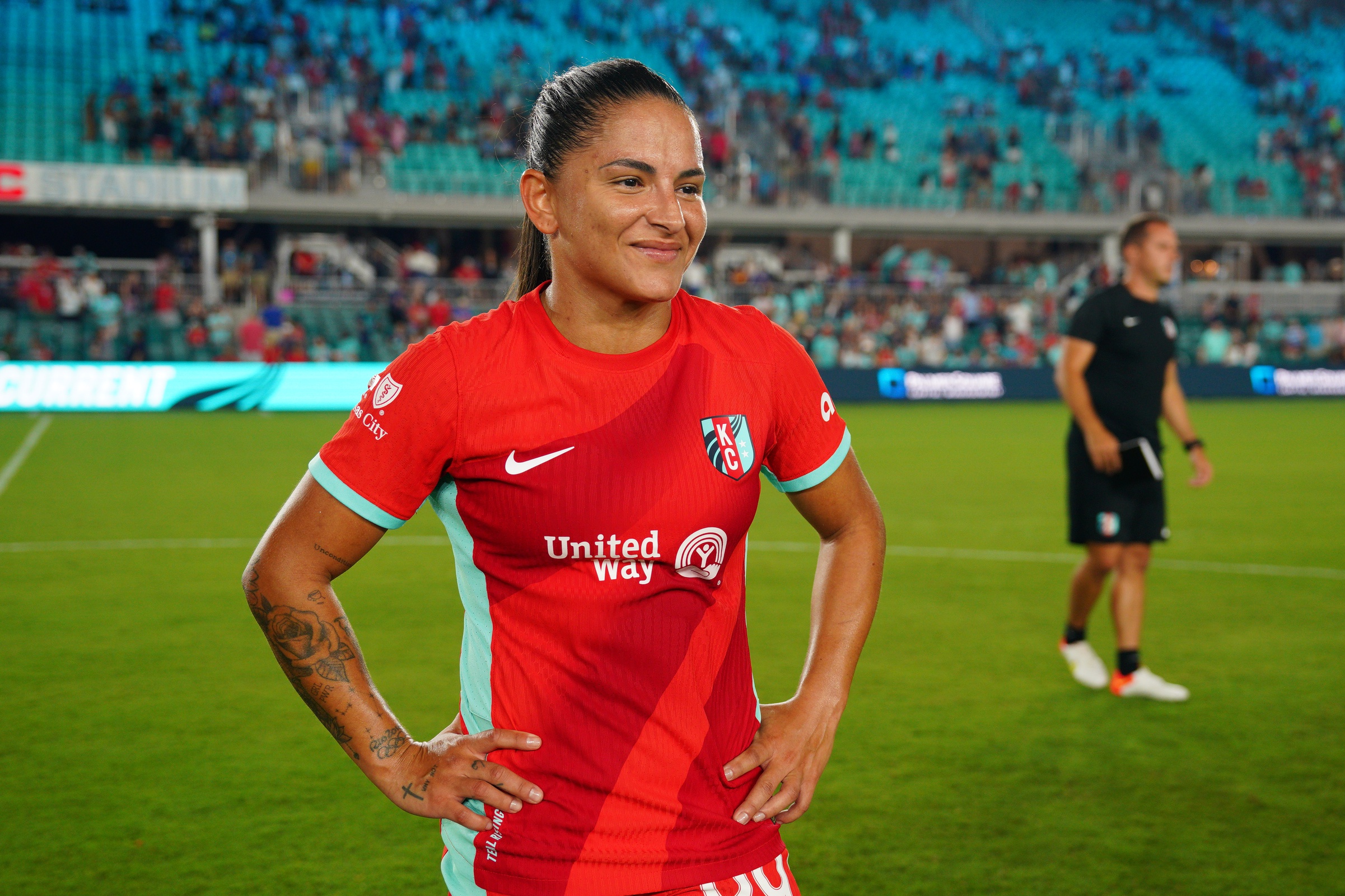
3. Debinha (Kansas City Current)

Original Contract: Through 2024 with a 2025 Mutual Option
Current Status: Though 2026 with a 2027 Mutual Option

Following the opening of 2025 Free Agency on September 1st, on September 6th Debinha agreed to a new contract through the 2026 season with a mutual option for 2027. 

4. Marta (Orlando Pride)

Original Contract: Through 2024
Current Status: 2025 Free Agent

Marta has continued her illustrious career through 2024 with an impressive eight goals and one assist thus far in the regular season, on top of earning a place in the NWSL’s Best XI for the month of September, and last weekend clinching the NWSL Shield for Orlando with her well placed penalty kick. 

5. Alex Morgan (San Diego Wave)

Original Contract: Through 2024 with a 2025 Club Option
Current Status: Retired + Maternity Leave

September 5th, Alex Morgan announced her retirement from professional soccer, that her final professional match would be September 8th, and that she was pregnant with her second child. 

6. Alyssa Naeher (Chicago Red Stars)

Original Contract: Through 2024
Current Status: Through 2025

Following the opening of 2025 Free Agency on September 1st, on September 25th Naeher signed a one year contract with the Red Stars through 2025. 

7. Denise O’Sullivan (North Carolina Courage)

Original Contract: Through 2024
Current Status: Through 2026

July 29th, O’Sullivan agreed to terms on a two-year contract extraction through the 2026 season. 

8. Christen Press (Angel City FC)

Original Contract: Through 2024
Current Status: 2025 Free Agent

July 31st, 781 days after tearing her ACL in June 2022, Press was removed from the SEI list and returned to the active roster. She made her playing debut in the Summer Cup, coming in as a substitute late in a match and then nailing her penalty kick after the final whistle. She’s played in six matches for Angel City, tallying up 84 minutes but still looking for her first goal in the run-of-play. 

9. Morgan Weaver (Portland Thorns)

Original Contract: Through 2024 with a 2025 Club Option
Current Status: Through 2028

September 12th, Weaver agreed to a five-year extension keeping the forward in the Rose City through the 2028 season 

6 Restricted Free Agents to Watch

1. Michelle Alozie (Houston Dash)

Original Contract: Through 2024
Current Status: Through 2026

September 9th, Alozie agreed to a new two-year contract that will commence on January 1st, 2025, keeping the forward in Houston through the 2026 season. 

2. Elyse Bennett (San Diego Wave)

Original Contract: Through 2024 with a 2025 Club Option
Current Status: 2025 Free Agent

San Diego has struggled with their identity throughout this season, now on their third coach of the season. Bennett has played in 13 matches for the Wave, earning one assist, and her 2025 option was not exercised prior to 2025 Free Agency opening up. 

3. Alana Cook (Seattle Reign → Kansas City Current)

Original Contract: Through 2024
Current Status: Through 2027

July 22nd, Cook was traded to Kansas City from Seattle, on August 29th she agreed to a three-year contract with the Current to keep her in Kansas City through 2027

4. Jordyn Huitema (Seattle Reign)

Original Contract: Through 2024
Current Status: Through 2026 with a 2027 Mutual Option

September 5th, Huitema signed a two-year extension to keep her in Seattle through 2026 with the mutual option for 2027. 

5. Kerolin (North Carolina Courage)

Original Contract: Through 2024
Current Status: 2025 Free Agent

Although Kerolin played for Brazil in the 2024 Paris Olympics, she didn’t make her post-ACL tear NWSL debut until September 21st. She’s had three games played, spanning 128 minutes, and has scored a goal for the Courage. 

6. Delanie Sheehan (NJNY Gotham)

Original Contract: Through 2024 with a 2025 Club Option
Current Status: 2025 Free Agent

Sheehan has played in all 23 of Gotham’s regular season matches thus far this season, with 1870 minutes, two goals, and a 78% passing accuracy. Recently, Gotham-expert Jenna Tonelli wrote an article titled, “Why Delanie Sheehan might just be Gotham FC’s Most Valuable Player” talking about how the midfielder is the driving force behind Gotham’s success last year and continued success this year

Keith SmithOctober 09, 2024
© USA Today Sports

NBA teams are fully in preseason mode, with the regular season less than two weeks away.

NBA preseason doesn’t come with the excitement of NFL camp or MLB preseason. Nor does it come with the competition for roster spots. Smaller rosters and more guaranteed money mean that NBA squads are generally set when camp opens.

However, all across the league battles for rotation spots are playing out out. Incumbents are trying to hold off newcomers. Young players are trying to break through. Vets are trying to hang on for one more season. In some cases, there are roster spots up for grabs too.

We’re going to going team by team and look some of the most interesting battles to monitor as we close in on the regular season. We previously covered the Southwest Division and Northwest Division. Next up are the Pacific Division teams!

Golden State Warriors

Frontcourt Rotation

Draymond Green, Jonathan Kuminga and Andrew Wiggins seem pretty set to start in the Golden State frontcourt. Behind them, things are a bit more unsettled. Also, should that trio be the starting group?

Trayce Jackson-Davis’ strong rookie season should have him in line for regular minutes at the five. Kevon Looney is still around as a physical, veteran presence, but his play slipped greatly last season. Kyle Anderson was signed as a do-it-all bench forward. He’ll play a big role with his ballhandling and passing in the Warriors motion system.

That’s about it for frontcourt options for Steve Kerr. Quentin Post is an interesting player on a two-way contract. He’s got the most size on the roster. But Post probably isn’t contributing a whole lot this season.

As for who should start, in order to put their best five on the floor, the Warriors probably need to run with a Green, Kuminga, Wiggins frontcourt. Green can certainly play the five, but asking him to do it all the time is a lot. Kuminga himself said his best position is small forward. Wiggins has been up and down production-wise and in and out availability-wise over the last couple of seasons. At least one of the backups is going to be needed for big minutes this season. Kerr getting this spot right may be the difference between a playoff spot and another trip to the Play-In Tournament.

LA Clippers

Forward Rotation

The Clippers couldn’t replace Paul George straight up, so they took the Moneyball approach of trying to replace George in the aggregate. Nic Batum came back, while Derrick Jones Jr. were signed for the frontcourt. Kris Dunn and Kevin Porter were brought in for the backcourt.

George’s role was pretty dynamic for LA. He’d play anywhere from the two to the four, depending on lineup constructions and who else was available that night. With a bunch of guard options, it’s the forward minutes where the Clippers need to replace George’s production most.

Jones or Batum will start next to Kawhi Leonard (and possibly both will start if Leonard is out to open the season). The other one will anchor the bench forward group. Behind them, Terance Mann and Amir Coffey can both play the three. Depth at the four remains an issue, so Ty Lue will continue to mix and match with small-ball options around Jones and Batum.

Keep an eye on Kobe Brown. The second-year forward looks better prepared for the NBA season this year. If Brown could break through, he’d give Lue another option, and a player with a bit more size than the team’s other forward options.

Los Angeles Lakers

Center Rotation

The Lakers have Anthony Davis as their starting center. That’s pretty great!

Behind Davis, Jaxson Hayes was pretty solid last season. He didn’t play a lot, but Hayes finished well around the rim, got on the glass and blocked shots at a decent clip. Hayes is a solid enough backup five.

Beyond those two, the Lakers have…a lot of questions.

Los Angeles was likely looking for bounce-back seasons from Jarred Vanderbilt and Christian Wood for additional big man depth. However, both Vanderbilt and Wood are starting out the season recovering from surgeries. It’s unknown when either will be able to contribute.

That leaves the Lakers looking at two-way centers Colin Castleton and, hopefully, Christian Koloko for minutes behind Davis and Hayes. Castleton did a nice job in the G League last season. He may be ready for an NBA shot, especially on the offensive end of the floor. Koloko had a promising rookie year with the Toronto Raptors, but he missed all of last season while dealing with blood clots. If fully cleared, Koloko could provide some rebounding and rim protection.

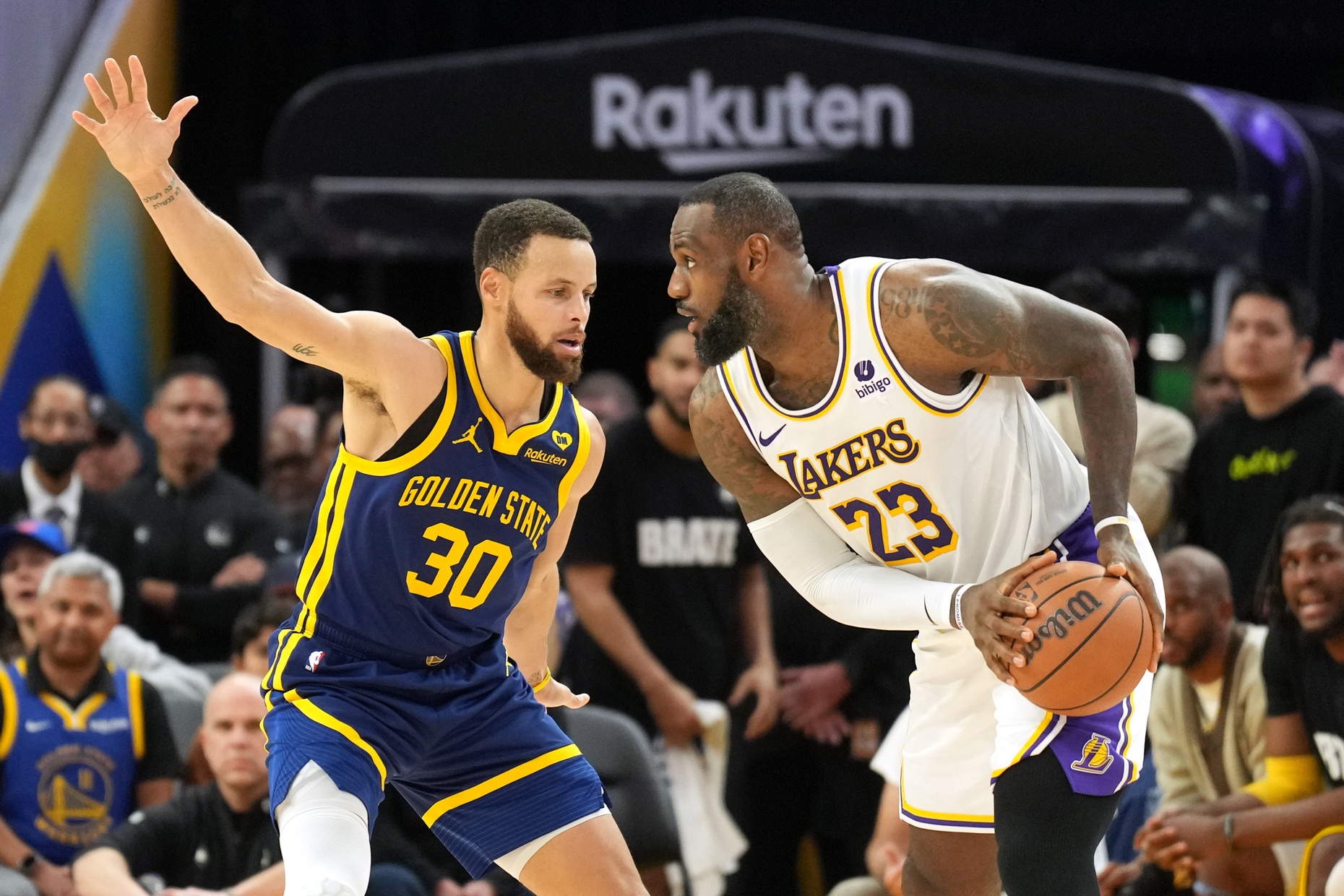
Without a trade, Los Angeles is going to have to piece together some minutes if Davis and Hayes can’t cover the full 48 at center. The Lakers don’t have great small-ball options, but may need to lean on LeBron James and Rui Hachimura in small lineups for at least a handful of minutes per night. And, of course, there’s always the chance this gets solved via a trade at some point this season.

Phoenix Suns

Perimeter Rotation

Phoenix has a lot of talent, just like last season. The good news is that the roster seems a bit more balanced this year, as they brought in Tyus Jones and Monte Morris to handle the point guard minutes. However, with real floor generals in place, the Suns have to slide the guys who previously masqueraded as point guards to other positions.

Devin Booker and Bradley Beal will start at two perimeter spots. That pushes Grayson Allen to the bench, where he’ll probably be a Sixth Man of the Year contender. Josh Okogie and Damion Lee are around for depth behind that main group at the guard spots.

For the bigger wings, Kevin Durant will play a lot as the four. Royce O’Neale will be first up for backup forward minutes. Rookie Ryan Dunn has looked increasingly ready for rotation minutes. If Dunn can make shots, his defense could be his ticket to playing time.

None of this is really an issue, except for Mike Budenholzer. He may not have enough rotation minutes to go around every night for all his veteran options. But that’s something that should work itself out eventually. The fun part is going to be watching how that happens.

Sacramento Kings

Bench Forwards

The Kings added DeMar DeRozan in place of Harrison Barnes this offseason. DeRozan will start alongside holdover Keegan Murray. That’s a nice duo at the forward spot.

Behind them, things are a lot more in flux. It seems like Kevin Huerter will see more of his minutes as a backup forward, as Malik Monk and Keon Ellis have the off-guard minutes locked up Sacramento. That should cover the small forward spot fairly well.

Alongside Huerter, the Kings are hoping that Jalen McDaniels can give them some minutes as a combo forward. After a promising start to his career, McDaniels struggled with the Toronto Raptors last season. If he can make shots, play defense and provide a little rebounding, McDaniels will get some minutes, especially as the backup four.

Trey Lyles will fill some backup power forward minutes, as well as seeing some time as Domantas Sabonis’ backup at the five. Lyles’ ability to space the floor is probably a bigger advantage at the five. That makes getting someone like McDaniels to fill minutes at the four a key coming into the season. Lyles is also recovering from an injury to open the year. That may make the power forward spot something that Mike Brown may have to piece together for a while.

For longer shots, keep an eye on two-way players Isaiah Crawford and Isaac Jones. Crawford doesn’t have great size, but he played up a lot at Louisiana Tech. He’s a rugged rebounder and athletic shot-blocker. Jones is a terrific athlete. He’s probably more of a five than a four right now, but Jones could eventually see the floor as a four. He’ll need to add some range and improve his perimeter defense, but there’s potential there.

Michael GinnittiOctober 07, 2024
© USA Today Sports

Brock Purdy (QB, 49ers)

I’ll eat it. I’ve prefaced the Brock Purdy era in SF as the first real potential “never-extend him” candidate. The 49ers have proven to be the ultimate plug-and-play offense for the past decade or so (to the extent that Jimmy Garoppolo was able to headline a near Super Bowl contending team).

But injuries, and a bit more parity in the league have brought the Niners back down to earth - with the exception of Purdy. These first 5 weeks have shown that Mr. Irrelevant is perfectly capable of putting a team on his back, and take on much more responsibility than he’s ever been asked to in recent years.

As of today, Purdy projects to a 4 year, $222M extension in our system, placing him as the 2nd highest average paid player in the league (Prescott, $60M), but 14th in terms of AAV percent of cap.

Drake London (WR, Falcons)

Now on his 3rd QB in 3 years, London has been able to maintain an above average level of production to start his NFL career - and could be poised for a full breakout by the end of 2024. He’ll become extension-eligible for the first time next spring, and should find himself in the conversation with Ja’Marr Chase, Tee Higgins, and a few others who will be seeking big pay days.

The (barely) 23-year-old projects toward a 4 year, $90M extension in our system to date, but should see this rise mightily with continued production in 2024.

Trey Smith (G, Chiefs)

The Chiefs selected Smith in the 6th round back in 2021, but he’s quickly established himself as one of the best guards in football. With left guard Joe Thuney scheduled to enter a contract year in 2025, KC may be looking to shift Smith over to Mahomes’ blindside - furthering his value within the organization.

For now, the 25-year-old carries a healthy 4 year, $72 million valuation in our system, placing him within the Top 7 of average paid guards in football.

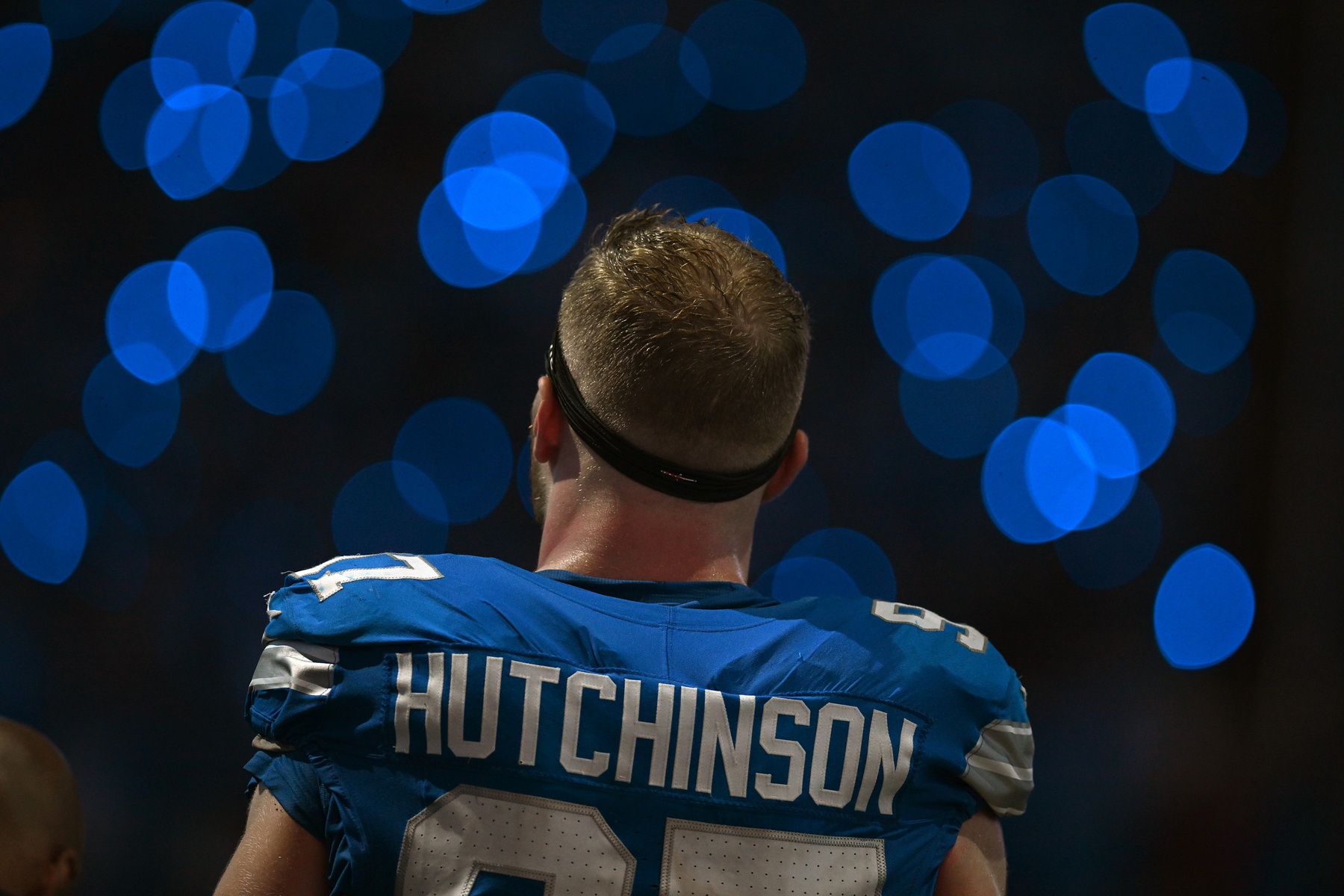
Aidan Hutchinson (DE, Lions)

The numbers are ridiculous. In 38 career games, Hutchinson has accounted for 119 tackles, 29 sacks, 4 forced fumbles, and 4 interceptions. He’s been as-advertised and then some, and he becomes extension-eligible for the first time next spring.

Mathematically speaking, he’s already a near $32M player in our system (4 years, $127M), but if the numbers continue on this pace through the end of 2024, Nick Bosa’s $34M, and Justin Jefferson’s $35M (highest average paid non-QB), are both very much in eyesight.

Christian Benford (CB, Bills)

One of the best kept defensive secrets in football, Benford is in the midst of putting together two of the better back-to-back seasons among active cornerbacks. The former 6th round pick is playing out his third season in Buffalo, making him extension-eligible for the first time after 2024.

Mathematically speaking, Benford (4 years, $98M projection) now joins Trent McDuffie, Derek Stingley Jr, & Sauce Gardner as cornerbacks who could reset this market in the coming months. Though it should be said: 6th round picks rarely swim with the big fish when it comes to rookie contract extensions. Don’t be surprised if Benford’s deal pales in comparison to these 1st rounders when it’s all said and done.

Scott AllenOctober 07, 2024
© USA Today Sports

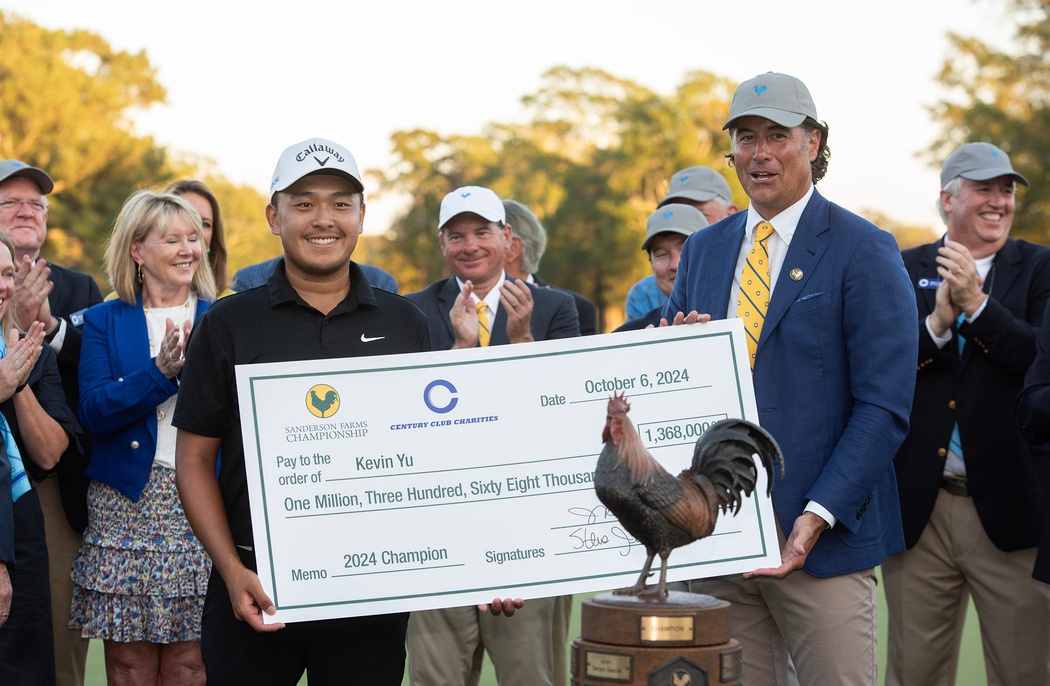
Kevin Yu wins the Procore Championship. Yu earns $1.37 million bringing his 2024 on-course earnings to $2.98 million and his career on-course earnings to $4.26 million. 

Sanderson Farms Championship Top 10 Payouts

Full Results

2024 Earnings Leaders Update

Full List

Michael GinnittiOctober 03, 2024
© USA Today Sports

With the November 5th NFL trade deadline just a month away, the hot stoves are already burning strong with potential candidates. We’ll dive into five players being discussed early on, including their contract statuses now and in the future.

WR Davante Adams (31, Raiders)

2024: $13.5M remaining ($968,333 less per week, $8.6M at the deadline)
2025: $36.25M (non-guaranteed)
2026: $36.25M (non-guaranteed)

The Raiders appear poised to grant Adams’ trade request this month, but they may need to retain some of this remaining salary to secure the type of draft compensation (2nd Rd pick) they are reportedly asking for. A few notable teams (Washington, Dallas, & the Jets) could slide Adams’ salary into their current books without disruption. The WR-needy Chiefs would need to process a salary conversion or two to make things work. While Buffalo, another team with interest, doesn’t have a path to free up even half of what Adams is owed for the rest of 2024.

LB Haason Reddick (30, Jets)

2024: $11M ($791,666 less per week, $7.1M at the deadline)
2025: UFA

Reddick has yet to report to the Jets, forfeiting/owing over $9M of salary & fines per his holdout. The pending free agent with 27 sacks over the past 2 seasons is seeking a multi-year extension from NY. The Jets have already given up a 3rd round pick in 2026 for this debacle (would convey to a 2nd with 67.5% snaps + 10 sacks this year), so any kind of trade would likely need to offset this as much as possible. There’s a world where the Jets pay this salary down a bit (since they’ve paid him nothing to date) in order to secure a healthy draft pick from a team like Arizona or Seattle, who are better positioned to hand Reddick the contract extension he’s looking for.

Of note: Reddick must report to the Jets (or his new team) by the Tuesday following the tenth week of the regular season, at 4:00 pm New York time, or he will be ineligible to play football in 2024, and his salary will toll to 2025. The Jets will retain his contractual rights into the offseason, further complicating Reddick’s future.

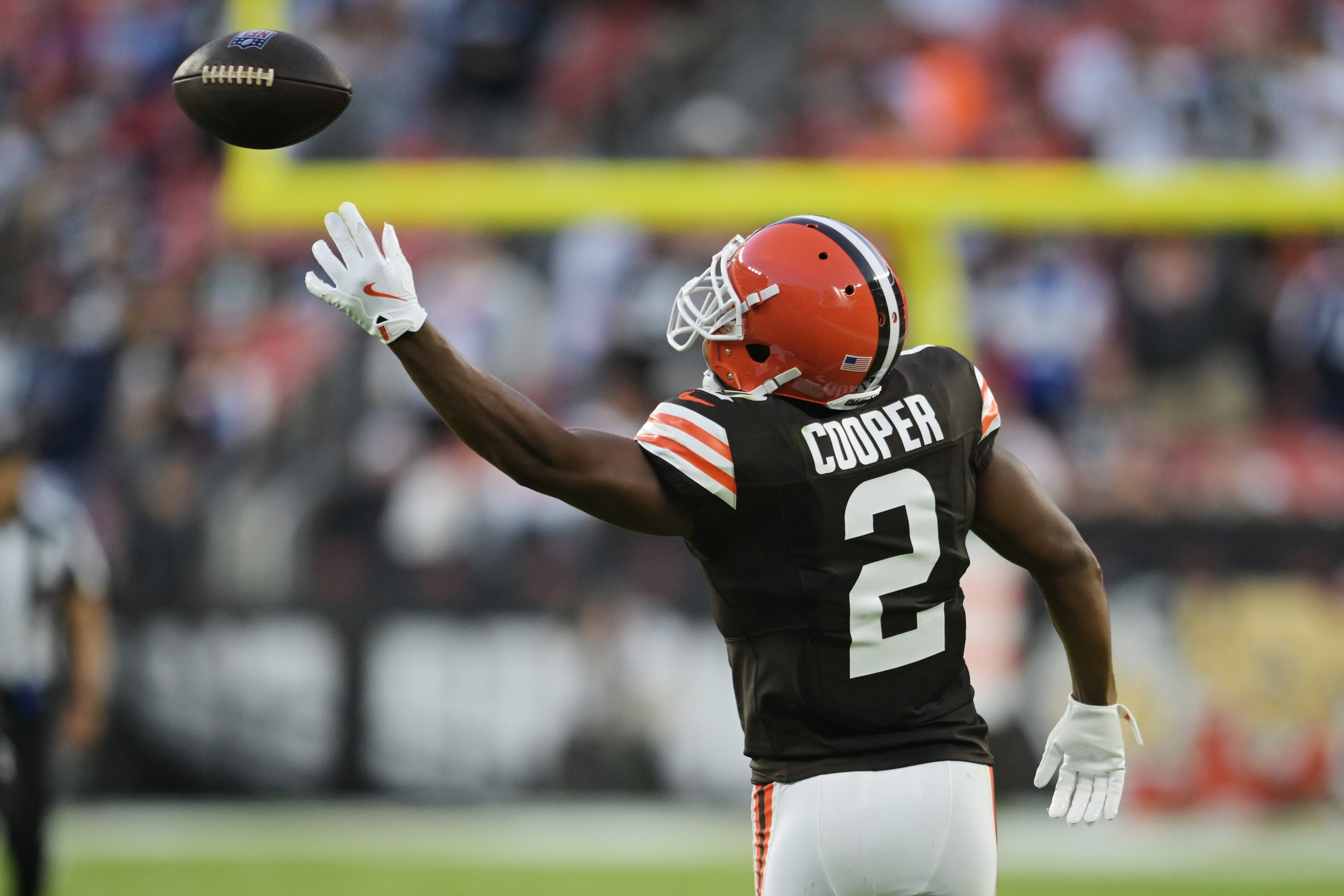
WR Amari Cooper (30, Browns)

2024: $941,111 ($67,222 less per week, $604,998 at the deadline)
2025: UFA

Cooper and the Browns have been rumored toward a split for the better part of 2024, which made an $18.79M salary conversion at the end of August somewhat puzzling. Yes, it makes for a hell of a clean trade offer, but it also means $19M paid to a player that you only kept for a few weeks this season.  

S Budda Baker (28, Cardinals)

2024: $11M ($788,888 less per week, $7.1M at the deadline)
2025: UFA

Baker has been included in trade rumors for the better part of 2 seasons, but he’ll finish out his 5 year, $62.6M contract in totality (a rarity in the NFL for contracts of or around this size). He remains a Top 20 safety in all of football according to PFF, so there will be plenty of interest from a football standpoint. But his deadline salary is on the higher side for most contending teams to swallow. The Cardinals may be inclined to take on salary and buy themselves a draft pick as they continue to rebuild around Kyler Murray.

QB Bryce Young (23, Panthers)

2024: $711,666 ($50,833 les per week, $457,500 at the deadline)
2025: $4.2M (guaranteed)
2026: $5.9M (guaranteed)
2027: Club Option

Young likely won’t be any team’s answer to band-aiding an injury for the rest of 2024, but getting him into a new regime to ensure he has a full offseason (and then some) to get up to speed on his new surroundings does make a lot of sense. Teams like Las Vegas, New York, & Tennessee, to name a few, could have interest in this idea before it’s all said and done.

Taylor VincentOctober 03, 2024
© USA Today Sports

The NWSL currently sits at 14 active teams. Boston has secured its place as the 15th team—expected to begin playing in 2026—and NWSL commissioner Jessica Berman is expected to announce the 16th team soon based on a previous statement that it would be awarded at "the beginning of Q4".

Previous Expansions - A tumultuous past

When the NWSL had its inaugural season in 2013, it comprised of eight teams: Chicago, Portland, Seattle, Washington, Boston, Washington, FC Kansas City, and Western New York Flash.

Houston joined the league in year two, and then Orlando was added in 2016 to even up the numbers to ten. In 2017, the Western New York Flash moved to North Carolina. Before the 2018 season was able to kick off, both FC Kansas City and Boston were no longer operating. Utah joined the league in 2018, absorbing all of the FC Kansas City player contracts, draft picks, and player related rights. The Boston players were then placed in a Dispersal Draft to be picked by the remaining nine teams and said players would not count against the teams’ salary cap. 

In December of 2020—just under two years after joining the league—the Utah Royals were disbanded and sold back to Kansas City, along with the player contracts. Under the agreement, Utah left the door open for the franchise to re-enter the league after 2023 at a lower expansion fee. Also entering the NWSL for the 2021 season was Racing Louisville—entering on a reported $1-2 million expansion fee—getting the league back up to ten teams. 

2022 saw the first dual expansion year, with Angel City and San Diego making their entry into the league for a reported $2 million expansion fee. Just two years later, the league would make another dual expansion, with the Utah Royals making their re-entry into the league on a reported $2-5 million fee, and Bay FC — the San Francisco Bay Area based team — paying a $53 million fee, over 25x what was paid just two years prior. 

In September of 2023, the NWSL announced that Boston had won the bid to be the 15th team in the league come 2026, at the expansion fee of $53 million. 

Where is the league going with expansion?

In late 2022, NWSL commissioner Jessica Berman said, “we are gonna be very intentional about expansion and someone actually asked me the question yesterday about whether we intend to add more teams after these two for 2024. We haven't yet made a decision about that.”

In contrast, last week Berman said in a press conference, “beyond team 16, we’re still determining the pace of how quickly we want to expand. We think that we can be as big as any of the men’s leagues in this country, 30+ teams, how and when we get there are still open questions that we are analyzing.”

Previous years with expansion drafts have caused lots of thrash and chaos for existing teams as the main part of team building for the new teams was the expansion draft—where teams had to protect a subset of the team and the expansion teams would then get to pick players from the unprotected pool of players. With the new CBA, the expansion draft has been eliminated. 

One other thing to note is that the new CBA also has been retooled to potentially align with the traditional European system, running from September to June. This could also have a high impact on expansion as playing soccer in January in places like Boston or Chicago where winter gets to sub-zero temperatures would likely require teams to make additional investments for heated pitches and switches to artificial turf which comes with its own risks for player safety. 

Team 16

In June there was a deadline for groups to submit their preliminary bids to the league for consideration. Some of the groups have confirmed publicly that they submitted a bit, including Cleveland and Minneapolis/St. Paul. Cleveland Soccer Group has since purchased 13.6 acres of land to build a stadium which could hold 12,500 fans with the ability to expand to 20,000 in the future. Unfortunately, Minneapolis/St. Paul, who hosts a very successful community-owned USL W League did announce that they had withdrawn their bid back in August. 

Some of the other rumored groups include bringing a NWSL team to Denver, Atlanta, Cincinnati, Nashville, and Miami. During the last expansion process, Berman did announce the final three finalists ahead of the decision being announced, but it’s up in the air how Team 16’s announcement will come out. The other thing that’s yet to be announced is whether Team 16 will be joining the league under the previous $53 million expansion fee or whether the league will increase it considering the increased valuations being seen via Sportico or the numerous sales which have occurred in the last year. 


RELATED

NWSL Ownership


Michael GinnittiOctober 02, 2024
© USA Today Sports

2024 Playoff Teams

NATIONAL LEAGUE

Los Angeles Dodgers (#5 Payroll)
Obviously this ranking is heavily suppressed by the $68M annual deferral in Shohei Ohtani’s historic contract, but the Dodgers still moved up a spot from their 6th place 2023 ranking with an aggressive offseason across the board, & won the NL pennant despite a rash of injuries to their pitching staff.

Philadelphia Phillies (#4 Payroll)
The Phillies have carried a Top 5 payroll each of the past 4 seasons and now possess 6 contracts of $100M or more, and their entire starting roster is on the books for 2025 as well.

Milwaukee Brewers (#21 Payroll)
The Brewers shed a coach, an ace, and a few notable bats this offseason - and still won the NL Central by 10 games. They’ll have the resources to be aggressive this winter if they choose.

San Diego Padres (#15 Payroll)
Despite a bounty of expensive veteran contracts, the Padres amazing stretch run was sparked by a youth movement in 2024. There’s potential for real staying power with this roster going forward. San Diego has held a Top 5 payroll for the past 3 seasons, but find themselves in the middle of the pack to finish the 2024 campaign.

Atlanta Braves (#6 Payroll)
The Braves regular season might be defined by injuries, but they’ll have a say in the postseason regardless. Atlanta will see a significant portion of their starting rotation and bullpen hit the open market this winter, so look for an aggressive offseason (again).

New York Mets (#1 Payroll)
The league’s top payroll snuck into the backend of the postseason with one of the crazier regular season games in recent memory. The Mets carried $87M of retained salary this season, which is more than the Pirates or A’s allocated to their entire payrolls this year alone. They’ll have plenty of decisions to make with their starting pitching & the Polar Bear this winter.

AMERICAN LEAGUE

New York Yankees (#2 Payroll)
It wasn’t always pretty, but the Yankees were steadily one of the best teams in the American League for most of 2024, and should be considered a prohibitive favorite this month. Juan Soto has been a dream fit in this lineup (and stadium). Will it continue after 2024?

Cleveland Guardians (#23 Payroll)
Projected by many to miss the playoffs altogether, Cleveland found magic in a young starting rotation and held on for dear life down the stretch to capture another AL Central title, and the 2 seed in the AL. Only two players on this team carry a salary north of of $10M in 2024, and one of them (Shane Bieber) was on the shelf for the entire season: Value-based winning at its finest.

Houston Astros (#3 Payroll)
One of the most expensive Astros teams in franchise history turned an extremely slow start into yet another AL West title this season. Houston held the 3rd most cash allocated to the Injured List in 2024, but found lightning in a bottle in many areas of the roster yet again. They’ll enter October with more injury questions, but shouldn’t be counted out (obviously).

Baltimore Orioles (#22 Payroll)
The Orioles answered the “did they do enough this offseason/deadline” question loudly but sliding miserably back to earth down the stretch. This team is young and talented enough to flip the switch in October and make an Arizona-like run in 2024 if a few bounces go their way. Look for a much more aggressive front office this winter (maybe).

Kansas City Royals (#20 Payroll)
The Royals pieced together a lot of “what-if” veterans this past winter to fall in around clear as day stars in Bobby Witt Jr.. and Vinnie Pasquantino. For the most part, their offseason risks paid off - though things got a little rocky through the dog days of 2024. Witt Jr. might need to be all-world to keep them alive in October, but this is a must-watch franchise this coming winter.

Detroit Tigers (#26 Payroll)
The Tigers were dead to rights halfway through 2024, but made a remarkable turnaround to sneak into October in the season’s final week. Sure-bet Cy Young Tarik Skubal & breakout star Riley Greene appear to be cornerstone pieces for a franchise that has been cursed by top of the draft busts over the past few iterations. The time to start spending in Detroit may be here.

How the Top-Paid Players Fared

Shohei Ohtani (DH, Dodgers)

Contract APY: $70M
Adjusted APY: $46M

Let’s get the asterisk out of the way ($2M cash today, $68M cash later). If he were earning all $70M in 2024, would anyone even blink an eye? Two things are true about Shohei Ohtani: He’s historically great & having him in the postseason is better than not. He’s locked up through the 2033 season.

Aaron Judge (OF, Yankees)

Contract APY: $40M

Nearly 2 years out from signing his 9 year, $360M deal to remain in NY, Judge posted his best all-around season to date, finishing 2024 with a .322 batting average, 1.159 OPS, 58 homers, 144 RBIs, & a whopping 10.82 WAR. Dropping Juan Soto ahead of him in the lineup worked about as well as we all thought it would. Judge is under contract through the 2031 season (with no opt-outs available).

Jacob deGrom (SP, Rangers)

Contract APY: $37M

The Rangers have now paid deGrom $70M for 9 starts (including just 3 in 2024), but better days appear to be on the horizon. The 36-year-old has 3 years, $115M remaining on his contract.

Gerrit Cole (SP, Yankees)

Contract APY: $36M

Cole just finished his 12th regular season, and his 11th with an ERA below 4.0 (3.41 in 2024). Injury held him to just 17 starts this year, but he was as effective (and valuable) as ever for a Yankees team looking to make a deep run in October. The 34-year-old has an opt-out available this winter, but the Yankees can void it with an extra $36M salary tacked on in 2029 (a likely outcome).

Mike Trout (OF, Angels)

Contract APY: $35.5M

The last time Mike Trout played 150 regular season games was 2016. The 33-year-old has now seen action in just 111 games over the past two seasons (including just 29 in 2024), which could make the next 6 years, $212.7M pretty uncomfortable for the Angels.

Top Offseason Signings

(See Ohtani above.)

Yoshinobu Yamamoto (SP, Dodgers)

12 years, $325,000,000

The 25-year-old free agent out of Japan posted a 3.00 ERA  (1.71 WAR) in 18 starts for the Dodgers this year, while also missing 4 months due to a shoulder issue. He’s locked in through 2029 before his first of two opt-outs becomes available

Bobby Witt Jr. (SS, Royals)

11 years, $288,777,777

Well that worked out. The #2 overall pick back in 2019 broke onto the scene in 2023, but broke into the MVP conversation in 2024 (.332/.389/.588/.977, 32 HRs, 109 RBIs, 31 SBs). He’ll earn $48.7M combined over the next 4 seasons (buying out his remaining team control) before things ramp up in 2028.

Aaron Nola (SP, Phillies)

7 years, $172,000,000

Nola returned to Philly on a deal that now guarantees him over $228M earned on the field throughout his career. He responded with a very Nola-like season (3.57 ERA, 3.60 WAR, 33 starts) helping the Phillies garner the #2 seed this October. Nola’s deal contains no options through 2030.

Will Smith (C, Dodgers)

10 years, $140,000,000

Smith has started 370 games for the Dodgers in the past three seasons. He’s both incredibly reliable & productive, posting yet another 20 HR, 75 RBI campaign in LA. The 29-year-old is locked in through 2033 with no options.

Tyler Glasnow (SP, Dodgers)

5 years, $136,562,500

The injury bug stuck with Glasnow per his move out West, as Glasnow missed the better part of 2 ½ months this season due to back and elbow injuries. He’s one of the game’s best when healthy, but it might be a rollercoaster ride through the next 4 years, $111M+.

Jung-hoo Lee (OF, Giants)

6 years, $113,000,000

The 25-year-old outfielder out of South Korea saw only 158 plate appearances this season before a  shoulder injury ended his season. He’s locked in through 2027 before a player opt-out becomes available.

Played into a Payday

Juan Soto (OF, Yankees)

Current Projection: 14 years. $514M

Soto finished 2024 with 41 HRs, 109 RBIs, and a near 8 WAR for the Yankees, linking up with Aaron Judge as the best 1-2 punch in the game. There will be a bidding war (despite the $500M valuation), but it’s hard to imagine the Yankees losing out in the end.

Teoscar Hernandez (OF, Dodgers)

Current Projection: 3 years, $72M

Hernandez posted a career year after (somewhat surprisingly) joining LAD on a 1 year, $23.5M deal. It’s impossible to imagine he won’t secure a multi-year guarantee this time around.

Max Fried (SP, Braves)

Current Projection: 6 years, $136M

Fried’s overall production was a little less consistent in 2024 than it’s been in recent years, but the resume as a whole speaks for itself as he enters the open market for the first time. He’ll join Corbin Burnes as the pre-eminent starter options in free agency.

Willy Adames (SS, Brewers)

Current Projection: 6 years, $152M

A shortstop who hits for power and all of a sudden decided to start stealing bases? Insert dollar sign emoji. A return to Milwaukee on something team friendly is certainly possible, but Adames will have big boy offers to change cities this winter if he so desires.

Alex Bregman (3B, Astros)

Current Projection: 4 years, $120M

Bregman just finished a 5 year, $100M contract in Houston and continues to post above average production with ridiculous consistency (pencil him in for a .260 average, 25 HRs, & a 4+ WAR every April). There will be a big push to keep Bregman an Astro for life, but the corner infield market this winter is weak.

Keith SmithOctober 02, 2024
© USA Today Sports

The New York Knicks, Minnesota Timberwolves and Charlotte Hornets (and KK Partizan of Serbia and the EuroLeague) got creative to make a monster eve-of-the-preseason trade happen.

This trade involves multiple teams (always fun!), multiple players (always fun!), All-Star and All-NBA players (always fun!), multiple draft picks (always fun!) and some incredible CBA, salary cap, tax apron maneuvering (always VERY fun!). And if that wasn’t enough, FIBA and a EuroLeague team had to jump in to help make this deal happen.

Here are the particulars for this three team-trade:

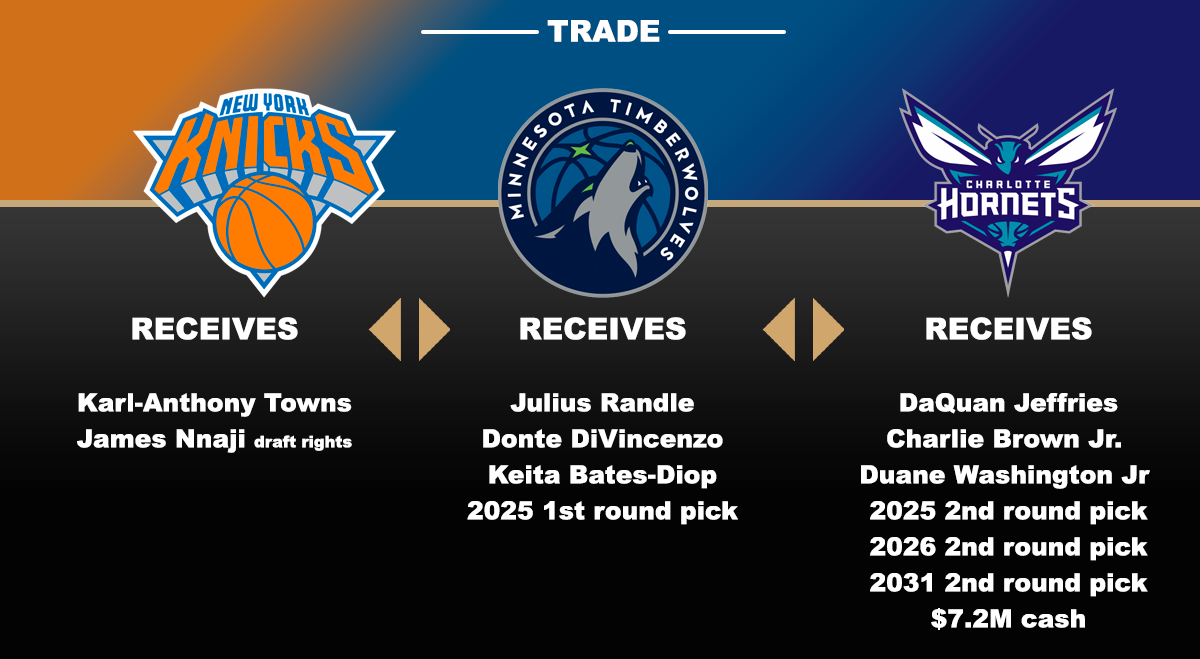
New York Knicks acquire: Karl-Anthony Towns (from Minnesota), draft rights for James Nnaji (from Charlotte)

Minnesota Timberwolves acquire: Julius Randle (from New York), Donte DiVincenzo (from New York), Keita Bates-Diop (from New York), protected Detroit Pistons 2025 first-round pick (from New York)

Charlotte Hornets acquire: Charlie Brown Jr. (from New York via sign-and-trade), DaQuan Jeffries (from New York via sign-and-trade), Duane Washington Jr. (from New York via sign-and-trade), 2025 least favorable of Denver Nuggets and Philadelphia second-round pick (from Minnesota), 2026 Golden State Warriors second-round pick (from New York), 2031 New York Knicks second-pick (from New York), $7.2 million in cash

Let’s dive in!

(Note: We are analyzing this deal as it has been reported. If the trade is adjusted to include additional players or teams, we’ll adjust the analysis.)

New York Knicks

Incoming salary: $49.2 million in 2024-25

  • Karl-Anthony Towns (C/PF, four years, $220.4 million)

Outgoing salary: $49.9 million in 2024-25

  • Julius Randle (PF, two years, $59.9 million (pre-trade bonus), second year player option), Donte DiVincenzo (SG, three years, $35.9 million), Keita Bates-Diop (SF, one year, $2.6 million), Charlie Brown Jr. (SG, three years, $7.6 million (only Year 1 guaranteed)), DaQuan Jeffries (SG, three years, $8.3 million (only Year 1 guaranteed)), Duane Washington Jr. (SG, three years, $7.2 million (only Year 1 guaranteed))

Before we get too deep into this particular trade, we need to step back to earlier this offseason when the New York Knicks acquired Mikal Bridges. In that deal, the Knicks could have made a fairly simple transaction to acquire Bridges by taking on a bit more salary than they would have sent out. That trade would have been perfectly legal, but it would have hard-capped the Knicks at the first apron.

Because the New York front office was forward thinking, they got creative and added some additional salary to the Brooklyn Nets, partially in the form of a sign-and-trade (keep that in mind for later!). By sending the Nets more money than they took back, the Knicks avoided a first apron hard cap and instead hard-capped themselves at the second apron.

Without that bit of foresight and creativity, the Knicks would not have been able to make this trade for Karl-Anthony Towns. There’s been some reporting that New York was pushing for a Towns trade as far back as the last few years, and really ramped up efforts over the summer. By being smart about how they structured Bridges trade, and their subsequent signings and re-signings as well, the Knicks put themselves in position to make their second seismic move of the offseason.

We’re going to start breaking down the Knicks acquisition of Towns from the CBA/cap/apron perspective, because this deal involved an incredible level of creativity to get it across the finish line.

Because Towns makes about $49.2 million this season, which is his maximum salary, his trade bonus is disregarded. That was the target number for the Knicks to match or beat. By doing so, New York would avoid triggering a first apron hard cap, which would make this deal die somewhere between extremely hard and impossible.

Julius Randle, Donte DiVincenzo and Keita Bates-Diop (Bates-Diop is able to be aggregated in this deal, because the 60-day waiting period has passed since New York acquired him as part of the Bridges trade) got New York to just over $43 million in outgoing salary. That left the Knicks about $6 million shy of the target mark.

This is where New York went to work.

The Knicks got to that $6 million by agreeing to sign-and-trade deals with their three remaining free agents in Charlie Brown Jr., DaQuan Jeffries and Duane Washington Jr. (More on the Washington situation later!) But just adding that $6 million wasn’t going to get it done. Sure, it solves the Knicks hard-cap issues, but it wouldn’t work for the Wolves. Because Minnesota is already over the second apron, they aren’t allowed to take back more money than they send out in a deal.

Enter the Charlotte Hornets.

The Hornets are sitting well below the luxury tax line. Charlotte also has their full Room Exception remaining, which can now be used as a Trade Exception under the new CBA.

Those two things will allow the Hornets to pick up three extra second-round picks, plus enough cash to cover the salaries for Brown, Jeffries and Washington, with a little extra to boot. All at the expense of a few roster spots for a short amount of time.

Back to the Knicks creativity for a moment…

When New York made the Bridges trade, the issue of “stacking minimum contracts” came up. To keep it simple, the Knicks couldn’t just pile up a host of players on minimum contracts to get to the salary-matching they needed to avoid a first apron hard cap. That’s part of why Shake Milton was signed-and-traded to Brooklyn in that deal.

This trade had the same issue. In order to get around that, Brown, Jeffries and Washington will each be paid slightly more than the minimum in Year 1 of their new three-year contracts (a sign-and-trade deal has to be for a minimum of three years, but only Year 1 needs to be fully guaranteed). That minor bump in salary will avoid the “stacking minimum contracts” restriction.

As for the future cap sheet, the Knicks are as locked-in to their new core of Towns, Bridges and holdovers Jalen Brunson, OG Anunoby and Josh Hart as you can be in the current NBA. Brunson and Anunoby are under contract for the next five seasons. Towns and Hart are under contract for the next four seasons. Bridges has only two seasons left on his deal, but is expected to add up to four additional years to his deal in the summer of 2025.

Now, even with Brunson signing an under-market extension, the Knicks are still going to be dealing with the tax aprons for foreseeable future. That’s going to make filling out the rest of the roster a bit of a challenge. New York is going to have to hit on some minimum signings and whatever draft picks they have left. They may have to get creative in future trades. Re-signing a player or two as future tradable salary is also in play, as that’s a tactic that apron teams have begun employing this offseason.

But here’s the kicker: the Knicks front office has shown the ability to get creative to get deals done. If their scouting is solid, and they are able to develop the players they acquire, New York should be just fine to make it work.

Now, let’s go on the court!

The Knicks needed a center in the wake of the Mitchell Robinson injury. Sure, they talked about playing Julius Randle at the five, and they like Precious Achiuwa and Jericho Sims as depth options at center. But with Robinson sidelined to open the season, manning the middle was going to be an issue for the Knicks.

Karl-Anthony Towns solves that. Towns is drastically different from both Randle and Robinson. Those two often get it done via brute force. Towns is one of the best shooting fives the NBA has ever seen, and he’s not afraid to get down on the block to score either. He won’t do it off the bounce like Randle, nor will he play above the rim like Robinson, but Towns is a solid scorer at every level. The Knicks gave up some on-ball creation by trading Randle, and they gave up a really good perimeter shooter in Donte DiVincenzo. But New York’s offense should still be very, very good. The Towns-Jalen Brunson combo is going to be a handful in the two-man game. Towns’ shooting will open the floor for Brunson and Mikal Bridges to attack off the bounce, which should open up the drive-and-kick game to create shots for OG Anunoby, Josh Hart and others.

On the other end of the court, the Knicks defense is going to have some issues. Towns isn’t as bad as he’s sometimes painted as being, but he’s not exactly good either. New York is now small with Brunson and slow with Towns. Those are two attack-points that opponents will go after repeatedly, especially because Bridges, Anunoby and Hart are all good to excellent defenders.

But there’s a fix for that once Robinson is healthy. When that day comes, Towns can slide down a position and play alongside a rim-running, shot-blocking center again, which was a successful alignment in Minnesota. That will see Hart go to the bench, but that will help solve for New York’s lack of depth.

In the short-term, the Knicks have a lot of work to do and not a lot of time to do it in. Tom Thibodeau has to get his new-look lineup on the same page. New York has to figure out rotations, with three of last season’s key players out of the mix. The defense probably won’t be as strong, but the offense should eventually be better. The Knicks traded some top-tier offensive rebounding and forcefulness in the paint for better shooting and spacing. That’s a workable swap.

One other short-term consideration: filling out the roster. New York has to eventually get to 14 players on standard contracts. As it stands now, they’ll have just 12 players post-trade. The Knicks are also about $3.6 million under the second apron, at which they are hard-capped. That means for now, New York has enough room to sign one player to a veteran minimum deal, which runs about $2.1 million for this season. Landry Shamet is reportedly the leader to get this spot, as he’s already in camp with the Knicks on a non-guaranteed Exhibit 9 contract.

That leaves about $1.5 million to fill the 14th spot. That’s not enough for a one- or two-year veteran minimum deal, so the Knicks will have to sign a player to a rookie minimum deal. But that’s not as simple as finding any rookie and plugging them in. A rookie who the Knicks don’t own draft rights for would come with a tax variance of the two-year veteran minimum amount of just over $2.1 million. That won’t fit under the second apron hard cap.

So, look for the Knicks to take one of two actions. They’ll either convert or sign one of their rookies that are currently on two-way contracts (Ariel Hukporti or Kevin McCullar). Or the Knicks could sign any one of the 13 former draft picks that they retain rights for. By signing a player they currently have or had draft rights for, New York will avoid the tax variance issue and can slide the player into that open 14th roster spot.

That leaves the team with one open roster spot, but they won’t have enough room under the second apron hard cap to fill that spot until later in the season. Or if New York makes another trade where they send out more money than they take back, they could create the room to fill that 15th spot sooner.

(There’s a very unlikely situation where New York could sign three rookies who they have or had draft rights for, but that’d be leaving an already thin bench with some very inexperience players.) 

In the longer-term, the Knicks can still play big when Robinson gets healthy. They can go smaller and quicker with Towns surrounded by guards and wings. New York is about out of tradeable draft picks, but they do have a few players they can still offer up in future deal, with Robinson chief among them.

Also thinking long-term, don’t discount the James Nnaji acquisition as just a toss-in to make the deal work. Nnaji is an interesting prospect. The 6-foot-11, 20-year-old big man is extremely raw. Think Mitchell Robinson, but less refined. Starting to get the picture?

At 2023 Summer League, Nnaji blocked 12 shots in about 105 minutes. He also snagged 38 rebounds during that time, with 14 of them coming on the offense glass. Nnaji’s range is measured in inches and everything is being done purely on instinct, but there’s an athleticism and power there that is very Robinson-like.

Sadly, last season with Barcelona was largely a wash. Nnaji barely saw any meaningful run for one of the better teams in Europe. Following last season, he had back surgery, which is also at least somewhat worrisome. All in all, Nnaji isn’t a major addition, but he’s a nice flyer to have around to see if he develops into something.

Are the Knicks better following this trade? That’s unclear. They’re certainly different. It feels like they have a higher ceiling, as Towns is such a special offensive player. But the lack of depth and the injury histories of Towns and Anunoby, along with less on-ball creation, gives the Knicks a lower floor. If nothing else, this is the kind of daring and creative deal that has been in short supply around the NBA in recent years.

Minnesota Timberwolves

Incoming salary: $43.0 million in 2024-25 (pre-trade bonus for Julius Randle)

  • Julius Randle (PF, two years, $59.9 million (pre-trade bonus), second year player option), Donte DiVincenzo (SG, three years, $35.9 million), Keita Bates-Diop (SF, one year, $2.6 million)

Outgoing salary: $49.2 million in 2024-25

  • Karl-Anthony Towns (C/PF, four years, $220.4 million)

The Minnesota Timberwolves were set to be the NBA’s second-most expensive team this season, behind only the Phoenix Suns. That was tenable for this season and this season only. Something was eventually going to give and some money was going to have to come off the Wolves books as soon as next summer.

Instead of making one more run with largely the same group as the prior season, Minnesota chose to start resetting their books now. However, rather than simply dumping salary, the Timberwolves made a deal that should keep them near the top of the Western Conference, while shoring up a major hole on the roster.

Let’s start with the cap and tax implications. Saving a bit over $6 million this season is nice for Minnesota. But it’s the long-term savings where the Wolves really make out.

Julius Randle and Rudy Gobert both have player options for the 2025-26 season. At this point, it’s far too early to project what either player is going to do. There’s a world where both players could pick up those options and delay free agency until 2026. They could opt out and re-sign with the Timberwolves. They could both come to extension agreements in advance.

The one thing that is certain: Minnesota is in full control as soon as the summer of 2026. Instead of having about $145 million on the books for only six players that summer, the Wolves have just $98 million committed for five players.

Now, it’s fair to suggest that more moves will happen over the next two seasons that will eat into that cap flexibility. But there’s $57 million off the books for that season. There’s a world where even a re-signed Gobert and Randle are only slightly north of that figure combined.

Essentially, by taking Towns contract off the books (it was going to be him, Gobert or the unimaginable exit of Naz Reid happening by next summer), Minnesota saved a little money now and freed up some major long-term flexibility. If Randle and/or Gobert leave as soon as the summer of 2025, that flexibility comes even sooner.

This is Anthony Edwards’ team now, if it wasn’t already. He’s a superstar and he’s the guy the Wolves will orbit everything around moving forward. Now, they have the flexibility to do that in a way that they didn’t before this trade.

Let’s flip things to on the court now!

In a vacuum, Karl-Anthony Towns is a better offensive player than Julius Randle. Minnesota will miss Towns outside shooting and his all-around offensive excellence.

But basketball isn’t played in a vacuum. One undoing for the Timberwolves in last season’s playoffs was a lack of on-ball creation. Everything fell to Edwards. Now, Minnesota’s star has some help in that area.

For all of Randle’s shortcomings as a shooter and sometimes sloppiness as a playmaker, he’s good with the ball. Randle can bulldoze his way to the rim with regularity. He’s generally a good passer. And sometimes Randle’s jumper is falling. (Randle has had this odd every-other-year thing where he goes back and forth from a passable three-point shooter to an awful one.)

That’s partially where Donte DiVincenzo comes in. The Wolves wing/guard rotation behind Anthony Edwards was a little shaky. Joe Ingles is more of a smaller four now than he is a wing. Terrence Shannon Jr. is a rookie and Nickeil Alexander-Walker is more of a combo guard.

DiVincenzo is primarily a shooting guard, but he can play small forward and he can also swing over to point guard too. No matter the position, he’s an elite off-ball player. The last two seasons DiVincenzo has shot 40% on 7.1 three-point attempts per game. He’s also a better-than-you-think rebounder and passer too.

Randle is a drastically different player from Towns, but he’s not necessarily a step backwards. DiVincenzo is a huge upgrade for a bench that felt one player short. Factor in that Naz Reid will now have more runway as a stretch big, and it doesn’t feel like Minnesota downgraded much at all.

Where this trade stings is emotionally. The Timberwolves invested nine years in Karl-Anthony Towns, and Towns invested nine years in the team and the state of Minnesota. This past season was the highest heights the franchise has hit, possibly ever. This upcoming season looked like a good bet to be another successful one.

It’s hard to pivot from that, especially with a loyal player who meant so much to the franchise. But the best front offices have to be daring and unconventional. The easy thing would have been to run it back, see what this season brought, and then go about cutting costs next summer.

By getting in front of this situation, and coming away with two players who can play and an additional first-round pick (let’s not forget Minnesota is still a bit pick poor after the Gobert trade), is good work. It’s not the way most front offices would do things, but you don’t get anywhere by being the same as everyone else, just more expensive.

Charlotte Hornets

Incoming salary: $6.8 million in 2024-25

  • Charlie Brown Jr. (SG, three years, $7.6 million (only Year 1 guaranteed)), DaQuan Jeffries (SG, three years, $8.3 million (only Year 1 guaranteed)), Duane Washington Jr. (SG, three years, $7.2 million (only Year 1 guaranteed))

Outgoing salary: $0.0 million in 2024-25

  • None

The Charlotte Hornets are acting as the facilitator here. This deal doesn’t get done without Charlotte’s involvement. And, as a fun little bonus, the Hornets got to make a little history too.

Under the new CBA, teams can use the unused portion of their Room Exception (or the Taxpayer or Non-Taxpayer MLE) as a Trade Exception. The Hornets are the first team to take advantage of that, by using most of their Room Exception as the mechanism to acquire Charlie Brown Jr., DaQuan Jeffries and Duane Washington Jr.

With all due respect to Brown, Jeffries and Washington, none of them are likely to be in Charlotte this season. The Hornets already have a full roster in terms of standard contracts. They’re also acquiring $7.2 million in this deal, which will cover what they are eating in salaries for the Brown, Jeffries and Washington trio for this season, plus a bit more.

As for long-term cap and tax impacts, there are none. While a sign-and-trade deal has to be for a minimum of three seasons, only Year 1 has to be fully guaranteed. Charlotte will very likely waive all three players, who got a nice payday simply for signing their names to a contract, and next summer the dead money will come off the books entirely.

The real win for Charlotte is picking up three extra second-round picks. Given the way teams move second picks these days, having a handful of additional picks in your stash is always a good thing. And who knows, maybe one ends up being a value pick near the top of the second round?

The Hornets did give up the draft rights to James Nnaji in this deal. As we covered in the Knicks section, he’s an interesting but very raw prospect. Nnaji wasn’t drafted by the current Charlotte front office, so they don’t have any real attachment to him.

Lastly, the NBA is all about relationships. Jeff Peterson is just getting started with running the Hornets front office. Charlotte’s ownership is still relatively new too. Helping to facilitate deals like this is a good way to build cache around the league. Don’t be surprised if Peterson hooks up with the Knicks and/or Timberwolves on future trades.

The Duane Washington Jr. Situation

We have one more thing to cover as part of this trade, because it’s endlessly fascinating.

At the start of the offseason, Duane Washington Jr. became an unrestricted free agent. He had finished a second two-way contract with the New York Knicks, who elected not to tender him a qualifying offer to make Washington a restricted free agent.

Despite a solid Summer League stint for the Knicks, Washington didn’t sign an NBA contract. In late-July, Washington signed a deal with KK Partizan in Serbia.

Wait…if Washington was signed to a deal, how in the world are the Knicks sign-and-trading him to the Charlotte Hornets to make this three-team deal with the Minnesota Timberwolves happen?

The answer is both fairly simple, while the process is fairly complex.

The simple answer is the NBA does not regard non-NBA contracts when considering a player’s NBA free agent status. So, despite Washington having a deal with Partizan, he’s still considered an NBA unrestricted free agent and the Knicks still hold his free agent rights.

Here’s where things start to get a little complicated…

After a couple of silly situations where NBA teams signed-and-traded players who had retired from the league in order to make trade math work (Hi Keith Van Horn!), the CBA was changed. In order to sign-and-trade a player now, that player has to have completed the previous season as a member of your roster.

Because Washington finished last season with the Knicks on a two-way contract, he’s eligible to be a part of a sign-and-trade.

But we still have the fact that Washington is signed with Partizan. And that’s where things get really complicated.

The Knicks did not want to have amend this trade to include a rostered player like Miles McBride simply to make the math work. New York is already thin on depth after this trade, so they really didn’t want to move a rotation player for salary-matching purposes.

This is where creativity and partnerships take over. Signing-and-trading Washington was clearly the best option to get this trade across the finish line. To make that happen, New York had to convince Partizan to play ball.

On one hand, Partizan loses nothing by releasing Washington to be a part of this deal, then re-signing him after he clears waivers from the Hornets. But, alas, things aren’t so simple!

The first issue is that it takes time for a player to receive what is called a Letter of Clearance (LOC) from FIBA. You may remember this from the Sasha Vezenkov situation this summer. FIBA has to clear players to sign contracts when coming to or from leagues under their jurisdiction.

So, in order to be signed-and-traded by the Knicks to the Hornets, Washington had to get a LOC from FIBA that says he’s free and clear from his contract with Partizan. Then, to re-sign with Partizan after clearing waivers from Charlotte, Washington has to get another LOC from FIBA.

All of that takes time. No matter how much the Hornets and Washington might want to set him free, there’s still a 48-hour waiver period in the NBA. And that’s if the FIBA LOC process is expedited very quickly.

And that’s where it gets even more complicated.

Partizan’s season has already started. Not only did Washington play in each of Partizan’s first two games, he started those games. In the first game of the season, the 6-foot-2 guard scored 13 points in 14 minutes. So, it’s safe to say that Washington is a key member of the team.

Making the timing tricky to pull all of this off, Partizan has a string of important EuroLeague contests over the next two weeks. While there wasn’t any reason financially for Partizan to not be good partners in terms of this trade, they aren’t going to want to be down an important player for some key upcoming games.

As it stands, Washington will miss Partizan’s EuroLeague game against Baskonia on October 3. It’s possible that he could be back in the lineup for an Adriatic League game against KK Cibona on October 6. A more likely scenario is that Washington is back for a EuroLeague game against Real Madrid on October 10.

It’s unknown at this point what Partizan is getting paid in terms of a buyout for Washington in this whole process. What is known is that Washington is going to get roughly $2.3 million in NBA salary for this season, while taking a short amount of time off from Partizan, for essentially signing his name a few times on various documents.

All around, this might be the first time we saw a multi-team, multi-league, multi-continent trade in NBA history. This entire process also proves that while it may be hard, make that VERY hard, for teams dealing with apron issues and hard caps to make big trades, it can be done. It just takes some creativity, partnerships and relationships to make it happen. Oh, and a handful of second-round picks too. Don’t ever forget the second-round picks.


Top