Tommy Fleetwood wins the TOUR Championship and FedExCup. This is the first win of Fleetwood's PGA Tour career. Fleetwood earns $10 million bringing his 2025 on-course earnings to $18.5 million and his career earnings to $59.8 million.
TRENDING PAGES
TRENDING PLAYERS
AFC East
AFC North
AFC South
AFC West
NFC East
NFC North
NFC South
NFC West
Atlantic
Central
Southeast
Northwest
Pacific
Southwest
AL East
AL Central
AL West
NL East
NL Central
NL West
Atlantic
Metropolitan
Central
Pacific
Eastern
Western
Eastern
Western
© USA Today Sports
The dust has (almost) (kind of) mostly settled from the NFL offseason, as final roster cuts loom, and real regular season football is right around the corner. Let’s recap the top contracts signed at each position in terms of practical guarantee over the past few months.
Related Links
Quarterbacks
Josh Allen (Bills)
Replaced a 4 year, $129.5M contract with a 6 year, $330M deal that includes $250M guaranteed. Allen will reel in $58M in 2025, and is now entrenched in Buffalo at 5 years $272.5M for practical purposes.
Position Ranks
APY: 2nd
APY % of Cap: 13th
Total Guarantee: 1st
Guarantee at Sign: 2nd
2-Year Cash: 2nd
3-Year Cash: 2nd
Brock Purdy (49ers)
Extended out of a 1 year, $5.3M rookie contract into 5 years, $265M new, including $182.5M guaranteed. The 25-year-old will see $41.1M in 2025, and $170M over the next 4 seasons. $177.5M of the deal is guaranteed at signing or with an early vesting trigger.
Position Ranks
APY: 7th
APY % of Cap: 14th
Total Guarantee: 8th
Guarantee at Sign: 12th
2-Year Cash: 10th
3-Year Cash: 11th
Running Backs
Saquon Barkley (Eagles)
A near-MVP season warranted a pot-sweetener for Barkley this offseason. The Eagles responded by turning a 2 year, $27.25M contract into a 4 year, $68.7M deal. More importantly, Barkley’s guarantees increase from $14M, to a position-leading $36M. In fact, nearly everything about this new contract is “position-leading”.
Position Ranks
APY: 1st
APY % of Cap: 2nd
Total Guarantee: 1st
Guarantee at Sign: 1st
2-Year Cash: 1st
3-Year Cash: 1st
Ashton Jeanty (Raiders)
The #6 overall pick secured a fully guaranteed 4 year, $35.8M contract from Las Vegas making him the 2nd-highest guaranteed running back in all of football. That’s about all anyone should need to know regarding the devaluation of the veteran running back contract.
Position Ranks
APY: 13th
APY % of Cap: 15th
Total Guarantee: 2nd
Guarantee at Sign: 2nd
2-Year Cash: 3rd
3-Year Cash: 7th
Wide Receivers
Ja'Marr Chase (Bengals)
It took a minute, but Cincinnati extended Chase out of his $21.8M 5th-year option, into a 5 year, $182.8M total value contract through 2029. The deal includes $112M guaranteed either at signing or with an early vesting trigger, keeping him secure into the 2028 season.
Position Ranks
APY: 1st
APY % of Cap: 1st
Total Guarantee: 1st
Guarantee at Sign: 2nd
2-Year Cash: 1st
3-Year Cash: 1st
Garrett Wilson (Jets)
Wilson gets a 3rd-year extension in NY to the tune of 4 years, $130M with $40.7M fully guaranteed at signing. But a whopping $90M of this contract is guaranteed for practical purposes through the 2028 season. Wilson caught a career-high 101 passes last season, putting forth his third-straight 1,000 yard campaign.
Position Ranks
APY: 5th
APY % of Cap: 9th
Total Guarantee: 4th
Guarantee at Sign: 14th
2-Year Cash: 16th
3-Year Cash: 13th
Tight Ends
Trey McBride (Cardinals)
Arizona tacked on 4 years, $76M to the 1 year, $5.7M left on McBride’s rookie deal, locking in $35.5M via upfront or early vesting guarantees. The 25-year-old breakout star (111 catches, 1,146 yards in 2024) should have no trouble seeing 3 years, $44M+ on this new contract.
Position Ranks
APY: 2nd
APY % of Cap: 4th
Total Guarantee: 1st
Guarantee at Sign: 3rd
2-Year Cash: 2nd
3-Year Cash: 2nd
George Kittle (49ers)
The Niners added 4 years, $76.4M to the 1 year, $15M remaining on Kittle’s previous deal, and locked in $33M through the 2026 season. Kittle had one of his best seasons to date in 2024 (94 catches, 1,106 yards, 8 TDs).
Position Ranks
APY: 1st
APY % of Cap: 3rd
Total Guarantee: 4th
Guarantee at Sign: 1st
2-Year Cash: 3rd
3-Year Cash: 1st
Offensive Tackle
Rashawn Slater (Chargers)
Slater entered 2025 on a $19M 5th-year option before LAC tacked on 4 years and $114M to it. The 26-year-old gets $56M fully guaranteed upfront, with $92M total secured into 2028 via early vesting triggers. Slater ruptured his patellar tendon 11 days after signing this contract.
Position Ranks
APY: 1st
APY % of Cap: 6th
Total Guarantee: 1st
Guarantee at Sign: 2nd
2-Year Cash: 2nd
3-Year Cash: 3rd
Dan Moore (Titans)
Tennessee signed Moore away from Pittsburgh on a 4 year, $82M free agent contract that includes $42.5M fully guaranteed at signing. The 2021 4th-round pick should see at least $50M through 2026 on this deal.
Position Ranks
APY: 14th
APY % of Cap: 23rd
Total Guarantee: 10th
Guarantee at Sign: 10th
2-Year Cash: 5th
3-Year Cash: 6th
Guards
Trey Smith (Chiefs)
Smith signed a $23.4M franchise tag back in March, putting pressure on the Chiefs to extend him before the July 15th deadline. That negotiation ran right up to the wire, bringing forth a 4 year, $94M contract for Smith that includes $70M guaranteed through 2027.
Position Ranks
APY: 1st
APY % of Cap: 3rd
Total Guarantee: 1st
Guarantee at Sign: 2nd
2-Year Cash: 2nd
3-Year Cash: 1st
Will Fries (Vikings)
Minnesota signed Fries away from the Colts on a 5 year, $87.7M contract that includes $34M fully guaranteed through 2026. The final 3 years of the contract are structured in a pay-as-we-go manner, but it’s still a heck of a second contract for a former 7th round pick.
Position Ranks
APY: 10th
APY % of Cap: 11th
Total Guarantee: 7th
Guarantee at Sign: 6th
2-Year Cash: 7th
3-Year Cash: 6th
Centers
Cam Jurgens (Eagles)
Philly extended Jurgens out of the final year of his rookie contract ($5.3M) to the tune of 4 years, $68M. The 25-year-old gets $39M fully secured through 2027, with a year-to-year structure thereafter.
Position Ranks
APY: 2nd
APY % of Cap: 3rd
Total Guarantee: 2nd
Guarantee at Sign: 4th
2-Year Cash: 5th
3-Year Cash: 3rd
Drew Dalman (Bears)
Chicago signed Dalman away from Atlanta on a 3 year, $42M contract that includes $28M guaranteed through 2026. The Bears added three new starting offensive linemen this offseason.
Position Ranks
APY: 4th
APY % of Cap: 5th
Total Guarantee: 4th
Guarantee at Sign: 2nd
2-Year Cash: 2nd
3-Year Cash: 1st
Interior Defensive Linemen
Milton Williams (Patriots)
The big free agency winner secured a 4 year, $104M contract in New England that comes with $51M fully guaranteed through 2026. Only Chris Jones is worth more on average among active IDL.
Position Ranks
APY: 2nd
APY % of Cap: 10th
Total Guarantee: 5th
Guarantee at Sign: 4th
2-Year Cash: 2nd
3-Year Cash: 2nd
Osa Odighizuwa (Cowboys)
Dallas kept their former 3rd round pick off of the open market with a 4 year, $80 million extension this past March. The contract includes $39M fully guaranteed at signing through 2026. Odighizuwa posted career numbers across the board in 2024.
Position Ranks
APY: 16th
APY % of Cap: 18th
Total Guarantee: 12th
Guarantee at Sign: 12th
2-Year Cash: 14th
3-Year Cash: 11th
Edge Defenders
Myles Garrett (Browns)
Early offseason drama was quickly squashed when Cleveland handed Garrett $59M guaranteed at signing and $123.6M locked in for practical purposes on a 4 year, $160M new money extension. The 29-year-old is now signed through 2030 at a whopping $204.8M total value.
Position Ranks
APY: 2nd
APY % of Cap: 3rd
Total Guarantee: 1st
Guarantee at Sign: 4th
2-Year Cash: 6th
3-Year Cash: 2nd
T.J. Watt (Steelers)
30-year-old’s don’t get paid? Watt secured $108M fully guaranteed at signing through 2027 on his 3 year, $127M extension in Pittsburgh. It’s an historic, possibly trend-setting deal for players still performing at a high level into their 30s.
Position Ranks
APY: 1st
APY % of Cap: 2nd
Total Guarantee: 3rd
Guarantee at Sign: 1st
2-Year Cash: 1st
3-Year Cash: 1st
Off-Ball Linebackers
Fred Warner (49ers)
Despite a healthy 2 years, $36.5M remaining on his previous contract, San Francisco did right by Warner this past May, adding 3 years, $63M to the mix. The 28-year-old secures $40.8M fully guaranteed at signing, with almost $57M locked in for practical purposes through 2027.
Position Ranks
APY: 1st
APY % of Cap: 3rd
Total Guarantee: 2nd
Guarantee at Sign: 2nd
2-Year Cash: 3rd
3-Year Cash: 2nd
Zack Baun (Eagles)
One of the best values in all of football last season (150 tackles, 4 sacks, 5 forced fumbles on a $1.6M salary), Philly kept Baun off of the open market with a 3 year, $51M extension. The deal includes $34M fully guaranteed at signing through 2026.
Position Ranks
APY: 4th
APY % of Cap: 4th
Total Guarantee: 4th
Guarantee at Sign: 4th
2-Year Cash: 4th
3-Year Cash: 4th
Cornerbacks
Derek Stingley Jr. (Texans)
Extended out of his rookie contract after year 3 to the tune of 3 years, $90M new. The contract includes $48M fully guaranteed at signing, with over $89M secure through the 2028 season.
Position Ranks
APY: 2nd
APY % of Cap: 2nd
Total Guarantee: 1st
Guarantee at Sign: 1st
2-Year Cash: 1st
3-Year Cash: 1st
Ahmad Gardner (Jets)
The Jets finished off a big summer of cornerback signings with a 4 year, $120.4M extension for Sauce Gardner. The deal includes $40.5M fully guaranteed at signing, with $85M+ secure through 2028. Gardner is under contract now at 6 years, $145M total value.
Position Ranks
APY: 1st
APY % of Cap: 1st
Total Guarantee: 2nd
Guarantee at Sign: 9th
2-Year Cash: 9th
3-Year Cash: 2nd
Safeties
Kerby Joseph (Lions)
Detroit extended Joseph out of the final year of his rookie deal to the tune of 4 years, $86M, including $33M plus guaranteed through 2027. Coming off of a career-year, the 2022 3rd rounder should see this deal through 2028 before re-upping after his age-28 season.
Position Ranks
APY: 1st
APY % of Cap: 4th
Total Guarantee: 4th
Guarantee at Sign: 10th
2-Year Cash: 12th
3-Year Cash: 12th
Trevon Moehrig (Panthers)
Carolina signed Moehrig away from Las Vegas on a 3 year, $51M free agent deal that includes $34.5M fully guaranteed through 2026. The 26-year-old posted 104 tackles and 2 INTs in 2024.
Position Ranks
APY: 7th
APY % of Cap: 9th
Total Guarantee: 7th
Guarantee at Sign: 6th
2-Year Cash: 8th
3-Year Cash: 5th
Kicker
Brandon McManus (Packers)
Green Bay kept McManus off of the open market with a 3 year, $15.3M extension. The contract includes $5M fully guaranteed, $7M total for the upcoming season. The 34-year-old made a career-high 95% of his field goals last season.
Position Ranks
APY: 8th
APY % of Cap: 13th
Total Guarantee: 15th
Guarantee at Sign: 13th
2-Year Cash:8th
3-Year Cash: 8th
Punter
A.J. Cole (Raiders)
Cole had 1 year, $3.3M remaining on his previous contract before Las Vegas handed him a 4 year, $15.8M extension. The deal includes $10M guaranteed, the highest amount for a punter in NFL history.
Position Ranks
APY: 3rd
APY % of Cap: 4th
Total Guarantee: 1st
Guarantee at Sign: 3rd
2-Year Cash: 1st
3-Year Cash: 1st
Long Snapper
Trent Sieg (Cowboys)
Dallas kept Sieg out of free agency with a 3 year, $4.45M extension that includes $3.1M guaranteed into 2026. The 2018 UDFA was available for every Cowboys game the past two seasons.
Position Ranks
APY: 6th
APY % of Cap: 12th
Total Guarantee: 1st
Guarantee at Sign: 7th
2-Year Cash: 6th
3-Year Cash: 5th
© USA Today Sports
Building off of the Evolution of NWSL Salaries and Roster Rules, here’s an extensive view into the improvement of NWSL player contracts (SPA’s) and player’s rights since the league formed in 2013.
Contracts
In the inaugural season, all contracts (that were announced) were single year contracts. Teams had the ability to waive players at any time prior to the roster freeze. Ahead of the 2014 season, the NWSL began to see contracts for one-year with one-year club options. The league also introduced the only caveat on waiving that teams were required to have a ‘favorable’ exit physical.
The 2016 season marked the first time that guaranteed contracts popped up in the verbiage of the roster rules. Along with it came the rules on buying out guaranteed contracts: during the offseason, a club could buy out one guaranteed contract without impacting salary cap and during the season, the buyout amount would be charged against the club’s salary cap.
A majority of contracts 2014 or later were one year with one year club options until 2020 expanded on the contract rules allowing three year contracts with no more than one option year, but could be 3+1. So a player could be signed to a 2+1 contract, but not a 1+2 contract. The 2020 season also marked the lifting of a limit on a team’s number of guaranteed contracts although the league never officially published what that limit was in prior years.
In 2021, the rules around guaranteed contracts evolved once again, updating the buyout clause so that teams could exercise a buyout during the season without impacting the salary cap.
Also as a part of the 2020 roster rules being updated, player contracts were no longer permitted to include “additional work” (for example, performing at camps, etc.). This was expanded upon in 2022 in the first ratified CBA so that any additional work up to $15,000 per player wouldn’t count toward the salary cap.
The latest CBA, which was ratified last August, has all new player contracts are required to be guaranteed and there is language around players who are on remaining semi-guaranteed contracts being able to receive severance pay if their contracts are terminated early for reasons other than misconduct.
Playing Rights
As a reminder, from 2013 through the 2021 season, there were Federation Allocated players. Each year these players were signed to contracts ahead of the season, and their salaries were subsidized by their National Team Federation (U.S., Canada, or Mexico). The unfortunate consequence that came with this system is that these allocated players were basically tied to their teams if they wanted to play in the U.S. and had little to no autonomy for where they would be playing.
Outside of Allocated players, there wasn’t verbiage in the Roster Rules about clubs retaining player rights until the 2015 rule that once preseason begins, teams had to make a decision on non-contracted players whose rights they held within 10 days once the player reports. In 2016, this window was expanded to 15 days, but in 2018 the league removed the limit entirely.
The 2016 season also marked the first sighting verbiage around clubs retaining the rights to a player until the next preseason following the expiration of a contract as long as attempts to re-sign a player was made. Along with this came the ‘Right of First Refusal’ where ‘the club who attempted to sign the player maintains a Right of First Refusal to acquire the player in the event she is subsequently signed to an NWSL contract.’
The 2022 CBA changed things dramatically, Allocation ended, free agency was defined, and for any player eligible to be a free agent, new contract option years must be mutual options (instead of club).
2022 Free Agency:
- In 2023, individuals who have six years of service with the NWSL will receive full Free Agency;
- In 2024, individuals who have three years of service in the NWSL will receive Restricted Free Agency; and
- In 2024, individuals who have five years of service in the NWSL will receive full Free Agency.
Full or unrestricted free agency is what is considered free agency in most other sports leagues. Restricted free agency is where the right’s holding team has 7 days to match an offer by another team or the player can sign elsewhere.
Last August’s CBA once again changed the landscape dramatically, giving collegiate players the right to choose where they wanted to play with the elimination of the Draft starting with the 2025 season. It also gave immediate unrestricted free agency for all players.
Minors in the NWSL
You can’t talk about player’s rights in the NWSL without talking about the progression of players under 18 years of age joining the league.
In 2018, the Roster Rules included the ability for teams to place foreign minors on discovery lists, given that the player would turn 18 before the end of the next transfer window. Example: Player A turns 18 on July 5 (which is during the transfer window). They would’ve been discovery eligible any time after the close of the previous transfer window, provided the contract begins July 5th and arrival of ITC.
Three years later in 2021, a 15-year old Olivia Moultrie successfully sued the NWSL for her right to play in the league, she was made eligible for the discovery process, and the OL Reign were able to secure her rights due to discovery order. The Reign then traded Moultrie to Portland for a third-round draft pick — definitely under market value — but she was able to sign a three year contract with the team that she had spent multiple years training with.
The next season, a 17-year old Jaedyn Shaw joined the Washington Spirit preseason and started looking at how she could enter the league. In July 2022, the NWSL allowed Shaw to enter via the discovery process, but San Diego was ahead of Washington in the discovery order and the teams were not able to come to an agreement on the terms of a trade for her rights. Shaw would then become the youngest player to score in their NWSL debut.
A few months later, the NWSL announced the U18 Entry Mechanism to allow players under 18 years of age to sign with a team of their choice. Teams were limited to two U18 players and unlike international spots, these spots were not tradeable. Ahead of the 2024 season, the U18 Entry has expanded to four spots per team. Since the mechanism's creation, 17 players have used it to join the league.
Loans
For the first two seasons of the NWSL, loans out of the NWSL were only referenced to in terms of allowing players to play elsewhere during the NWSL offseason. This was expanded upon in 2015 with a specific section for loaning NWSL players to the WPSL during the season, but all loans needed to be through the end of the NWSL season. There is nothing in the rules for 2015 which mention teams getting roster or salary cap relief with the loan.
The following year, loans outside of the league became what we now know them as, where a player can be loaned at any time to a club outside the league (subject to that federation’s transfer window), and subject to the consent of the player. These loans come with roster relief and salary cap relief.
Player’s Rights
There wasn’t much mention about how player’s rights were changing in the roster rules until 2020 when the league assuring housing and cars year around (cars being supplied were optional, but if supplied needed to be year around). Prior to this, teams supplied housing, but only during the season.
The 2022 CBA was truly groundbreaking for the players, it defined the maximum number of games in a season, guaranteed 42 days of vacation throughout the year (offseason included), and required a 7-day in-season break. It also guaranteed parental leave for new birth or adoptive parents, with leave and salary continuation for pregnant players and mental health leave for players up to 6 months. Additionally, it required that the league employ a medical director, and all teams employ Team Physician, Massage Therapist, Sports Scientist, Sports Psychologist, and Mental Health Clinician.
In 2023, the roster rules expanded on the CBA so that players on mental health leave don’t count towards the active roster.
The 2024/2025 CBA continued to build on this, with rules around workload management and specifically game frequency, travel conditions, time off, and standards for charter flights. It also changed things around team-provided housing with the Locality Cost of Living Adjustment and Supplemental Stipend (learn more here).
Closing Thoughts
Although the league has made great progress on a number of fronts over the years, there is still work to be done. The 2025 season has seen players forced to finish a game after seeing a teammate/friend collapse on the field as well as the league trying to force a match in the heat against its own competition rules/guides. The player’s physical safety needs to be a priority for the league as it continues to progress, especially if it wants to claim being ‘the best league in the world’ as the commissioner Jessica Berman keeps stating.
© USA Today Sports
Since its inaugural season in 2013, NWSL salaries and roster rules have changed dramatically, here’s a comprehensive look into how things have changed over the years.
Salaries
The league has come a long way since 2013 where there was a minimum salary of $6,000 and a maximum salary of $30,000. Starting in 2024, there is no longer a maximum salary at all, and the 2025 minimum salary is $48,500.
Salary trends: Left axis - Salary Cap (yellow), Right axis - Min Salary (blue), Max Salary (red)
Part of why the maximum salaries were so low had to do with the National Team Allocation process. In the inaugural season until the first CBA was ratified for the 2022 season, USSF, Canada Soccer, and for a time the Mexican Football Federation subsidized player salaries for the NWSL and these costs did not count toward a team’s salary cap.
The Mexican Football Federation (FMF) announced ahead of the 2016 season that it would no longer allocate players to the NWSL following a 2015 season where none of its players received minutes. In 2017, FMF would launch their own league, Liga MX Femenil.
From the start of the league, trades including federation players required that teams could only trade federation players for other federation players. Coinciding with the release of the 2014 federation players, the league announced that this restriction had been lifted and “allocated for allocated” was no longer required.
In April 2017 the USWNT and U.S. Soccer announced a new CBA, which not only increased the pay of the U.S. allocated players but also had fiscal commitments from U.S. Soccer to invest in improving NWSL stadiums, facilities, and player accommodations.
Allocation Money
Allocation Money was first introduced in November 2019 ahead of the 2020 season, and teams had the option of buying $300,000 from the league in addition to their salary cap to use to:
- Pay a player on a contract more than the league maximum salary
- Reduce the salary cap charge of a player’s salary
- Pay a transfer fee when acquiring a player who is currently under contract outside the US.
- Trades inside the NWSL for the current season and the next three league seasons.
There were certain conditions that needed to be met for the Allocation Money to be used toward player contracts:
- NWSL Best XI or Second XI for either of the two most recent seasons
- International players who have more than three caps for their national team in the prior 24 months
- NWSL MVP, Golden Boot, Rookie of the Year or Defender of the Year winner for one of the two most recent seasons
- Domestic players who have completed at least five seasons in the NWSL
- Players who were formerly designated as allocated players by the U.S. or Canada (unless if the player refused the option to be allocated)
- Players previously on a contract that included allocation money
Starting in 2022 the available allocation money increased to $500,000, and it increased again to $600,000 in 2023. Ahead of the start of the 2024 season, the NWSL announced that they would be phasing out allocation money and any that had been stockpiled by teams needed to be used by December 31st, 2026.
The exception to this is that in June the NWSL announced that expansion sides Boston and Denver would have $1,065,000 in allocation money available to help their roster building. These new Allocation Funds don’t expire until December 31, 2027.
Roster Size
For the first six years of the NWSL, the active roster size minimums and maximums stayed consistent, at 18 and 20 respectively until 2019 where they both increased by two and there was an additional allowance of four supplemental players. Supplemental players could count toward the league minimum players but were on the league minimum salary and didn’t count towards a team’s salary cap. In the 2023 season, the distinction between senior players and supplemental players disappeared and the roster minimum of 22 and maximum of 26 have been held since. The 2027 season will see an increase in the minimum roster size to 23.
Over the years, the NWSL has also seen a steady increase in the number of international spots available — although in the first 10 seasons of the league, the Federation Allocated players didn’t take up a spot. (The Canadian players who haven’t left the NWSL after the designation was dropped were grandfathered in and continue to not occupy a spot). Fun fact: International Spots could be traded in perpetuity until the 2023 season limited it to the current season plus three additional NWSL seasons.
Mechanisms to Add Players
During the 2013 preseason, there were a lot of limitations to how the original eight teams built their rosters. Each of the teams was allocated three U.S. Women’s National Team players and two Canada and Mexico National Team players (with the exception of the Western NY Flash, which received two U.S. players). Each of the clubs then added four players at the 2013 NWSL College Draft. Teams were then allowed to add an additional 4 free agents, five for WNY Flash who only received two U.S. players. And then there was a Supplemental Draft.
For the Supplemental Draft, each of the eight teams submitted a list of 8-10 players to be eligible in the pool for the draft – both domestic and international – and then there were six rounds of drafting players.
They created a mechanism called Discovery, where teams can basically call dibs on a player’s playing rights in the NWSL. Teams were not required to announce the players on their discovery list until discovery as a process was squashed in the latest CBA.
Additionally, they created a way for ‘amateur’ players to play for teams when a national team player was away for a match but the teams were not allowed to pay their amateur players and only able to cover their travel expenses. In 2015, a World Cup year, the league expanded on amateur player rules limiting the number a team could use to 10. In 2018, the amateur designation was joined by the now-used National Team Replacement Player (NTRP) and after the 2020 Challenge Cup bubble which allowed no NTRP’s and amateur ‘contracts’ the amateur player as it was then designated no longer existed.
The most recent CBA has amateur players making a comeback although there are more restrictions on the title that previously hadn’t existed. Now an amateur player can’t have signed a Letter of Intent to enroll in college, is not already enrolled in college or has not exhausted their college eligibility. Teams can have no more than three amateurs training with them at any given time, and can only participate in preseason matches or friendlies.
© USA Today Sports
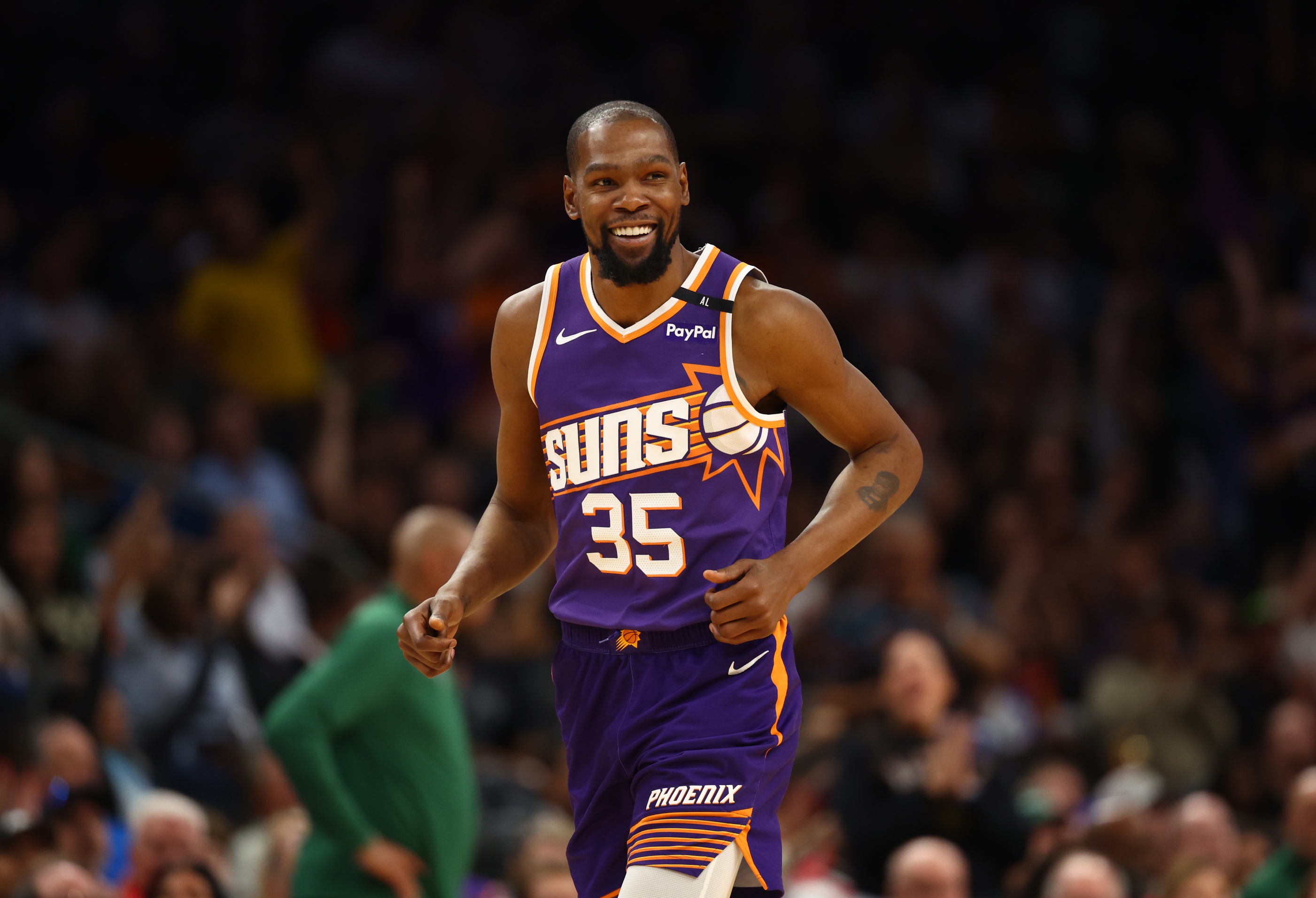
From the moment Kevin Durant was known to be available in trade from the Phoenix Suns, the questions started.
- “You can’t trade for Durant without signing him to an extension, right?”
- “Durant is going to demand the max on his next deal, right?”
- “How much can you pay a guy who will 37 years old when the season starts, especially with his injury history?”
So, far the answers are:
- The Rockets did…at least so far.
- Doesn’t look like it.
- That’s still to be determined.
What we’re going to do today is take a look at what the options are for Durant and the Houston Rockets, after they acquired him this offseason. We’ll do this is our standard way of looking at the maximum Houston can give Durant, the max another team can pay the superstar forward, and then trying to project what feels fair for all parties involved.
However, with Durant and the Rockets, there is a bit of context needed before we start talking numbers. This is all related to the questions we opened this piece with.
Despite the fair speculation about Durant needing an extension as part of a trade, that hasn’t been the case. In fact, recent reporting is that Houston and Durant aren’t in any kind of rush to lock into a new deal. That’s huge for the Rockets, because it allows them some flexibility as they map out their future.
As for the second question: Durant doesn’t seem to be demanding a max deal. There are reports that the veteran forward isn’t looking to pull every penny that he can on his next contract. Again, that’s big for the Rockets, who are starting to get a little expensive.
When it comes to the last question, it’s exceedingly fair to ask how much you can lock into for an older player who has missed considerable time. Here are Durant’s games played per season since tearing his Achilles’ tendon during the 2019 NBA Finals:
- 2019-20: 0
- 2020-21: 35
- 2021-22: 55
- 2022-23: 47
- 2023-24: 75
- 2024-25: 62
That’s a lot of missed time, even when accounting for some of those being shortened seasons. Durant isn’t likely to get any healthier as he moves into his late 30s, either. His next deal has to factor in that there will be some missed time to account for.
All of that having been said…we’re talking about Kevin Durant!
Despite his advanced age, Durant remains one of the league’s best scorers. Since missing the 2019-20 season, Durant has averaged 27.9 points on 53/42/88 shooting splits. He’s also grabbed 6.7 rebounds, dished out 5.2 assists and blocked 1.2 shots per game over the last five seasons. He’s not slowing down very much.
Durant remains incredibly productive and continues to play at an All-NBA level each season. That’s going to see him paid quite handsomely on his next contract. Let’s take a look at what that might look like!
The Over-38 Rule
Before we dive into the numbers, a quick note on the Over-38 rule. Durant will trigger that starting with the 2026-27 season, which will be the first year on his next contract. (Side note: Durant only triggers the Over-38 rule in 2026-27 by two days. The Over-38 rule considers October 1 as the start of a new season. Durant was born on September 29, putting him just outside missing the Over-38 rule for another season entirely.)
To keep things simple, we’re going to limit out analysis here to two- and three-year deal structures. The Over-38 rule only applies to contract that are four or five years in length. Because it’s complicated, and hard to fit in the salary for player on a near-max deal (as Durant will be), on a four- or five-year contract, we’re going to assume shorter-term agreements in our analysis.
Extending with the Rockets
Kevin Durant is extension eligible with Houston and will be all the way through June 30, because he’s on an expiring contract. That means that at any point this year, the Rockets and Durant can agree to a contract extension.
Because extensions are added to what is left on a current deal, Durant is functionally limited to a two-year extension. That will avoid any Over-38 rule complications. Here’s what a two-year maximum extension projects to look like for Durant:
- 2025-26: $54,708,609 (final season of current contract)
- 2026-27: $57,915,200
- 2027-28: $62,548,416
- Total: three years, $175,172,225
- Total extension: two years, $120,463,616
This is a two-year extension that starts at 35% of the cap in 2026-27. It’s likely that the second year of the extension would include a player option, as Durant will want to evaluate things on a year-to-year basis at that point.
Re-signing with the Rockets
If Durant lets his contract expire, he can re-sign with Houston as a free agent in the 2026 offseason. The Rockets will have full Bird rights for Durant, which allows them to offer him a full max deal. Again, to avoid Over-38 complications, we’re going to limit this to a deal that is three seasons in length. Here’s what that max contract projects to look like:
- 2026-27: $57,915,200
- 2027-28: $62,548,416
- 2028-29: $67,181,632
- Total: three years, $187,645,248
This is a three-year deal that starts at 35% of the cap. Like with the extension we covered above, Durant would probably get a player option on the final season.
Re-signing with the Rockets on a 1+1 contract
It’s been widely reported that Durant and Houston have been talking about two-year deals, which would likely be of the “1+1” variety. That allows Durant to go year-to-year with his contracts. A two-year max deal would look exactly like what Durant would add in an extension:
- 2026-27: $57,915,200
- 2027-28: $62,548,416
- Total: two years, $120,463,616
That’s again 35% of the cap, and the second season would likely be a player option for Durant.
Signing with another team in free agency
We’ve seen Kevin Durant leave a pretty good situation in the past, when he left the Golden State Warriors for the Brooklyn Nets. It’s not necessarily what we expect to happen with the Rockets, but if it does, he’d likely be landing a max or near-max deal. Here’s what that could look like:
- 2026-27: $57,915,200
- 2027-28: $60,810,960
- 2028-29: $63,706,720
- Total: three years, $182,432,880
In this case, Durant still would start at 35% of the cap, but he gets 5% raises instead of 8%. All total, that would cost Durant about $5.2 million over the course of a three-year deal.
Signing with another team in free agency on a 1+1 contract
Let’s say Durant leaves Houston, but is going the mercenary route and playing things out year-to-year. Here’s what a “1+1” deal would look like:
- 2026-27: $57,915,200
- 2027-28: $60,810,960
- Total: two years, $118,726,160
This one sees Durant give up about $1.7 million, which is a relatively small amount when we’re talking max deals.
Finding common ground with the Rockets
To this point, we’ve laid out what all of the max deals could look like for Kevin Durant on an extension, re-signing with Houston or leaving for another team. But let’s go back to where we started this analysis.
Durant doesn’t seem to be pushing for a full max deal with the Rockets. That’s massive for Houston, because they’ve got a decent chunk of money on their books already for the next few seasons. Alperen Sengun and Jabari Smith Jr. are signed to long-term extension that see them making a combined $59 to $63 million from 2026-27 through 2028-29.
Now, that combined figure for Sengun and Smith is exceedingly fair. Both players are good bets to return terrific value on their non-max deal. Because Sengun and Smith are on team-friendly contracts, Houston has pretty good flexibility moving forward. That’s important because the team wants to keep Tari Eason (who is extension eligible now) and Amen Thompson (extension eligible in the summer of 2026) on long-term deals.
For Durant, his main priorities seem to be winning and being where he wants to be. By not maxing out on his next deal, Durant can increase the likelihood of both of those things coming to fruition. Here’s a pretty fair compromise for Durant and the Rockets on a new deal, either via an extension or a new contract next summer:
- 2026-27: $50,000,000
- 2027-28: $50,000,000 (player option)
- Total: two years, $100,000,000
This contract lops off roughly $20.5 million from the max Durant could get from the Rockets. By keeping the contract flat (unfortunately, the salary in an option year can’t be lower than the year preceding it), this gives Houston good flexibility in the summer of 2027, assuming Durant opts in.
That summer, the Rockets will already have about $152 million on the books (assuming a max or near-max deal for Thompson). With Durant at $50 million, that would leave Houston roughly $18 million under the first apron. If Durant was willing to take even less, that would further increase the Rockets flexibility. If Durant opted out, Houston could potentially be a cap space team.
Kevin Durant doesn’t seem to be demanding a max deal on his next contract. But he’s not likely to take a massive discount either. A contract that comes in at roughly $50 million per season is good middle ground for both Durant and the Houston Rockets.
Scottie Scheffler wins BMW Championship. Scheffler earns $3.6 million bringing his 2025 on-course earnings to $23.96 million and his career earnings to $191.72 million.
BMW Championship Top 10 Payouts
Sebastián Muñoz wins the thirteenth LIV Golf event of 2025 at Indianapolis and earns $4.75 million.
Chicago Top 10
The Buffalo Bills and RB James Cook agreed to terms on a 4 year, $46 million base value extension Wednesday, ending a month- long hold-in. Cook is coming off of an outstanding 2024 year campaign that saw him collect 1,300 yards from scrimmage and 18 total TDs. The 25-year-old was previously set to earn $5.3M in the final year of his rookie contract.
RELATED: James Cook Full Contract Breakdown
Cook is now set to cash in $10.355M for the upcoming season, due in large part to a $9M signing bonus. The deal includes $15.28M fully guaranteed at signing, with $5M of his 2026 compensation locked in right now.
Cash Flow
2025: $10.355M
2026: $10M
2027: $9.72M
2028: $10.271M
2029: $11M
Rankings
Average Per Year: $11.5M (7th)
APY % of Cap: 4.12% (7th)
Total Guarantee: $28.82M (3rd)
Guarantee at Sign: $15.2M (12th)
2-Year Cash: $20.3M (7th)
3-Year Cash: $30.1M (8th)
Structure & Guarantees
The Bills incorporated a 2-bonus structure for Cook: a $9M signing bonus in 2025, and a $7.4M option bonus for 2026 This allows for more control from Buffalo’s standpoint, and a great deal of team-friendly cap figures early on.
In addition to the $15.28M locked in initially, Cook will see $10.63M of his 2026 & 2027 compensation become fully guaranteed early next year. $4.41M of that locks in on February 9th, while the remaining $6.22M becomes fully guaranteed on the 5th league day (mid-March).
The deal also includes $2M worth of escalators. If Cook plays more than 45% of the offensive snaps in 2 seasons (2025-2027), his 2028 & 2029 base salaries will increase by $1M. This gets the deal up to the previously reported $48M total value.
Potential Outs & Practicality
On its surface, this is a 3 year, $30.1M contract for Cook, with $26M of that fully guaranteed either at signing, or with an early vesting trigger. Another $2.91M of 2027 salary locks in that preceding March, putting nearly $29M of that $30M in solid standing.
With that said, the smaller initial guarantee does offer Buffalo an ugly but doable out after 2025. If the wheels fall off this season, Buffalo can part ways with Cook before February 9th, owing him a $5M “buyout” based on future guarantee. That $5M would be subject to offset language, but at least initially, it would mean a 1 year, $15M payout for Cook, and $12.2M of dead cap for the Bills.
Once March 2026 hits, Cook is all but locked in through 2027, as $6.2M of his $9.7M 2027 compensation becomes fully guaranteed. Buffalo will almost certainly exercise the option bonus for 2026, spreading out the dead cap over a 5-year span.
As noted above the most likely path forward for this contract is 3 years, through the 2027 season. Cook will secure around $30M (give or take a few per-game-active bonuses missed), and the Bills will be staring at around $8M of dead cap (possibly more if cap conversions occur in the next 2 seasons). Cook will be entering his age-29 season in 2028, so this would be well-past the normal RB timeline.
Concluding Thoughts
This will be a polarizing signing amongst the NFL world, as there are many out there who believe extensions like this at the running back position are reckless, regardless of the status. The Bills are in a clear and present Super Bowl window, and have handed out over $424M of practical guarantee to Josh Allen, Greg Rousseau, Christian Benford, Khalil Shakir, James Cook, & Terrel Bernard this offseason. The assumption here of course is that keeping this core together for a 2-3 year run will keep Buffalo near the top of the AFC. We’ve seen it work glowingly in the past, and we’ve seen it blow up emphatically just as many times. For a Bills’ organization thirsty for its first title, and welcoming a new stadium in 2026, the time to be all-in with Allen in his prime is here and now.
A $30M payday for James Cook certainly comes with risk, but he’s proven over back-to-back seasons that he has a significant role in this offense, and now Buffalo plans to keep it that way.
Roman Anthony is the latest top prospect to sign an early career extension after agreeing to terms on an 8 year, $130M guarantee with the Boston Red Sox. Spotrac broke down a few of the financials:
Realistic Total Value:
The extension includes a 2034 Club option that would change the base value to 9 years, $160M if it gets exercised.
Salary escalators could increase the total value to $230M but Anthony would need to parlay the following:
1. Top-2 finish in 2025 AL Rookie of the Year voting (2nd best odds across most major sportsbooks at signing)
2. Win 9 straight MVP awards starting in 2025 (Barry Bonds won 7x over span of 15 years)
3. Make 8 consecutive All-Star appearances (2026 through 2033)
4. Boston exercises a $53.8M Club option in 2034 (Juan Soto AAV = $51M)
The ceiling outcome for this deal relies on Anthony becoming the best player in MLB history so how much could he actually earn on this extension?
Using current players to model the salary escalation structure:
8 years, $141.15M OR 9 years, $180.7M - Francisco Lindor (2015-2023)
8 years, $145.55M OR 9 years, $187.3M - Jose Ramirez (2015-2023)
8 years, $151.75M OR 9 years, $195.9M - Mookie Betts (2015-2023)
8 years, $160.85M OR 9 years, $208.75M - Mike Trout (2012-2020)
Comparable Extensions:
Julio Rodriguez signed a 12 year, $209.3M extension ($17.4M+ AAV) with 141 days of service .
Roman Anthony signed an 8 year, $130M extension ($16.25M AAV) with 58 days of service.
Jackson Merrill signed a 9 year, $135M extension ($15M AAV) after one full season of service .
Corbin Carroll signed an 8 year, $111M extension ($13.875M AAV) with 38 days of service.
Ronald Acuna signed an 8 year, $100M extension ($12.5M AAV) with 159 days of service.
Jackson Chourio signed an 8 year, $82M extension ($10.25M AAV) before his debut.
Arbitration Breakdown:
The extension buys out all of his club controlled seasons but how much could Anthony have made by going year to year through the arbitration process?
The following are among the highest earners in arbitration:
Juan Soto - $79.6M (S2)
Vladimir Guerrero Jr. - $70.85M (S2)
Kris Bryant - $61.85M (S2)
Mookie Betts - $57.6M
Francisco Lindor - $50.35M
George Springer - $48.9M (S2)
Trea Turner - $45.175M (S2)
Bryce Harper - $42.85M (S2)
Pete Alonso - $42.4M
Aaron Judge - $37.675M
Comparable extension - arbitration earnings:
Ronald Acuna - $54M (projected S2)
Julio Rodriguez - $54M
Corbin Carroll - $36M
Jackson Chourio - $32M
Jackson Merrill - $24M
Anthony was on pace for arbitration eligibility starting in 2029 but that would shift to 2028 if he automatically earns a full year of service by finishing top two in Rookie of the Year voting or qualifies for Super Two status. That service time uncertainty means we can’t yet determine the actual amount earned over those seasons but the total will be $42M (2028-2030), $57M (2029-2031) or $65M (2028-2031) if he qualifies for an extra year of arbitration.
Boston Red Sox Extensions:
The organization has now locked up a talented young core with five early extensions over the last two seasons:
Brayan Bello signed a 6 year, $55M pre-arbitration extension in March 2024 (1.082 years of service).
Ceddane Rafaela signed an 8 year, $50M pre-arbitration extension in April 2024 (49 days of service).
Garrett Crochet signed a 6 year, $170M arbitration extension in March 2025 (4.028 years of service).
Kristian Campbell signed an 8 year, $60M pre-arbitration extension in April 2025 (6 days of service).
Roman Anthony signed an 8 year, $130M pre-arbitration extension in August 2025 (58 days of service).
Justin Rose wins FedEx St. Jude Championship. Rose earns $3.6 million bringing his 2025 on-course earnings to $8.29 million and his career earnings to $78.75 million.