


.png)


 NEWS
NEWS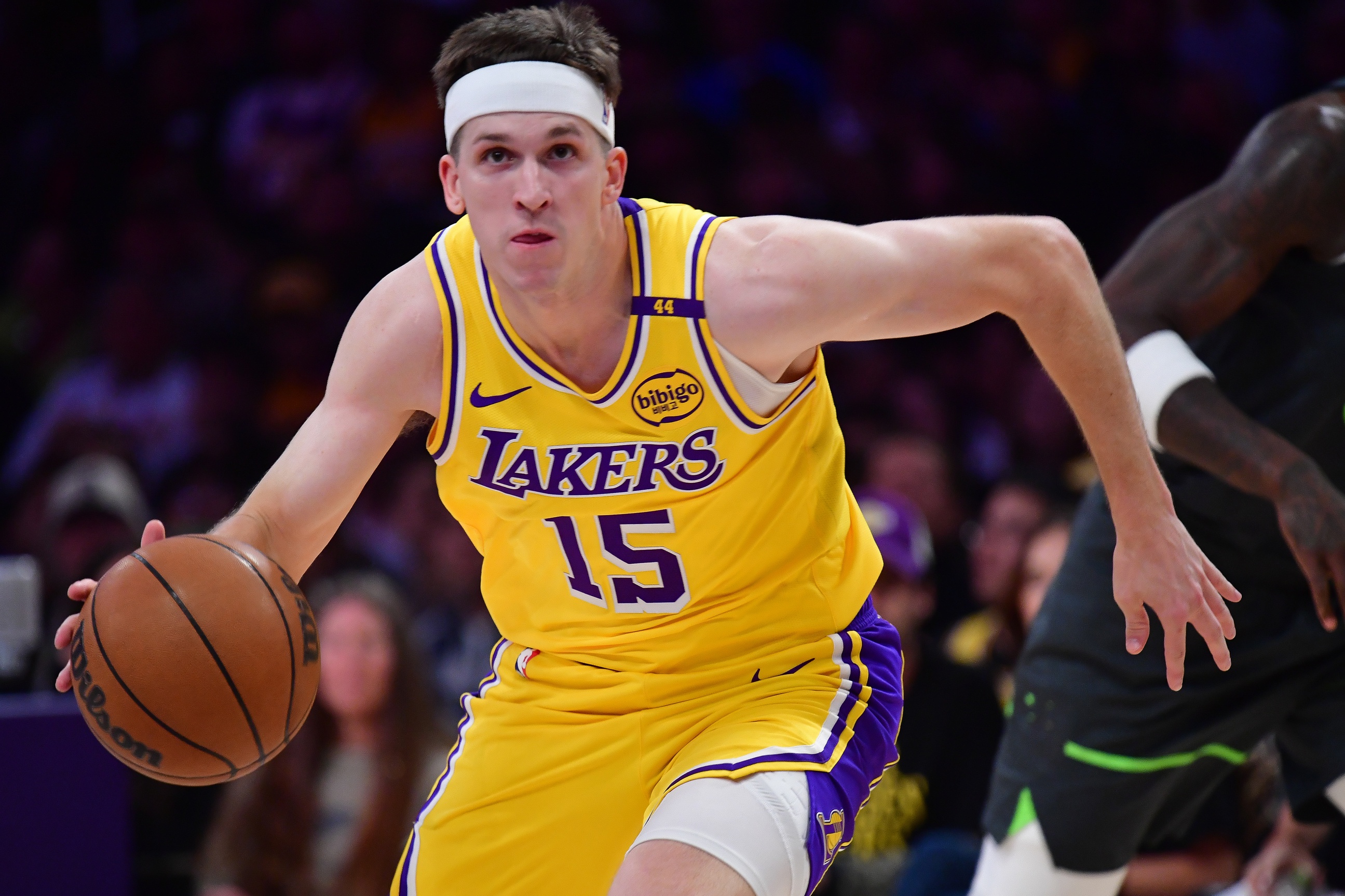 © USA Today Sports
Austin Reaves is the kind of story we love to celebrate in sports. He’s from a small town in Arkansas. He was a high school hero, leading his team to state championships. He started his college career at Wichita State before transferring to Oklahoma. After going undrafted at the 2021 NBA Draft, Reaves signed a two-way deal with the Los Angeles Lakers. He didn’t even make it to the start of the season on a two-way before the Lakers signed him to a standard deal. A solid rookie season was followed by a breakout second season. The Lakers then inked Reaves to the four-year, $54 million contract that he’s on now. Reaves and his representatives were prescient enough to get a player option on the final year of the deal.
Normally, for a player like Reaves, a next contract is pretty simple. He’s entering his prime years. Reaves has improved each year that he’s been in the NBA, averaging 20.2 points (on good efficiency), 5.8 assists, 4.5 rebounds and 1.1 steals last season. The 6-foot-5 combo guard is also good on- and off-ball, which is crucial on a Lakers team led by Luka Doncic and LeBron James (for now, at least, with the latter!).
That’s the profile of a player you don’t mess around with. You get them paid and you move forward knowing you have a backcourt spot taken care of for years to come.
However, Reaves has outplayed his current deal, and by a sizable margin too. That’s not to suggest that Reaves or his representatives did anything wrong with his last contract. He was coming off a nice season, but wasn’t at the level he’s at now. He was also a restricted free agent, which limits a player’s options. Reaves took the most the Lakers could offer, with his team being smart to snag a player option on his final season. Now that’s he leveled up to a borderline All-Star, Reaves is set to cash in on his next deal.
Despite being extension-eligible right now, Reaves and his reps have made it clear that they have no real intentions of signing an extension. Barring something unexpected, the 27-year-old guard will play this season for $13.9 million, then he’ll opt out of his deal and become an unrestricted free agent in the summer of 2026.
We’re going to look at some of the options for Reaves on his next deal. This will explain why Reaves won’t extend now, and why that should ultimately benefit both him and the Lakers.
The Veteran Extension
This season, Austin Reaves is set to make just over $13.9 million. For reference: that’s less than the Non-Taxpayer MLE for this season. That makes him one of the best value contracts in the entire NBA. It also makes his contract basically un-extendable.
Here’s what the Lakers can offer Reaves right now in a veteran extension:
- 2026-27: $19,512,604
- 2027-28: $21,073,612
- 2028-29: $22,634,620
- 2029-30: $24,195,628 (player option)
- Total: four years, $87,416,464
That’s 140% of Reaves’ current salary with 8% raises. We included a player option on the deal, as Reaves has one now and will likely get one on his next contract too.
(Side note: Reaves’ current salary is just a hair over the Estimated Average Player Salary. Players are allowed to extend for 140% of the greater of their current salary or the EAPS. In this case, Reaves would extend off his current salary.)
This extension would be an AAV of about $21.8 million. Not bad, right? Sure, but it’s not enough for a player of Reaves’ caliber. A starting salary of a bit more than $19.5 million for the 2026-27 season would rank as the 89th largest in the NBA. Among guards, that would be the 39th largest salary in the NBA next season. It’s not a perfect frame of reference, but Reaves ranked as the 60th-best player in ESPN Top 100 for 2025. That was up from 72nd in the previous season.
No matter how you slice it, Reaves would be underpaid immediately if he signed a veteran extension with the Lakers right now.
Re-Signing with the Lakers as a free agent
The most likely path for Austin Reaves is to decline his $14.9 million player option for 2026-27, then to re-sign with the Lakers as an unrestricted free agent. For reference, here’s the projected max the Lakers could offer Reaves next summer:
- 2026-27: $41,500,000
- 2027-28: $44,820,000
- 2028-29: $48,140,000
- 2029-30: $51,460,000
- 2030-31: $54,780,000 (player option)
- Total: five years, $240,700,000
That’s the full 25% of the cap max with a projected cap of $166 million for next season. The deal also includes 8% raises, and we again added a player option to the final season. If Reaves played out the entire run of the deal, it would take him through his age-32 season.
A starting salary of $41.5 million for next season would rank Reaves as tied for 35th among all players and would come in at 16th among all guards. So, we’re probably a tad high here, both in terms of starting salary and total salary.
RELATED: 2025-26 Lakers' Cap Table
Signing with another team as a free agent
When Austin Reaves signed his current contract, he was a restricted free agent. Even though it’s been well-reported that the San Antonio Spurs were looming with a potential offer sheet, the Los Angeles Lakers still controlled the process because of Reaves restricted status. This time around, Reaves will be an unrestricted free agent. That means another team could swoop in with a big offer for the combo guard. Here’s the projected max contract Reaves could get from a rival team in the 2026 offseason:
- 2026-27: $41,500,000
- 2027-28: $43,575,000
- 2028-29: $45,650,000
- 2029-30: $47,725,000 (player option)
- Total: four years, $178,450,000
This deal starts at the same 25% of the cap max, but includes only 5% raises. And players are limited to signing for just four years when they sign with a new team. For reference, the four-year-to-four-year comparisons are $178.5 million with a new team vs $185.9 million with the Lakers.
This is still a bit high, but if a team was going to convince Austin Reaves to leave Los Angeles, they’re going to have to make it worth it. That means probably pushing somewhere into max territory, even if going all the way to the max shouldn’t be necessary.
Of course, for Reaves to sign elsewhere, teams would need to have interest and, likely, cap space. The good news for Reaves, is that somewhere between six and 10 teams project to have cap space in the summer of 2026. That group includes the Lakers, but also crosstown rivals, the LA Clippers. Of teams further down the contention pecking order, the Washington Wizards, Utah Jazz, Brooklyn Nets and Chicago Bulls all project to have significant cap space.
Austin Reaves cap hold and the Lakers 2026 cap space
The Los Angeles Lakers are in transition. Luka Doncic is there now, and he’s locked up on an extension. LeBron James is there for now, but that does feel very much like it’s “for now”. This is the first time in his career that James doesn’t have a contract, even with a player option, for the next season. He’s not extension-eligible, so the NBA’s all-time leading scorer will be an unrestricted free agent in 2026. Will he return to LA? Will he play elsewhere? Will James retire? Only he knows those answers.
James being a free agent has the Lakers in position to be a cap space player next summer. And we all know that when the Lakers have cap space, they’ll be in position to do something big.
(Note: If LeBron James re-signs with the Lakers, they won’t have cap space in the summer of 2026.)
As of right now, if the Lakers were to clear the books of their pending free agents, minus Austin Reaves, they project to have nearly $55 million in cap space. That’s with Reaves on the books with a $20.9 million cap hold.
This is where Reaves’ current salary coming in just above the Average Player Salary is important. If that holds, then Reaves’ cap hold will be the figure above. If Reaves’ salary slips below the Average Player Salary, then his cap hold would go to $26.5 million. That would shave about $5.6 million of cap space off the Lakers projection. That’s important because a 30% of the cap max salary projects to land at $49.8 million for players with 7-to-9 Years of Service and at $58.1 million for a 35% of the cap max salary for players with 10-plus Years of Service. Right now, we’re going to keep Reaves’ cap hold at the lower figure of $20.9 million. That would give the Lakers enough cap space to sign a 30% of the cap max, and puts them easily within range of a 35% of the cap max.
If Los Angeles goes the cap space route, they’d also have the projected $9.4 million Room Exception. That could be enough to entice Deandre Ayton to opt out, re-sign via the Room Exception for next season, then the Lakers could re-sign him in 2027 using Early Bird rights. Just don’t put any of that in writing anywhere, ok? For Reaves, his cap hold of $20.9 million is very likely to be lower than his starting salary on a new deal. That means that the Lakers would take care of spending their cap space, then they’d re-sign Reaves later in terms of order of operations.
Let’s pause here…We don’t know who will be available as free agents in the summer of 2026. There could be players like Trae Young, James Harden, Zach LaVine, Draymond Green and Coby White on the market as unrestricted free agents. Dyson Daniels, Keegan Murray, Walker Kessler, Shaedon Sharpe, Tari Eason, Jalen Duren, Jaden Ivey and Bennedict Mathurin could all hit restricted free agency if they don’t come to agreements on extensions. And, of course, there will be high-salary veterans available via trade. Maybe even someone like, say, Giannis Antetokounmpo.
At that point, adding a new max player via free agency or trade, the Lakers roster could look something like:
- Luka Doncic
- Austin Reaves
- Max Player X
- Deandre Ayton
- Jake LaRavia
- Jarred Vanderbilt
- Marcus Smart
- Dalton Knecht
That roster would need to hit on a handful of veteran minimum signings, as well as getting something from their 2026 first-round pick, but that would be a pretty good place to start from. And if the Lakers didn’t go all-in on one player, they could split their cap space between a couple of impactful signings, which would help round out the depth of the roster considerably.
Lastly, if Reaves were leave the Lakers for another team, his cap hold would come off the books. That would leave Los Angeles with nearly $75 million in projected cap space. Not a bad consolation prize, as they’d reset the roster around Doncic.
RELATED: 2026-27 Lakers' Cap Table
Austin Reaves Next Contract
Bringing things back around to Austin Reaves and his next deal…it’s likely to come with Los Angeles. The Lakers love Reaves and he loves being a Laker. Despite making it clear that there won’t be an extension signed, both Reaves and the Lakers have said that they intend for their partnership to continue. That leaves the question of:
What’s a fair value for Reaves on his next deal?
We’ve already covered that the Lakers can use cap space while retaining Reaves’ cap hold. That means that there is no reason to “fit him in” around signing other players. If the team goes the cap space route, the Los Angeles should still be able to avoid being a luxury tax team too. A starting salary of $32 million for the 2026-27 season would rank Reaves at 58th among all players, and 29th among guards. For reference, that would drop the Lakers guard in a salary neighborhood among Tyler Herro, Dejounte Murray, Immanuel Quickly, Jalen Suggs, Aaron Gordon, Derrick White, Andrew Wiggins and Jalen Johnson.
That feels about the correct spot, as some of those players are overpaid, some are underpaid and some feel just about right.
If Reaves’ starting salary nudged up to $35 million for the 2026-27 season, he’d be the 49th highest player overall and 23rd among all guards. His salary neighbors then become Jalen Green, Alperen Sengun, Jrue Holiday, Jerami Grant, Jordan Poole, Mikal Bridges and Julius Randle. That’s an even more eclectic mix, despite the first-year salary bumping up by just $3 million. If the Lakers are concerned about long-term money, they could pitch the idea of starting Reaves high at $35 million, then having the contract descend year to year. Having a higher salary in 2026-27 shouldn’t be an issue, as Los Angeles shouldn’t have any tax concerns. Then, having Reaves on a lower number in the out years will be important for when Luka Doncic eventually signs a 35% of the cap max.
Here's what that deal could look like for Reaves and the Lakers:
- 2026-27: $35,000,000
- 2027-28: $32,200,000
- 2028-29: $29,400,000
- 2029-30: $26,600,000
- 2030-31: $26,600,000 (player option)
- Total: five years, $149,800,000
Given that something in the range of $150 million over five years seems fair for Reaves and the Lakers in terms of total value, this structure should be workable. Maybe the Lakers have to go a bit higher in first-year salary, but that shouldn’t be an issue. They’ll have an idea of how far they can go without tripping into tax territory.
The other beneficial part of this structure is that the deal would be extendable. The Lakers could easily extend Reaves off of the $26.6 million he’d be making in 2029-30. He’d be in his early-30s at that point, and a deal that bumps up to $30 million would be fair value, assuming Reaves continues to be a productive player over the next handful of seasons.
Summary
The Los Angeles Lakers and Austin Reaves are going to sign a new contract, barring something really unexpected. It’s just not going to happen until the summer of 2026. And that’s fine, because by then the Lakers should have more clarity on what’s happening with LeBron James and their potential cap space plans.
The key for Reaves is getting paid, after outplaying his current deal. The key for Los Angeles is managing their cap sheet and roster-building ability around max deals for Luka Doncic. The good news? Both things are well within range, given the great relationship between Reaves and the Lakers. There will be some negotiating, of course, but it would be a surprise to see Reaves playing anywhere but Los Angeles after this season.
RELATED: 2025-26 Lakers' Cap Table
 © USA Today Sports
 © USA Today Sports
 © USA Today Sports


 Trevor Ruszkowski-Imagn
 © USA Today Sports