Taylor VincentSeptember 11, 2025
© USA Today Sports

On September 2nd, FIFA published the detailed breakdown of the 2025 mid-year transfer window. This includes the time period of June 1st through September 2nd — although the English Women’s Super League’s window closed September 4th, so not every transfer is encompassed in the data below. 

The transfer fees climbed to $12.3 million this summer, an increase of more than 80% compared to the mid-2024 window, and the highest ever. Additionally, the total number of transfers set a new record at 1,185. 

The USA emerged as the biggest spender, investing more than $4 million USD, the highest amount ever reported for women’s football. The leading associations by the number of incoming transfers were Germany, England and the USA.

*Reminder that the USA numbers in this article include both the NWSL and the USL Super League*

International Transfers During the Mid-year Transfer Window

For the USA, 2025 marked a 45.7% reduction in incoming transfers, which likely can be attributed to the fact that 2024 was the USL Super League’s first season with Division I sanctioning and kicked off in mid-August, so a large number of incoming transfers were due to initial roster building. 


Even with the reduced number of incoming transfers, the USA’s transfer fees almost quadrupled year over year while the global trend almost doubled in both total fees. 

International Transfers by Type

Comparison of Transfer Activity By Region - USA v England v France

This year’s mid-year transfer window also marked a 100% increase in outgoing transfers from the USA. 


Top Five Partner Associations during the 2025 Mid-year Transfer Window

Average transfer fees and % of international transfers with fees during the mid-year transfer window

The global average transfer fee increased year-over-year by almost 20% while the USA’s average transfer fee increased by over double, with an impressive trend over the last couple of years. 


Reference Data: https://inside.fifa.com/transfer-system/transfer-reports?tab=Women%27s+mid-year+transfer+snapshot+2025 


Dan SoemannSeptember 08, 2025

The final month of the 2025 MLB season is here, and Spotrac is tracking all of the various player performance incentives that could pay out. This reviews the incentives earned over the past week and gives a glimpse of bonuses that could be added over the next 7 days.

Earned:
Ryne Stanek (RP, Mets)
Stanek earned $100k each for reaching 50 and 55 appearances, and could add the same amount for 60, 65, and 70 games.

Harrison Bader (OF, Phillies)
Bader earned an extra $200k for 400 plate appearances and could keep adding to that total for every 25 PAs through 500.

Jose Quintana (SP, Brewers)
Quintana added another combined $1.1M for reaching 22 starts ($1M) and 120 innings pitched ($100k). He already earned an additional $3.55M and the incentives can max out at $5.75M if he reaches 26 starts and 140 innings.

Luke Weaver (RP, Yankees)
Weaver earned $200k for 55 relief appearances and could add another $50k for 60 games.

Jeff Hoffman (RP, Blue Jays)
Hoffman reached 60 innings pitched, which added $500k to his $11M earnings for 2025.

Rafael Montero (RP, Tigers)
Montero earned $100k for reaching 50 appearances and could add the same amount for 55, 60, 65, and 70 games.

Up Next:
Justin Wilson (RP, Red Sox)
Earns $150k for 55 Pitching Appearances - 54 G in 2025

Robert Suarez (RP, Padres)
Earns $500k for 50 Games Finished - 49 GF in 2025

Andres Munoz (RP, Mariners)
2026-28 Club options increase by $250k for 40 Games Finished - 39 GF in 2025

Brooks Raley (RP, Mets)
Earns $125k for 20 Pitching Appearances - 19 G in 2025

Pete Fairbanks (RP, Rays)
2026 option escalates $1M for 150 combined pitching appearances between (2023-25)

Hoby Milner (RP, Brewers)
Earns $150k for 65 Innings Pitched - 63.1 IP in 2025


Taylor VincentSeptember 04, 2025
© USA Today Sports

We’re 10 weeks into the 2026 free agency period, and all 15 players that are signed for 2026 have stayed with the team that they are currently playing on. Meanwhile, there are 120 players available in free agency, and one player has already announced their retirement from the NWSL—but not from playing elsewhere. 

NWSL Free Agency Tracker


Of the 12 teams, Seattle has led the way in re-signing their free agents with three, while Angel City, Houston, San Diego, and Washington don’t have any yet. Looking at the free agency trends, last season’s free agency started during the season, but by week 9 already had 25 players re-signed to their current team. 

Previous iterations of free agency saw an initial year of mostly players staying with their current team, to 2024 free agency that had players moving and staying evenly, to 2025 where there was an even harder swing to players staying with their current teams. 

Considering the first five months of 2026 free agency are during the 2025 season, it is unlikely that we will see any players signing with different teams for the upcoming season until the current one concludes. 


*Not including players on loan through June 2026

Looking at teams’ current roster situation for 2026, Washington leads the way with 25 players signed, while the average number of players for non-expansion sides is 19-ish players. Boston Legacy has a head start on their expansion counterpart Denver with seven players to Denver’s two.  


*Not including players on loan through June 2026

The other thing to consider for 2026 rosters is the international spots. Washington again leads the way with -3 international spots, which they’ll have to figure out what to do about before the roster compliance date in pre-season. Portland is the other club without any unutilized slots, while Racing leads the way in non-expansion clubs unused spots.

Dan SoemannSeptember 02, 2025

The final month of the 2025 MLB season is here, and Spotrac is tracking all of the various player performance incentives that could pay out. This reviews the incentives earned over the past week and gives a glimpse of bonuses that could be added over the next 7 days.

Earned:
Andrew Heaney (SP, Pirates)
Heaney earned $50k for reaching 120 innings pitched before the Pirates released him.

Brooks Raley (RP, Mets)
Raley earned $125k each for 10 and 15 games and could add the same amount if he reaches 20 appearances later this week.

Justin Wilson (RP, Red Sox)
Wilson earned $150k each for 40, 45, and 50 appearances and could add up to $300k more if he reaches 60 games.

Patrick Corbin (SP, Nationals)
Corbin has earned $1.15M for reaching 130 innings, which more than doubles the $1.1M contract he signed in free agency.

Chris Paddack (SP, Tigers)
Paddack earned $500k by surpassing 140 innings and could add more over the coming weeks.

Pete Fairbanks (RP, Rays)
Fairbanks completed his 40th game, which escalates his 2026 Club option by $500k. In total, that option has increased by $3.5M from $7M to $10.5M and Fairbanks will likely add another $1M in the final weeks.

Andrew Kittredge (RP, Cubs)
Kittredge has added $150k for reaching 45 games and could add another $100k if he makes 10 more appearances down the stretch.

Up Next:
Brooks Raley (RP, Mets)
Earns $125k for 20 Pitching Appearances - 18 G in 2025

Andres Munoz (RP, Mariners)
2026-28 Club options increase by $250k for 40 Games Finished - 39 GF in 2025

Hoby Milner (RP, Brewers)
Earns $150k for 65 Innings Pitched - 62.2 IP in 2025

Justin Wilson (RP, Red Sox)
Earns $150k for 55 Pitching Appearances - 53 G in 2025

Ryne Stanek (RP, Mets)
Earns $100k for 55 Pitching Appearances - 54 G in 2025

Michael GinnittiAugust 31, 2025
© USA Today Sports

A visual look at how each NFL team is allocating their finances defensively. The following dataset includes the combined average salaries of all players either on the active roster or a reserve list for their respective team. The data has been categorized into Edge Defenders, Interior Defensive Linemen, Linebackers, Cornerbacks, & Safeties.

Total Defense

Average: $132M

If we’re talking “percent of cap” here, NFL teams are allocating 47% of their contracts to the offensive side of the ball this season. The Texans ($179M) and Steelers ($173) carry top allocations, while the Rams ($53M) bring up the rear by nearly $15M. Closest to the pin in terms of league average? KC ($132M).

Edge Defenders

Average: $35M

No surprise here, but Green Bay’s ($79M) recent acquisition/extension for Micah Parsons vaulted them to the top of this list (by nearly $11M). They surpassed San Francisco, who recently held the belt with Nick Bosa and friends on the books. 9 teams are allocating less than $20M to their edge rush, with the Rams ($8.8M) comfortably bringing up the rear.

Interior Defensive Linemen

Average: $31M

Back-to-back strong offseasons have lifted the ceiling on this position greatly. In fact, teams are spending nearly as much on average here as they are on the edge. The Panthers, Broncos, Patriots, and Lions all have $50M+ pumped into the middle of their D-Line, while 8 teams are at the $40M+ mark. The Packers, fresh off a move that traded Edge for Interior, now carry a league-low $7.5M at this position group.

Linebackers

Average: $19M

A position group that continues to slide down the ranks in terms of overall value and growth now has more than half of the league spending less than $20M total for the upcoming season. The Bears ($33M) and Commanders ($31M) hold healthy leagues in terms of LB spending, while three teams - the Chargers ($9M), Panthers ($6M) and Rams ($4M) are going in a different direction.

Cornerbacks

Average: $28M

5 massive extensions gave this position a much-needed ceiling lift this summer, heading toward a season where 6 teams are allocating at least $40M to their CB room. The Jets ($59M), Cowboys ($52M), and Texans ($51M) lead the list, with LV ($9.6M), CIN ($9.5M), and NO ($9.2M) bringing up the rear.

Safeties

Average: $18M

Newly minted extensions for Kyle Hamilton, & Kerby Joseph reset the market in almost every fashion, but this is still the lowest paid defensive group on average (just barely below linebackers). Hamilton’s big deal vaulted Baltimore to the top allocation ($34M), while 6 teams enter 2025 with less than $10M assigned to their safeties. The Chiefs carry a league low $3.8M at the time of this piece.

  EDGE IDL LB CB S TOTAL DEF
AVG $34,498,899 $31,724,481 $19,104,699 $28,348,397 $18,884,382 $132,560,857
HOU $64,313,466 $19,869,582 $19,943,987 $51,038,996 $24,583,200 $179,749,231
PIT $60,415,963 $32,669,159 $27,149,980 $39,484,058 $14,000,000 $173,719,160
JAX $44,327,322 $33,359,650 $19,851,469 $45,730,625 $19,091,002 $162,360,068
CHI $43,605,574 $24,999,004 $33,805,363 $41,958,985 $13,907,218 $158,276,144
DEN $20,141,716 $56,193,430 $21,714,515 $32,002,234 $25,135,722 $155,187,617
BUF $48,333,315 $37,093,109 $20,409,619 $40,035,472 $8,175,333 $154,046,848
NYG $54,686,055 $33,069,047 $16,246,655 $28,885,949 $20,195,636 $153,083,342
NE $24,440,873 $54,057,287 $25,778,260 $26,957,987 $21,562,944 $152,797,351
DAL $15,408,620 $49,757,786 $14,151,883 $52,775,875 $18,907,500 $151,001,664
MIN $48,728,383 $36,974,174 $13,103,100 $29,942,553 $20,230,000 $148,978,210
DET $15,814,760 $51,368,504 $23,982,481 $30,074,615 $27,235,006 $148,475,366
ARI $42,425,093 $38,230,221 $20,172,434 $12,904,535 $33,091,711 $146,823,994
CLE $48,502,461 $27,481,005 $23,775,934 $28,693,175 $16,741,667 $145,194,242
NYJ $10,538,358 $35,774,167 $24,840,298 $59,166,981 $13,037,535 $143,357,339
GB $79,160,478 $7,480,214 $12,029,646 $20,855,176 $22,830,822 $142,356,336
SF $68,320,416 $11,578,267 $27,559,203 $28,887,906 $5,689,280 $142,035,072
BAL $13,719,882 $33,919,061 $24,822,935 $32,340,759 $34,521,981 $139,324,618
CAR $19,896,942 $56,663,289 $5,883,292 $34,542,673 $20,421,779 $137,407,975
WAS $15,285,297 $41,194,498 $31,209,893 $32,175,644 $16,494,333 $136,359,665
IND $24,154,799 $39,491,912 $16,176,527 $34,166,226 $21,412,375 $135,401,839
KC $42,468,523 $36,762,593 $27,829,639 $22,052,750 $3,853,962 $132,967,467
ATL $23,022,396 $20,495,910 $20,254,129 $32,868,382 $21,090,252 $117,731,069
TB $24,251,800 $28,354,931 $13,305,998 $20,913,420 $28,216,181 $115,042,330
MIA $21,907,390 $31,062,405 $18,887,051 $18,453,163 $23,956,755 $114,266,764
SEA $31,251,124 $38,172,341 $12,701,473 $13,093,110 $16,929,766 $112,147,814
TEN $18,628,959 $37,003,110 $11,108,496 $25,800,247 $18,123,748 $110,664,560
NO $31,100,000 $24,723,184 $19,378,160 $9,239,761 $20,919,650 $105,360,755
CIN $45,653,732 $22,409,194 $15,843,650 $9,534,428 $9,097,221 $102,538,225
LV $54,967,828 $10,002,415 $11,702,062 $9,596,278 $15,815,244 $102,083,827
LAC $28,955,487 $13,464,457 $9,256,190 $16,062,831 $33,405,737 $101,144,702
PHI $10,731,361 $14,249,365 $24,263,036 $11,272,590 $7,831,246 $68,347,598
LAR $8,806,383 $17,260,129 $4,213,000 $15,641,310 $7,795,415 $53,716,237
Michael GinnittiAugust 31, 2025
© USA Today Sports

A visual look at how each NFL team is allocating their finances offensively. The following dataset includes the combined average salaries of all players either on the active roster or a reserve list for their respective team. The data has been categorized into Quarterbacks, Running Backs, Wide Receivers, Tight Ends, and Offensive Linemen.

Total Offense

Average: $157M

If we’re talking “percent of cap” here, NFL teams are allocating 56% of their contracts to the offensive side of the ball this season. The Eagles ($247M) and Seahawks ($96M) are considerable outliers on each side of this spectrum, with the former sitting $45M above the rest of the league, and Seattle sitting $20M below it. The Top 5 allocated offenses are currently Philadelphia, San Francisco, Cincinnati, Minnesota, and Detroit.

Quarterbacks

Average: $37.3M

The Cowboys lead the league with a $61.05M allocation, thanks of course to Dak Prescott's $60M per year contract. 14 teams carry a $50M+ allocation, while 11 currently sit under the $20M mark. The Saints bring up the rear at $3.8M, though it should be noted that New Orleans is paying out $10M cash to Derek Carr per the terms of his retirement.

Running Backs

Average: $11.7M

The 49ers ($23.7M) slightly edge Philly ($23.1M) for the top spot here, with these teams carrying quite a bit of separation from the rest of the league. 14 teams are carrying a total running back allocation of less than $10M in 2025, with the Dolphins ($5M), Buccaneers ($4.3M), and Bengals ($3.9M) bringing up the rear.

Wide Receivers

Average: $36.5M

No surprise, but the Bengals ($73.5M) extended themselves into the top WR allocation - by more than $8M. Miami ($65.6M) and Philly ($63.8M) round out the Top 3, while the Commanders’ recent extension for Terry McLaurin raised them into the 4th spot ($55.8M). At $13.1M, Jordan’s Love WR room in Green Bay remains the low mark.

Tight Ends

Average: $14.3M

Adding/extending Jonnu Smith to the room this summer vaulted Pittsburgh ($27.5M) to the top TE spot. Minnesota ($26.3M) and the Chiefs ($26.3M) round out the Top 3. 13 teams have less than $10M allocated to their TE room, with Tennessee ($3.2M) bringing up the rear.

Offensive Line

Average: $57M

There are a lot of reasons why the tush-push remains successful, but allocating nearly $95M to an offensive line is certainly one of them. Philly holds the belt here by $8.5M, overtaking KC ($86.1M), and Minnesota ($85.7M) for the upcoming season. 6 teams enter 2025 with less than $40M allocated to their O-Line, with the Jets ($32M), Steelers ($27M) and Seahawks ($22M) bringing up the rear.

  QB RB WR TE OL TOTAL OFFENSE
AVG $37,297,076 $11,738,600 $36,579,519 $14,388,143 $57,011,458 $157,014,796
PHI $53,012,030 $23,121,741 $63,822,176 $12,708,536 $94,645,922 $247,310,405
SF $60,088,559 $23,772,280 $50,215,856 $25,380,000 $43,214,402 $202,671,097
CIN $55,972,500 $3,939,253 $73,544,764 $19,239,040 $39,350,201 $192,045,758
MIN $7,455,366 $16,239,710 $53,261,729 $26,348,956 $85,752,098 $189,057,859
DET $54,270,000 $17,064,669 $42,360,754 $8,803,998 $65,487,347 $187,986,768
KC $46,170,000 $7,048,146 $17,735,668 $26,300,488 $86,183,430 $183,437,732
BUF $57,625,000 $15,183,297 $36,970,732 $14,320,143 $55,327,767 $179,426,939
MIA $60,182,894 $5,010,033 $65,638,499 $3,895,833 $44,376,876 $179,104,135
LAR $46,139,785 $13,740,636 $36,015,475 $19,449,611 $61,265,686 $176,611,193
ATL $51,560,659 $7,481,441 $28,287,016 $14,767,624 $73,955,289 $176,052,029
WAS $18,859,163 $7,658,857 $55,806,403 $17,103,655 $72,681,774 $172,109,852
DAL $61,050,829 $6,572,150 $43,686,124 $15,916,005 $40,384,816 $167,609,924
CLE $52,968,426 $5,115,999 $25,620,480 $16,403,222 $62,115,278 $162,223,405
GB $56,290,025 $15,405,175 $13,095,351 $5,905,084 $71,082,704 $161,778,339
CHI $17,121,515 $13,918,373 $39,587,133 $21,659,002 $66,897,582 $159,183,605
IND $23,607,319 $17,356,186 $33,583,472 $9,432,358 $71,777,183 $155,756,518
JAX $57,250,000 $6,971,576 $29,675,343 $6,778,583 $54,847,405 $155,522,907
LAC $54,500,000 $10,781,671 $13,310,400 $9,725,176 $65,134,221 $153,451,468
ARI $52,350,000 $12,948,235 $17,894,884 $22,481,449 $46,747,720 $152,422,288
BAL $55,100,000 $19,981,800 $26,007,289 $16,132,306 $33,765,293 $150,986,688
HOU $15,176,932 $16,168,133 $54,685,122 $16,519,734 $44,057,285 $146,607,206
TB $34,588,333 $4,362,054 $54,019,924 $4,119,280 $48,001,738 $145,091,329
DEN $10,653,292 $6,283,253 $30,381,138 $17,181,667 $77,244,541 $141,743,891
CAR $13,488,768 $14,456,457 $15,217,252 $8,651,301 $77,518,447 $129,332,225
NE $14,189,941 $17,492,476 $32,463,064 $14,000,000 $51,057,778 $129,203,259
TEN $16,017,946 $10,832,281 $35,624,090 $3,280,145 $58,054,780 $123,809,242
NYG $18,744,482 $8,916,092 $26,828,224 $5,829,347 $62,742,126 $123,060,271
LV $42,104,321 $12,718,734 $21,528,450 $8,387,607 $38,291,838 $123,030,950
PIT $19,612,025 $8,729,016 $39,052,377 $27,572,283 $27,423,634 $122,389,335
NYJ $26,000,000 $5,899,440 $49,493,746 $7,908,392 $32,705,284 $122,006,862
NO $3,790,300 $14,776,408 $21,719,148 $26,243,418 $50,329,163 $116,858,437
SEA $37,566,022 $5,689,628 $23,412,529 $7,976,340 $21,947,039 $96,591,558
Keith SmithAugust 29, 2025
© USA Today Sports

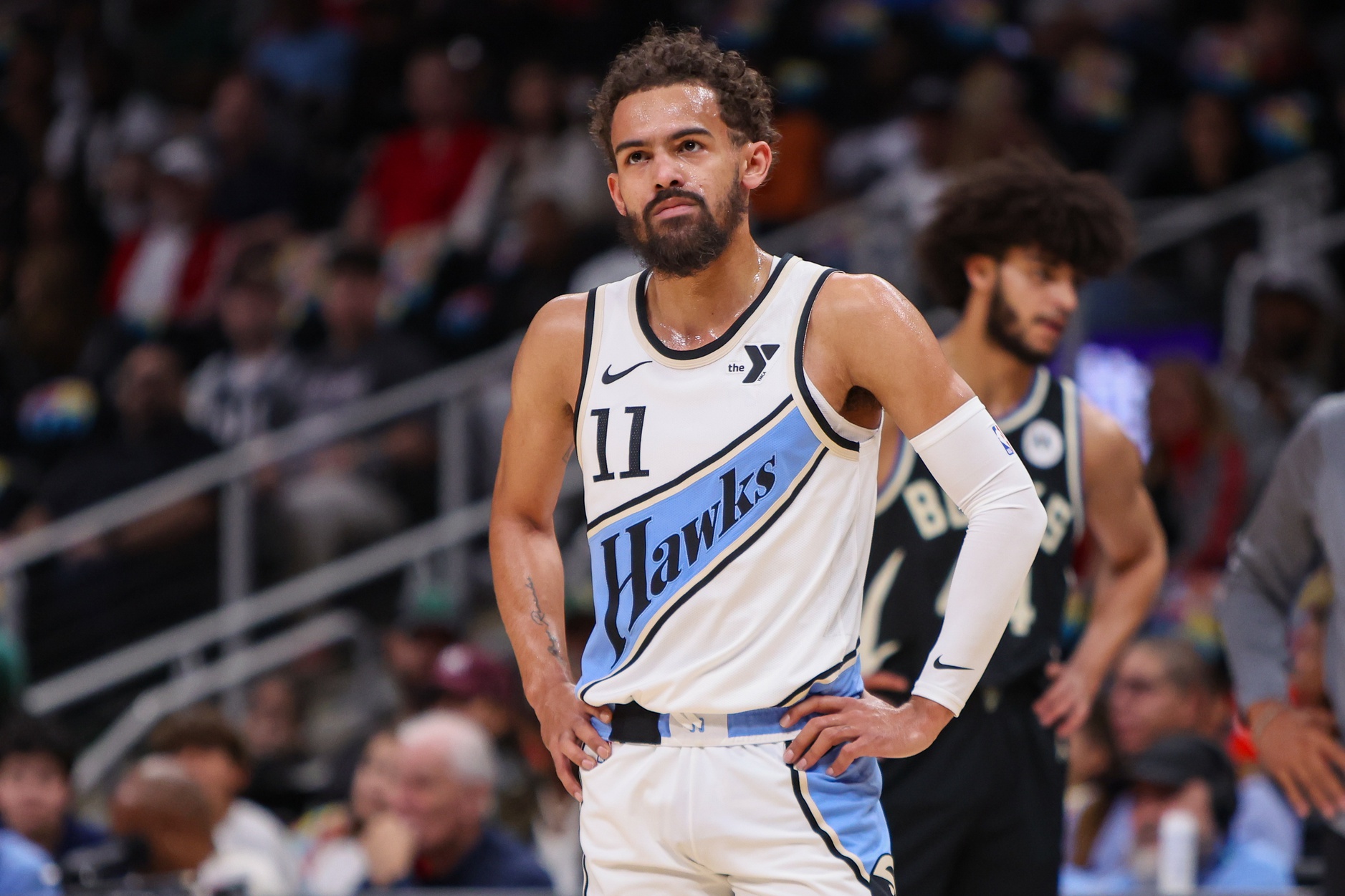
In the summer of 2021, the Atlanta Hawks were flying high. The team was coming off an unexpected run to the Eastern Conference Finals. The team’s young core was coming together nicely. The future was bright.

That offseason saw Atlanta ink Trae Young to a Designated Rookie Extension, despite the guard having yet to make an All-NBA team. But with Young’s and the team’s stars on the collective rise, no one really blinked.

Young was named to the All-NBA Third Team for the 2021-22 season, which meant his extension bumped up to 30% of the cap starting with the 2022-23 season. It’s that contract that Young is nearing the end of now.

Starting with 2021-22, things got a little sideways for Atlanta. They were unable to build on the success of the prior season and bowed out in five games in the first round. The next season saw a similar result. The last two campaigns? The Hawks haven’t even made it to the playoffs, falling in the Play-In Tournament each season.

As for Young, he hasn’t made another All-NBA team. The star guard is now coming off his worst shooting and scoring season since his rookie year. However, that’s not to suggest that Young has been bad. Not by any means. He’s just set the bar fairly high for himself.

In fact, Young has improved his assists per game in each of his first seven NBA seasons. That culminated in leading the league with 11.6 assists per game last season. For context, that’s the 23rd-most assists per game in NBA history. And Young did it while also averaging 24.2 points and carrying a pretty middling Hawks offense, especially after Jalen Johnson went down for the season.

In addition, last season was probably the best Young has ever played defensively. No one would suggest he was close to winning accolades, but Young showed real effort on defense. For the Hawks to get to where they want to go, they need that version of Young to be there every night on the defensive end.

For Atlanta to become a contender, they also need to smartly manage the cap sheet. That’s where Young’s next contract comes in. And it’s a trickier one than many seem to realize.

On one hand, Young is an established All-Star. He’s made four All-Star teams, including in three of the last four seasons. He’s one of the best playmakers in the NBA. Despite having a down shooting season last year, Young is still deadly from deep, in combined volume and efficiency.

On the other hand, Young is small guard who will get picked on defensively, despite the improved effort. The Hawks have had one good playoff run with Young leading the way. And Atlanta has to be wary of locking in too many players and seeing their cap sheet return to being bloated. In addition to Young, Dyson Daniels and Kristaps Porzingis are also due for new deals. There’s a lot the front office has to do over the next year or so.

As of this writing, reporting has been that the Hawks have no real desire to engage in deep extension negotiations with Young. They want to see how he looks with a much-improved roster around him this season. Given that Young has two years left on his current deal, but with a looming player option for 2026-27, that could be a risky strategy.

Here are some of the different contract options for Young, both now and next summer. We’ll explain the math, plus some of the considerations that come with each one. Then we’ll close by suggesting something that might work for both Young and the Hawks.

The Veteran Extension

Young is eligible right now to sign a standard veteran extension. We’re going to assume that he’d decline his player option for 2026-27 to start the extension as soon as possible. That deal projects to look like this:

  • 2026-27: $49,641,600
  • 2027-28: $53,612,928
  • 2028-29: $57,584,256
  • 2029-30: $61,555,584 (player option)
  • Total: four years, $222,394,368

This extension starts at 30% of the cap and has 8% raises. Players of Young’s stature can almost always command a player option, so we tacked one onto the final season. It’s important to note that this extension would be limited to four years, because it’s a standard veteran extension. Only a designated veteran extension could add five new years to a contract. Young isn’t eligible a designated veteran extension as he hasn’t made All-NBA recently enough to sign that type of contract now.

Will Trae Young make All-NBA?

Let’s pause our contract analysis to discuss if Trae Young is an All-NBA candidate. Here’s where Young finished in each of the last three years, since he made the 2022 All-NBA Third Team:

  • 2022-23: 1 point (80 points from last Third-Team spot)
  • 2023-24: 0 points (70 points from last Third-Team spot)
  • 2024-25: 3 points (65 points from last Third-Team spot)

As you can see above, Young hasn’t been particularly close to make All-NBA in any of the last three seasons. That’s not really surprise, as his teams have struggled, despite his good individual stats.

But it’s also important to add some helpful context for Young’s All-NBA possibilities moving forward. First, the Hawks should be a good team this year. If they are, Young will be a driving factor. That will improve his All-NBA candidacy in a major way.

Next, with the games-played rules in place for All-NBA selections, some worthy candidates won’t be eligible. That helps a guy like Young, who rarely misses more than a handful of games.

Lastly, Young will be motivated to have a strong season. He’ll be pushing for that next big contract, assuming he doesn’t extend. That’s because he could still cash in big-time on a designated veteran contract. Let’s take a look at that now.

The Designated Veteran Contract (Supermax)

Let’s say Young and the Hawks can’t reach an agreement on an extension. The lead guard can still cash in on a so-called Supermax deal. If Young makes All-NBA (or wins MVP or DPOY, which are both unlikely), he’ll be eligible for the same deal he could have gotten in a designated veteran extension. It’ll just be as a new deal. Here’s what that would look like:

  • 2026-27: $57,915,200
  • 2027-28: $62,548,416
  • 2028-29: $67,181,632
  • 2029-30: $71,814,848
  • 2020-31: $76,448,064 (player option)
  • Total: five years, $335,908,160

That’s a 35% of the cap max in Year 1 with 8% raises. Same player option on the final season. But here’s the kicker, and it’s a big one: Because this would be a new contract, Young would be eligible to get an elusive No-Trade Clause. He’d have the required eight years of service, with at least four with the Hawks. You can’t get an NTC in an extension, unless it exists in the current deal. But since this would be a new contract, Young could push for an NTC. (Keep this is mind, because we’ll come back to it later.)

Re-signing with the Hawks in 2026

As with our above examples, we’re assuming that Young is going to opt out for next season. In that case, he’ll be an unrestricted free agent in the summer of 2026. For this example, let’s say Young has a good season, but doesn’t make All-NBA. Here’s the projected max deal the Hawks could sign him to:

  • 2026-27: $49,641,600
  • 2027-28: $53,612,928
  • 2028-29: $57,584,256
  • 2029-30: $61,555,584
  • 2020-31: $65,526,912 (player option)
  • Total: five years, $287,921,280

That’s a 30% of the cap max in Year 1 with 8% raises. As you can see, it’s about $48 million less than the designated veteran contract. But if Young doesn’t qualify, there isn’t anything that can be done on that front. This would be the most he could possibly get as a free agent. As with the designated veteran contract, Young would be eligible for an NTC, as this would be a new deal.

Signing with another team in 2026

If things go sideways for Young and the Hawks, he’ll have all kinds of options as an unrestricted free agent next summer. He’ll arguably be the best available free agent, as so few players actually reach free agency these days. Here’s what the projected max Young could get from another team in free agency looks like:

  • 2026-27: $49,641,600
  • 2027-28: $52,123,680
  • 2028-29: $54,605,760
  • 2029-30: $57,087,840 (player option)
  • Total: four years, $213,458,880

This contract would start at the same 30% of the cap max for next season. However, when changing teams, contracts are limited to 5% raises and four years. Clearly, that gives the Hawks a fairly large advantage on re-signing Young vs him moving to a new team.

A Workable Compromise

It would be going too far to say that the Atlanta Hawks don’t want to give Trae Young a max extension, either standard or designated. They may be ok to do that, just not today. The Hawks seem to be very focused on managing their cap sheet, while evaluating how their star player looks with an improved roster.

The slight issue with this approach is that there’s a very real clock on it. And that clock has already started ticking…kind of.

Atlanta and Young have until the final day of the offseason (October 20) to sign an extension. But it’s crucial to note that date only holds if Young picks up his player option for the 2026-27 season. If Young declines that option, his contract becomes an expiring one, and he’s extension-eligible through June 30.

So, the clock is ticking, but there’s a long way to go before time will actually run out. That means that Atlanta and Young can evaluate things into the season and can figure out where they are at all the way up to the start of the 2026 offseason.

There are a couple of ways the Hawks and Young can find common ground. If Atlanta is committed to keeping the cap sheet in a manageable range, they might stick on including any kind of Designated Player language in a deal. If Young isn’t insistent on getting the so-called supermax, then coming to terms on a standard veteran extension makes a lot of sense.

Young is a no-brainer 30% of the cap max player, even if you have some concerns about the weak points in his game. He’s one of the best offensive players in the league. Offense gets paid more than defense, so suggesting Young isn’t a 30% of the cap max guy is underrating him.

On a standard veteran extension, Young wouldn’t start at a salary much higher than the player option he’d be declining for 2026-27. The following years will likely grow faster than the cap, keeping Young in the 30-32% of the cap range every year, but that’s not the end of the world. Again, he’s a max player. This shouldn’t keep Atlanta from doing what they need to with the rest of the roster.

If the Hawks are stuck on not doing any kind of extension with Young, then a large chunk of the risk transfers to them. It’s not very likely Young would play so poorly that another team wouldn’t be willing to max him out in free agency. That means that the potential risk for Atlanta is that Young leaves town. Or, Young makes All-NBA and can command a designated veteran contract. At that point, he’d be making 35% of the cap and any savings the Hawks could have found will have evaporated.

Let’s say there is no extension, the Hawks have a good season, and Young is really solid, but not at an All-NBA level. Both sides want to stay together, but a full max deal isn’t on the table. This is where a compromise could make sense.

When Luka Doncic (who will forever be linked with Young due to the draft night trade involving both players) extended with the Los Angeles Lakers, he wasn’t eligible for a supermax extension. (A player can only get a Designated Extension or Contract from the team who drafted them or from a team that acquired the player while they were still on their rookie scale contract.) What Doncic and the Lakers did (similar to Donovan Mitchell and the Cleveland Cavaliers a year prior) was to sign a three-year, 30% of the cap max extension with a player option on Year 3. That will allow Doncic to opt out in 2028-29, when he’ll have 10 years of service and will be eligible for a 35% of the cap max.

Young is in a different situation than Doncic or Mitchell because he hasn’t been traded, but a similar structure (with a twist!) could work for him and the Hawks.

Let’s say the Hawks are insistent on a non-max deal in terms of years, then Young could wait until this summer and sign a deal that looks like this:

  • 2026-27: $49,641,600
  • 2027-28: $53,612,928
  • 2028-29: $57,584,256 (player option)
  • Total: three years, $160,838,784

That’s a 30% of the cap max, but only a three-year deal. Like Doncic, Young could opt out in 2028 when he has 10 years of service. He could than cash in for 35% of the cap at that time.

Here’s the twist: After this season, Young will have eight years of service and he’ll have spent all eight of them with the Hawks. That means Young will be eligible for a No-Trade Clause. In this kind of compromise. Atlanta should give it to him.

I’m sure you flinched at reading that, given the way things went sideways with Bradley Beal’s NTC, but this would be a bit different. If the Hawks are re-signing Young, then Year 1 isn’t really a consideration for trade purposes. At that point, there would be two years left and the final year is a player option. Because this is a shorter-term contract, and one for a younger player, the presence of the NTC isn’t nearly as worrisome as it would be on a four- or five-year deal. But it will give Young some measure of control, while on a short-term contract.

Giving a player a NTC isn’t something a team should do lightly. It can cause a lot of headaches down the line. However, if the Hawks aren’t willing to commit to Young on a full max extension (Designated Player or otherwise), this could be a workable compromise to keep moving forward together, while not taking any long-term options off the table.


Taylor VincentAugust 29, 2025
© USA Today Sports

The NWSL’s 55-day long Secondary Transfer Window officially closed on Monday, here’s an in-depth look at all the movement and how it compares to previous years. 

For a by-team breakdown of the window, check out the NWSL Secondary Window Tracker or the NWSL transaction tracker   

There were seven trades, five including player movement, and three players loaned within the NWSL. There were 25 players signed to clubs via external transfers, loans, or free agency. There were only three transfers of players to leagues outside the NWSL, but 19 player loans outside the league. 

Comparing previous secondary windows, with almost 90% more days, the 2025 window had two less signings than 2024, but a significantly smaller number of trades — which may come down to the fact that there are no more barriers within the league on trades until after the Roster Freeze in October. 

There really is no consistency between how active a team was in both 2024 and 2025 when looking at their ranking heading into the Secondary Window and a teams’ activeness doesn’t seem to be dependent on their ranking. Interestingly enough the bottom four teams had a combined 11 players incoming in both 2024 and 2025. In 2024 there was an average of 3 incoming players per team—with 6 teams below the mean—-but in 2025 that dropped down to 2.28—with 9 teams below the mean. 

Looking a bit more in depth into 2025 and adding the players on a medical leave of some type that either went on or came off leave (this data wasn’t tracked in 2024 in an automated manner which is why it’s not in the comparison table)


*MT = Mutual Termination, for simplicity loans includes players being recalled from loans back to originating team

North Carolina was the sole team without an incoming player via signing or trade, but they did have a player — Sydney Collins — come off a 2024 season-ending injury designation, although they also traded Collins to Bay FC during the window. They remain in ninth place, and along with the mystery behind the sudden firing of Sean Nahas, it’s hard to see the Courage’s route to the playoffs this season. 

The two teams with only one addition are first place Kansas City, who has a chance to clinch a playoff place this weekend, and sixth place Seattle. Both teams’ single additions were pretty big ones, with the Reign landing striker Mia Fishel from Chelsea FC and the Current having the addition of forward Ally Sentnor from Utah. 

Chicago had the highest number of *new* players in the Secondary Window, but only if you count the three players coming off the D45 list during the window. Bay FC and Angel City lead the rest, using a number of different mechanisms, and hopefully their changes will aid them getting from 12th and 10th in the table, respectively, to above the playoff line. 

In terms of outgoing players, Orlando led the way with eight players leaving the active roster (at least momentarily - i.e. Ally Watt), including six players being loaned out, one being traded (although Ally Watt was loaned back into the team), and the devastating season-ending injury of Barbra Banda. 

Michael GinnittiAugust 27, 2025

With the August 26th deadline now by and gone, all NFL teams have trimmed their rosters to (at least) 53 active players as they prepare for regular season football. We've identified a few notable takeaways from the hundreds of transactions.

Notable Notes

  • The Lions set their first roster at 50, the only team to dip below the 53 mark. More moves to come.
  • The Commanders carry the oldest active roster (28.5 years), while the Packers begin as the youngest (25.6).
  • The 49ers ($96M), Saints ($90M), and Eagles ($80M) lead the league in dead cap.
  • The Bears ($265M) hold the largest active-53 cap, while the Saints ($151M) bring up the rear.
  • The Browns ($47M) begin with the most reserve-list cap, while the Rams ($540k) start clean.
  • The Browns also carry the belt for most total salary cap allocations ($312M), while the Steelers ($255M) begin the year at the bottom
  • In terms of cash to be paid, the Falcons’ roster currently leads the way with over $365M on the books, while New Orleans ($227) brings up the rear.

Top Cap Hits

The top 8 cap hits in the league belong to QBs, led by Dak Prescott’s $50.5M figure. Maxx Crosby ($38.1M) is the highest non-QB number.

By Position
QB: Dak Prescott, $50,518,430
RB: Jonathan Taylor, $15,382,000
WR: Calvin Ridley, $28,000,000
TE: Travis Kelce, $19,801,667
OT: Jawaan Taylor, $27,391,666
G: Quenton Nelson, $22,763,059
C: Elgton Jenkins, $17,600,000
IDL: DeForest Buckner, $26,600,000
ED: Maxx Crosby, $38,153,250
LB: Roquan Smith, $23,720,955
CB: Denzel Ward, $24,560,505
S: Derwin James, $23,856,400
K: Jason Myers, $6,825,000
P: A.J. Cole, $4,900,000
LS: Luke Rhodes, $1,560,000

2025 UDFAS

52 Undrafted Free Agents signed in 2025 cracked an initial active roster, led by 7 Vikings and 6 Browns players.

Arizona Cardinals

Josh Fryar (T, Ohio State)

Atlanta Falcons

Nate Carter (RB, Michigan State)

Baltimore Ravens

Jay Higgins (LB, Iowa)
Reuben Lowery III (CB, Chattanooga)
Keyon Martin (S, Louisiana-Lafayette)

Buffalo Bills

None.

Carolina Panthers

Ryan Fitzgerald (K, Florida State)
Bam Martin-Scott (LB, South Carolina)
Corey Thornton (CB, Louisville)

Chicago Bears

Jahdae Walker (WR, Texas A&M)

Cincinnati Bengals

Eric Gregory (DL, Arkansas)
Howard Cross (DL, Notre Dame)
William Wagner (LS, Michigan)

Cleveland Browns

Isaiah Bond (WR, Texas)
Adin Huntington (DL, Tulane)
Dom Jones (CB, Colorado State)
Gage Larvadain (WR, South Carolina)
Easton Mascarenas-Arnold (LB, USC)
Donovan McMillon (S, Pittsburgh)

Dallas Cowboys

Zion Childress (S, Kentucky)

Denver Broncos

Karene Reid (LB, Utah)

Detroit Lions

None.

Green Bay Packers

Nazir Stackhouse (DL, Georgia)

Houston Texans

Austin Brinkman (LS, West Virginia)

Indianapolis Colts

Johnathan Edwards (S, Tulane)

Jacksonville Jaguars

Danny Striggow (ED, Minnesota)
B.J. Green (ED, Colorado)

Kansas City Chiefs

Cooper McDonald (LB, TCU)

Las Vegas Raiders

None.

Los Angeles Chargers

Nikko Reed (CB, Oregon)
Jaylen Jones (S, Virginia Tech)
Marlowe Wax (LB, Syracuse)

Los Angeles Rams

Shaun Dolac (LB, Buffalo)

Miami Dolphins

None.

Minnesota Vikings

Chaz Chambliss (ED, Georgia)
Ben Yurosek (TE, Georgia)
Austin Keys (LB, Auburn)
Myles Price (WR, Indiana)
Max Brosmer (QB, Minnesota)
Joe Huber (G, Wisconsin)
Elijah Williams (DL, Morgan State)

New England Patriots

Efton Chism III (WR, Eastern Washington)
Elijah Ponder (ED, Cal Poly)

New Orleans Saints

Torriccelli Simpkins III (G, South Carolina)
Kai Kroeger (P, South Carolina)

New York Giants

Beaux Collins (WR, Notre Dame)

New York Jets

None.

Philadelphia Eagles

Darius Cooper (WR, Tarleton State)

Pittsburgh Steelers

None.

San Francisco 49ers

Drew Moss (G, Colorado State)

Seattle Seahawks

Connor O'Toole (ED, Utah)
Nick Kallerup (TE, Minnesota)
Jared Ivey (DL, Mississippi)

Tampa Bay Buccaneers

Benjamin Chukwuma (T, Georgia State)
John Bullock (LB, Nebraska)
Josh Williams (RB, LSU)

Tennessee Titans

Brandon Crenshaw-Dickson (T, Florida)

Washington Commanders

Ale Kaho (LB, UCLA)

Dan SoemannAugust 25, 2025

The final month of the 2025 MLB season is fast approaching, and Spotrac is tracking all of the various player performance incentives that could pay out. This reviews the incentives earned over the past week and gives a glimpse of bonuses that could be added over the next 7 days.

Earned:
Clayton Kershaw (SP, Dodgers)
Kershaw started his 16th game of the season and maxed out his total incentives at $8.5M. He earned $4.5M for 90 days on the active roster and added $1M each for 13, 14, 15, and 16 Games Started. That raises the one-year guarantee to $16M and career totals to over $314.6M.

Walker Buehler (SP, Red Sox)
Buehler secured another $500k by making his 22nd start of the season and has now added an extra $1M onto the $21.05M guarantee he signed with Boston after the Dodgers declined to extend a qualifying offer for that same amount. His total incentives could reach $2.5M, but the remainder will go unearned after it was announced that Buehler is moving to the bullpen.

Andrew Kittredge (RP, Cubs)
Kittredge earned $50k for reaching 40 appearances and could add another $50k if he reaches 45 games, potentially this week.

Robert Suarez (RP, Padres)
Suarez earned another $500k by reaching 45 Games Finished. His incentives pay $250k each for 20, 25, 30, 35, and $500k each for 40, 45, 50, and 55 Games Finished. Suarez maxed out the full $3M last season and has already added an extra $2M to his 2025 salary.  

Ryne Stanek (RP, Mets)
Stanek earned $100k for reaching the 50-game threshold and could add that same amount for 55, 60, 65, and 70 appearances.

Michael Lorenzen (SP, Royals)
Lorenzen earned an additional $ 150,000 for reaching 20 appearances. He’s already added a total of $500k, split between innings pitched ($250k) and appearances ($250k).

Carson Kelly (C, Cubs)
Kelly started his 81st game of the season, which earned him an additional $250k.

Jose Quintana (SP, Brewers)
Quintana added another $1.1M total for reaching 20 starts ($1M) and 110 innings pitched ($100k). He already earned an additional $2.65M and his incentives could max out at $5.75M if he reaches 26 starts and 140 innings.

Danny Coulombe (RP, Rangers)
Coulombe earned $50k for reaching the 50-game threshold. He adds $50k for 45, 50, 55, and 60 pitching appearances and has already secured $100k of the potential $200k of available incentives.

Luke Weaver (RP, Yankees)
Weaver earned $50k for reaching the 50-game threshold. His incentives pay $50k each for 40, 45, 50, 55, and 60 pitching appearances, and Weaver could max out the full $250k as he did in 2024.

Up Next:
Chris Paddack (SP, Tigers)
Earns $500k for 140 Innings Pitched - 137.1 in 2025

Patrick Corbin (SP, Nationals)
Earns $250k for 130 Innings Pitched - 123 IP in 2025

Justin Wilson (RP, Red Sox)
Earns $150k for 50 Pitching Appearances - 49 G in 2025

Brooks Raley (RP, Mets)
Earns $125k for 15 Pitching Appearances - 14 G in 2025

Andrew Heaney (SP, Pirates)
Earns $50k for 120 Innings Pitched - 119.2 IP in 2025 

Andrew Kittredge (RP, Cubs)
Earns $50k for 45 Pitching Appearances - 42 G in 2025

Top