


.png)


 NEWS
NEWS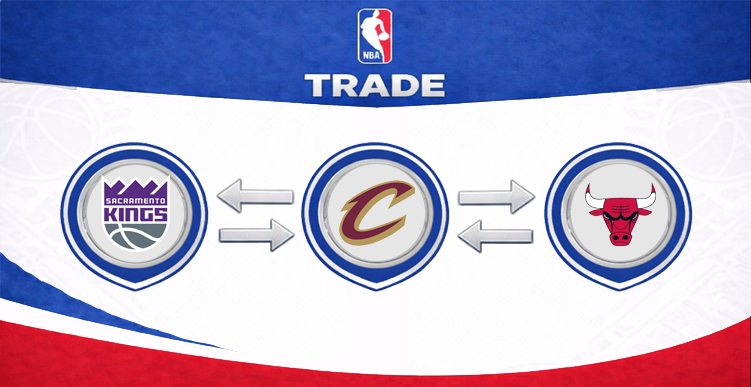 spotrac
It took a while for trade season to get moving with a second deal, but when it did, we got a three-team trade! The Cleveland Cavaliers began the process of getting under the second apron, while adding backcourt depth. The Sacramento Kings added a combo forward for the future. The Chicago Bulls uncharacteristically jumped in to facilitate and picked up a couple of assets.
Here are the particulars:
Cleveland Cavaliers acquire: Keon Ellis, Emanuel Miller (two-way), Dennis Schroder
Sacramento Kings acquire: De’Andre Hunter
Chicago Bulls acquire: Dario Saric, 2027 Nuggets second-round pick, 2029 least-favorable second-round pick
Let’s dive in!
Cleveland Cavaliers
Incoming salary: $16.4 million in 2025-26
-
Keon Ellis (SG, one year, $2.3 million), Dennis Schroder (PG, three years, $44.4 million (final season $4.4 million guaranteed)), Emanuel Miller (two-way)
Outgoing salary: $23.3 million in 2025-26
-
De’Andre Hunter (SF/PF, two years, $48.2 million)
-
Luke Travers (two-way) waived
The Cleveland Cavaliers pulled off the rare double feat of clearing out some salary while also improving their team. This trade has both immediate impacts and long-term impacts for the Cavs.
De’Andre Hunter’s play has really slipped this season. After being a Sixth Man of the Year candidate last season, Hunter has fallen off to 42% shooting, including just 31% from behind the arc. Maybe it’s a one-year blip, as Hunter had been on an upswing as a shooter, but it came at an awful time for the Cavaliers.
Cleveland has battled injuries all year long. Part of Hunter’s value is that he should have been able to slide into Max Strus’ spot in the rotation without the team missing a beat. Instead, he’s been surpassed in the rotation by Jaylon Tyson. Now, Tyson has a runway to playing more, which is a win for him and the team. Add it all up, and this made Hunter, and the $48 million he’s owed through next season, a logical trade candidate for the Cavs.
Dennis Schroder and Keon Ellis should pay immediate dividends for the Cavaliers backcourt. As of this writing, Donovan Mitchell is the only healthy and productive playmaker on the roster. Craig Porter Jr. is day-to-day with a knee injury, while Darius Garland is out long-term with a toe injury. Lonzo Ball hasn’t been productive and has fallen out of the rotation. Off-ball, Sam Merrill is back, but he’s dealt with injuries all season. And, as referenced above, Strus remains out, as he recovers from a foot injury.
Schroder has his foibles, but he’s a reliable veteran playmaker and scorer. He’ll help take some of the pressure off Mitchell. Ideally, Schroder will help the Cavs offense from going to pieces when Mitchell is on the bench. Cleveland’s offensive rating drops by nearly nine points when Mitchell is off the floor.
Ellis will help by giving the Cavs a 3&D component they’ve lacked since Isaac Okoro was traded. Okoro wasn’t perfect, but he was the best 3&D player that Cleveland had. Ellis will step into that role. His shooting has slipped this year, but context is important here. All season long, Ellis’ role and playing time have been all over the place. He goes from playing a lot to not playing at all to being yanked in and out of games. It’s been impossible for him to find any kind of rhythm.
Emanuel Miller is coming in to satisfy the Chicago Bulls need to send something out in this three-team trade. Miller has seen very little NBA action in his two-year career, and his G League production has been mixed. The Cavaliers are waiving Luke Travers to open up the spot for Miller. This is probably a wash in terms of on-court value and production.
In terms of the bookkeeping, the Cavs win there too. They saved $6.9 million in salary in this deal. Because Cleveland is a second-apron team and deep into the tax, that results in more than $44 million in luxury tax savings. Altogether, the Cavaliers will knock just over $51 million off their books in salary plus tax penalties.
Long-term, Cleveland gets out of Hunter’s $24.9 million for next season too. Some of that savings will be taken up by the $14.8 million that is owed to Schroder for 2026-27. In addition, Cleveland is expected to pursue an extension with Ellis. On February 9, Ellis will be eligible for a three-year extension worth up to $52 million. He may not see that much, but expect Cleveland to keep Ellis in the fold on a new deal.
The second-rounder the Cavs gave up is a 2027 second from the Denver Nuggets. Cleveland still has three more tradable seconds in their cache (their own in 2026, 2028 and 2032).
Last thing to keep an eye on for Cleveland is roster spots. The roster is now full with 15 players on standard contracts. That means that there is no room to convert/sign two-way player Nae’Qwan Tomlin to a standard deal. Expect that to be rectified by the deadline, as Tomlin is a regular rotation guy for the Cavs. With the backcourt now strengthened, Lonzo Ball’s pseudo-expiring $10 million contract could be on the move. If Cleveland can get off Ball’s deal without salary coming back, that would save them another $65 million in salary plus tax penalties.
Sacramento Kings
Incoming salary: $23.3 million in 2025-26
-
De’Andre Hunter (SF/PF, two years, $48.2 million)
Outgoing salary: $21.8 million in 2025-26
- Keon Ellis (SG, one year, $2.3 million), Dario Saric (PF/C, one year, $5.4 million), Dennis Schroder (PG, three years, $44.4 million (final season $4.4 million guaranteed))
The Sacramento Kings are the NBA’s preeminent sadness factory and this trade does little to change that. De’Andre Hunter is a good and helpful player, assuming this year’s shooting dip is a one-year blip and not the start of a slide. But this really doesn’t do a lot for the Kings on the court, hurts the cap sheet next year and is a disappointing return for Keon Ellis.
On-court, Sacramento is said to be excited about teaming Hunter with Keegan Murray in a versatile, interchangeable forward pairing. That’s a fair thing to be positive about. Murray now has a defensive partner, and one who has shown the ability to slide down and cover bigger guards. If Hunter gets his shot back on track, and history tells us that he will, that’s a good set of forwards moving forward.
The Kings lose backcourt depth and production in this deal with Ellis and Schroder headed out. Trading the two guards opens up even more of a runway for rookie Nique Clifford to play, but that was already happening. Ellis’ playing time and role were inconsistent all season, as the fourth-year guard never found a real role under Doug Christie.
Schroder will be a loss in terms of ballhandling and playmaking. He’s been inefficient as a shooter, but he’s still a solid volume scorer and creator to have off the bench or in the starting lineup. However, the Kings roster still seems in flux, so we’ll see what happens next with the backcourt.
It’s there where we have to pause and preach a little patience. Sacramento is tied to countless trade reports involving just about everyone on the roster except for Murray, Clifford and rookie center Maxime Raynaud. It’s hard to always sell hope, but we do have to see what comes next. This deal could be the first in a series that reshapes the roster.
The challenge is that when you are pivoting towards rebuilding, you really don’t want to take on money, unless you are paid to do so. The Kings didn’t receive any kind of draft capital in this deal to taking on about $10.1 million in additional salary for 2026-27. That will have Sacramento nudging up against the luxury tax next season, when you factor in a hopefully high draft pick and filling out the roster.
It’s kind of a neutral thing, but the second-round pick Sacramento gave up is a 2029 second that is the least-favorable of the Detroit Pistons, Milwaukee Bucks and New York Knicks. There’s a good chance that pick won’t be very good. You don’t want to be in the business of just giving picks away, but this shouldn’t hurt the Kings too much.
That leads to the next challenge here…Sacramento was said to be asking for a first-round pick for Ellis in trade talks. Going from looking for a first to giving up a second is either a mistake in execution or valuation. Either way, it’s not a good look for the Kings.
To finish on a positive, Sacramento now has the roster opening to convert two-way player Dylan Cardwell to a standard contract. The rookie big man has been a nice find for the Kings this season. He’s averaged 4.7 points, 7.1 rebounds and 1.7 blocks in 19.8 minutes per game. Sacramento’s defensive rating improves by nearly 11 points when Cardwell is on the court. For a team that struggles with interior defense, Cardwell has been an outstanding pickup. Look for the Kings to use some of the Non-Taxpayer MLE to give the rookie big man a multi-year deal.
Chicago Bulls
Incoming salary: $5.4 million in 2025-26
-
Dario Saric (PF/C, one year, $5.4 million)
Outgoing salary: None
-
Jevon Carter waived
-
Emanual Miller (two-way) traded
The Chicago Bulls have long-been criticized for the reluctance to take on salary in exchange for draft capital. The Bulls didn’t hit a homerun here or anything, but it’s a small step forward towards maybe a new era of roster management in Chicago.
The Bulls will take on the $5.4 million owed to Dario Saric, while eating the $6.8 million owed to Jevon Carter in this deal. Chicago is using most of their Traded Player Exception from when they dealt Zach LaVine to the Sacramento Kings to bring in Saric. The Bulls were over $13.6 million from the luxury tax, so taking on the additional salary for Saric doesn’t burden them at all.
Given that roughly half of Saric’s contract has already been in actual dollars by the Kings, the Bulls essentially bought two second-round picks for the price of about $2.5 million. Given that the going rate for second-round picks at the draft has landed anywhere from $1.5 million to $3 million in recent years, this is good work by Chicago.
The Bulls are getting a 2027 Denver Nuggets second-round pick from the Cleveland Cavaliers and a 2029 least-favorable second-round pick (Detroit Pistons, Milwaukee Bucks or New York Knicks) from the Kings to facilitate this deal. Even if neither pick pans out to be very good, it’s additional draft capital for the Bulls.
Saric has no real on-court value for Chicago. He may be waived to open up a roster spot when all is said and done. Jevon Carter rarely played in a deep backcourt. His loss will be felt more as a locker room voice than on the floor. And Emanuel Miller had rarely played in the NBA over two seasons, so there’s no production lost there either.
On the cap sheet for next season, there is no impact as Saric is on an expiring deal. We still projected the Bulls of have over $33 million in cap space this summer. It’s an uncharacteristic move from Chicago and one we haven’t seen in a while. It may be baby steps, but it’s still progress!