


.png)


 NEWS
NEWS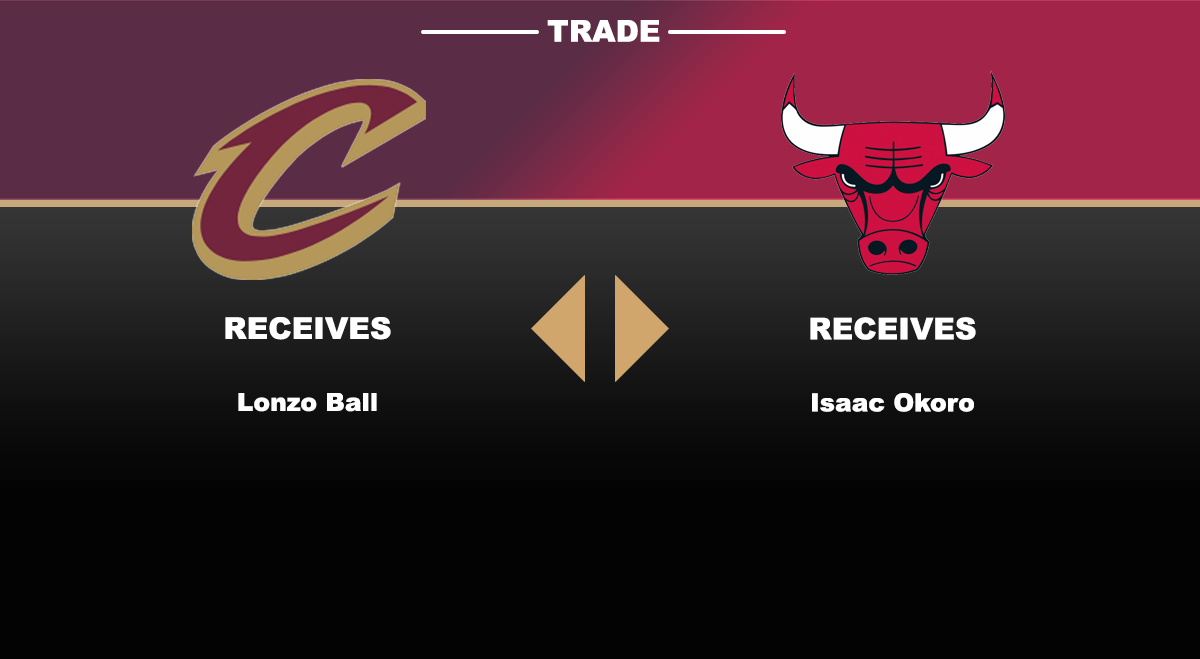 © USA Today Sports
The Chicago Bulls cleared up some of their guard logjam in a rebalancing trade. The Cleveland Cavaliers added some guard-depth insurance, while saving a little money.
Here are the particulars:
Cleveland Cavaliers acquire: Lonzo Ball
Chicago Bulls acquire: Isaac Okoro
Let’s dive in!
(Note: We’re running our analysis of this trade starting with the 2025-26 season. If the terms of the deal change, we’ll adjust the analysis.)
Cleveland Cavaliers
Incoming salary: $10.0 million in 2025-26
- Lonzo Ball (PG/SG, two years, $20.0 million (team option for final season))
Outgoing salary: $11.0 million in 2025-26
- Isaac Okoro (SF/SG, two years, $22.8 million)
The Cleveland Cavaliers are living in the apron world now. Specifically, the Cavs are living as a second-apron team. That makes roster moves difficult for them. Knowing those restrictions, this is a solid move to add depth, and to protect against losing a key player in free agency.
Lonzo Ball deserves all the accolades in the world for making it back to the NBA after what was essentially a three-year absence. When he did make it back last year, Ball looked predictably rusty. But he also looked good physically and moved well. That was all we wanted to see in his court time a year ago. The rest will come, and he’s still a great passer and floor general.
Before this trade, the Cavs were nearly $10 million over the second apron. That’s with four open roster spots, one of them crucially belonging to unrestricted free agent Ty Jerome. Now, Cleveland is protected if Jerome leaves in free agency.
Because they hold Early Bird rights for Jerome, Cleveland was roughly limited to paying him the equivalent of a Non-Taxpayer MLE contract. That’s something that other teams can do for Jerome also, giving the Cavs competition to keep Jerome. In addition, whatever re-signing Jerome would cost would push Cleveland even further over the second apron.
After acquiring Ball, the Cavs save $1 million towards the tax and the aprons, while shoring up their guard depth behind Donovan Mitchell and Darius Garland. In addition, if Ball doesn’t work out, Cleveland can decline the $10 million team option for him for next season. That’s a savings of $1 million now and potentially $11.8 million next season, because Isaac Okoro’s deal was fully guaranteed for 2026-27.
Trading Okoro shouldn’t damage Cleveland’s wing rotation much, if at all. Max Strus took over as the starter when he arrived in Cleveland. When De’Andre Hunter was added at the trade deadline, he took the primary backup wing minutes. The Cavaliers also have second-year wing Jaylon Tyson, who they are very high on.
This is a really solid deal for Cleveland. They used depth at one spot to fill a need at another spot. And they saved a little money in doing so. That’s good work by Koby Altman and crew.
Chicago Bulls
Incoming salary: $11.0 million in 2025-26
- Isaac Okoro (SF/SG, two years, $22.8 million)
Outgoing salary: $10.0 million in 2025-26
- Lonzo Ball (PG/SG, two years, $20.0 million (team option for final season))
The Chicago Bulls had a glut of guards. Coby White, Josh Giddey, Ayo Dosunmu, Jevon Carter and Lonzo Ball. By moving on from Ball, the Cavs added some depth on the wing, while clearing up that logjam in the backcourt.
Isaac Okoro can play. He was squeezed out of the rotation in Cleveland, but there’s talent here. Okoro has shot it well from behind the arc for three seasons in a row, and he can guard both small forwards and shooting guards. There’s not a lot of on-ball juice with Okoro, but as shown above, the Bulls have a lot of playmakers. Okoro should give them a 3&D presence that they don’t really have.
It’s clear the Chicago roster is in transition. They still feel like a major work in progress. It’s hard to know which veterans will stick around long-term, but bringing Okoro into that mix is fine. He’s experienced enough to help now, but still young enough to fit if the team pivots towards youth.
The Bulls took on a little money in this deal, but they have plenty of room to do so. Chicago is over $46 million under the luxury tax. They do have to re-sign Josh Giddey, but they only have one open roster spot after doing so. That’s more than enough room to re-sign Giddey, fill out the roster and still have plenty of wiggle room for whatever else come next.
It’s become fashionable to dump on Chicago over the years. Every move they make seems designed to keep them squarely in the 7-10 range in the Eastern Conference. So, they’ve certainly earned some of that criticism. But that doesn’t mean that those are all bad moves. Okoro for Ball solves for an overcrowding issue in the backcourt, while adding wing depth. And the team has the flexibility to take on some money by acquiring Okoro. Not bad, considering Ball was no longer a part of the long-term plan for the Bulls.