


.png)


 NEWS
NEWS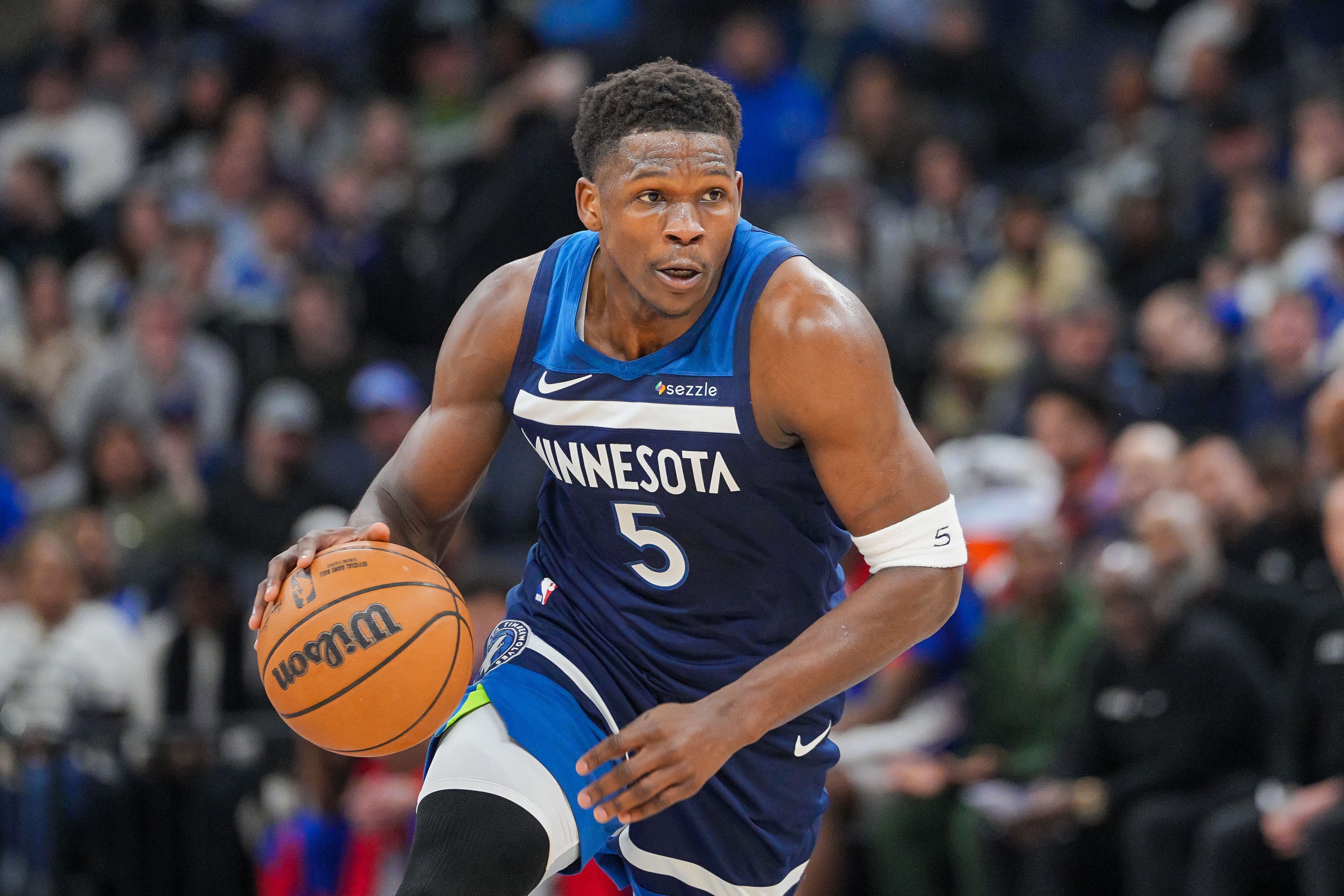 © USA Today Sports
Offseason Approach
Re-signing key free agents and adding depth for a Finals push
Actual Cap Space
-$111.7 million
Practical Cap Space
-$92.7 million
Projected Luxury Tax Space
$6.8 million
Under Contract (9)
Jaylen Clark
Mike Conley
Rob Dillingham
Donte DiVincenzo
Anthony Edwards
Rudy Gobert
Jaden McDaniels
Leonard Miller ($1.1 million guaranteed)
Terrence Shannon Jr.
Potential Free Agents (9)
Nickeil Alexander-Walker (unrestricted)
Jesse Edwards (restricted – two-way)
Luka Garza (unrestricted – team option)
Bones Hyland (restricted – two-way)
Joe Ingles (unrestricted)
Josh Minott (restricted – team option)
Tristen Newton (restricted – two-way)
Julius Randle (unrestricted – player option)
Naz Reid (unrestricted – player option)
Dead Cap (0)
None
Projected Signing Exceptions
Taxpayer MLE ($5.7 million)
Notable Trade Exceptions
Kyle Anderson ($8.8 million)
Karl-Anthony Towns ($4.7 million)
First Round Draft Pick
#17
Notable Extension Candidates
Donte DiVincenzo (veteran extension)
Josh Minott (veteran extension)
Leonard Miller (veteran extension)
Julius Randle (veteran extension)
Analysis
After a slow start, the Minnesota Timberwolves found their rhythm and made another run to the Western Conference Finals. This summer the Wolves will continue the quest for how to break through to the NBA Finals.
That quest is made tricky by the uncertain future for several key Minnesota players this summer. Julius Randle and Naz Reid can both opt for free agency. Nickeil Alexander-Walker is an unrestricted free agent. That’s a starter and two key reserves. And, in Randle’s case, that’s a major salary that will either be on or off the books.
We might as well start there, as Randle’s situation will probably set the tone for the Timberwolves offseason.
Path one for Randle is picking up his $30.9 million player option for next season. That’s the simplest way forward, but things do branch off from there.
If Randle opts in, Minnesota could then sign him to an extension that starts with the 2026-27 season. The veteran forward will turn 32 near the start of that season, so an extension shouldn’t go all the way to the max for Randle. Something in the range of $30 million AAV over three or four years would make sense. That keeps the former All-Star well-paid, while not inflating the Wolves already expensive salary sheet more than necessary.
Path two for Randle and Minnesota could see him opt out, but then ink an extension before hitting free agency. In that case, the Wolves could start the big man at a salary that is slightly less than the nearly $31 million he was set to make for the upcoming season. That could give the team the flexibility to re-sign Reid and Alexander-Walker, without pushing too far past the second apron. More on this in a bit!
The third path sees Randle opt out. From there, he either re-signs, which could look a lot like the opt-out-and-extend option we laid out above. Or Randle could look around in free agency. The issue with the latter idea is that only the Brooklyn Nets have significant cap space this summer, and they aren’t likely to sign a pricey veteran like Randle.
The final path is that Randle picks up his option and plays out next season without anything locked in for the future. Given that he’s heading into Year 12 and on the other side of 30 years old, bet on Randle looking to get something done that gives him security beyond the upcoming season.
Having Randle in the fold is critical for the Wolves, because they don’t really have a replacement for him on the roster. Despite his flaws, Randle is a good scorer, rebounder and playmaker. He’s also a good fit with Anthony Edwards, Jaden McDaniels and Rudy Gobert. In addition, having another salary in the range of $30 million would give Minnesota a nice chunk of tradable salary to use in future trades.
When it comes to Naz Reid, he’ll be looking to cash in this offseason. He’s got a $15 million player option, but that’s very likely to be declined. Reid isn’t extension-eligible, so this will be a straight-up re-signing situation.
If Randle is back and with Gobert in the fold, Reid will be ticketed for a backup role with the Timberwolves again. He’s excelled there, but this is the point of a career where a player wants to test himself as a starter. That could be a factor in whether or not Reid re-signs this offseason.
Of course, money will also be a factor. While there’s a great deal of interest in Reid in free agency, most teams will be limited to offering him the Non-Taxpayer MLE. That’s less than the option Reid would be declining. That means that if Reid changes teams this summer, it’s probably via sign-and-trade. That would be a good way for the Wolves to recoup some value, while rebuilding their depth.
Part of that outgoing depth could include Nickeil Alexander-Walker. After another strong regular season, combined with a solid playoff run, Alexander-Walker is drawing a ton of interest as an unrestricted free agent. He’s a target for several different teams using the Non-Taxpayer MLE. The good news for Minnesota? They have full Bird rights and can beat MLE offers to keep Alexander-Walker. The bad news? Doing so would very likely push the Timberwolves past the second apron again.
While the new ownership group has said that they won’t break up the team over tax concerns, the second apron is a whole other issue for the Wolves. Because they finished last year over the second apron, Minnesota’s 2032 first-round pick is already frozen. Finishing over the second apron again would mean the same for the team’s 2033 first-round pick too. And it would push the team one year further away from “thawing” out those picks and getting them unfrozen.
And that’s before we get to all of the other roster restrictions that would make it difficult for Minnesota to add outside talent. For a team that is out several draft picks moving forward, these are real issues, beyond just have an incredibly expensive roster.
If any of Randle, Reid or Alexander-Walker move on, the Timberwolves might be able to avoid the second apron. But that comes at the loss of a key rotation player. That would put increased pressure on 2024 first-round picks Rob Dillingham and Terrence Shannon Jr. to step into rotation roles next season. That’s probably going to happen anyway, but having the vets around would make that transition easier.
Minnesota also has a few other free agent decisions to make. Josh Minott has flashed potential, but hasn’t been able to force his way into the rotation. He’s unlikely to spark a bidding war in unrestricted free agency in 2026, so expect the Timberwolves to pick up their option for him for next season.
The same will likely be true of Luka Garza, who provides good frontcourt depth at the end of the bench. The team’s other unrestricted free agent is Joe Ingles. We’re at the point where Ingles’ desire to play and the availability of roster spot will determine if he’s back on a minimum deal or not.
Of the two-way players, Tim Connelly took another shot on his former Denver draftee Bones Hyland. He’d be a candidate to return, but Hyland is out of two-way eligibility. There isn’t likely to be a standard roster spot for him to return to, barring other roster changes.
Jesse Edwards and Tristen Newton both showed enough in the G League to come back on two-way deals. As older prospects, this is probably a “one more year” type of situation. But many teams prefer some more experience in the two-way ranks.
At the draft, the Wolves have a mid-round pick in the first round. That should land them an eventual rotation player. There are a lot of options in that range of the draft, including both developmental prospects and guys who are ready to pay now. Given the team has fairly solid depth across the board, Minnesota can take the best-player-available approach.
This offseason is going to test how committed the Minnesota Timberwolves are to this group. There are real decisions to be made with several key players, and that’s before we even factor in making a big trade. There’s nothing preventing the Wolves from paying everyone to bring them back, minus those ever-present second-apron issues. It’s just a question of weighing the present vs the future vs the cost of a team that is close, but not quite there.