


.png)


 NEWS
NEWS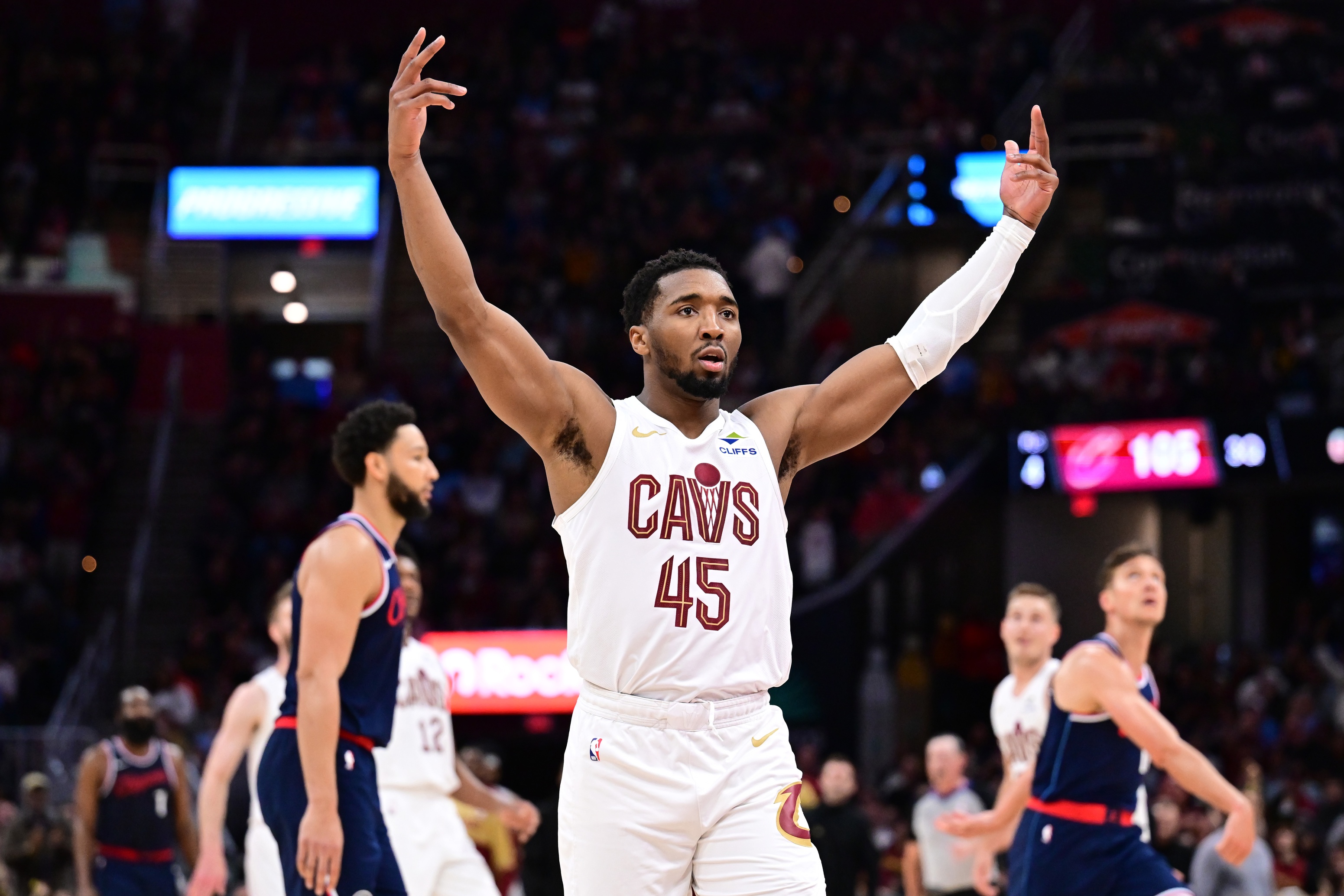 © USA Today Sports
Offseason Approach
Patience while retaining key free agents and adding frontcourt depth
Actual Cap Space
-$83.8 million
Practical Cap Space
-$84.1 million
Projected Luxury Tax Space
-$29.9 million
Under Contract (11)
Jarrett Allen
Darius Garland
De’Andre Hunter
Donovan Mitchell
Evan Mobley
Isaac Okoro
Craig Porter Jr. (non-guaranteed)
Max Strus
Nae’Qwan Tomlin (two-way)
Jaylon Tyson
Dean Wade ($4.6 million guaranteed)
Potential Free Agents (7)
Emoni Bates (restricted – two-way)
Javonte Green (unrestricted)
Ty Jerome (unrestricted)
Sam Merrill (unrestricted)
Chuma Okeke (unrestricted – team option)
Tristan Thompson (unrestricted)
Luke Travers (restricted – two-way)
Dead Cap (1)
Ricky Rubio ($424,672)
Projected Signing Exceptions
None (projected to be unusable due to being over the second apron)
Notable Trade Exceptions
Georges Niang ($8.3 million – unusable due to being over the second apron)
First Round Draft Pick
None
Notable Extension Candidates
Darius Garland (veteran extension)
De’Andre Hunter (veteran extension – as of October 1)
Sam Merrill (veteran extension – through June 30)
Max Strus (veteran extension)
Dean Wade (veteran extension)
Analysis
The Cleveland Cavaliers season finished in disappointment for a second consecutive year. The banged-up Cavs fell in the second round of the playoffs again, this time to the Indiana Pacers. Now, Cleveland is left looking at a roster that had an excellent regular season but hasn’t found postseason success.
Some have pushed that the Cavaliers should be looking to break up the core foursome of Donovan Mitchell, Evan Mobley, Darius Garland and Jarrett Allen. Is that really the way to move forward? Or is giving this group another year to figure things out the more prudent path?
Cleveland should listen to offers for Allen, and slightly less enthusiastically for Garland. Allen is a good, but limited offensive player. He’s also a good, but not game-changing, defensive player. Garland is a terrific point guard, but his skills are somewhat duplicative with Mitchell’s. In addition, Garland has been injury prone throughout his career, and he doesn’t offer much on the defensive end of the floor.
All of that said, it should have to take a really good offer to draw Allen away from the Cavs in a trade. And Cleveland would need to be blown away in a deal for Garland. You don’t give away good players, who are just hitting their prime years, unless the offers are ones you can’t refuse.
That’s just one of the reasons the Cavaliers should mostly run it back next season. The other reason is that the Eastern Conference is there for the taking. The Pacers are very good, but they aren’t going to enter next season as overwhelming favorites. Same for the New York Knicks or Orlando Magic. The Boston Celtics are likely to take a step back, as are the Milwaukee Bucks. So, why not Cleveland? Let’s not forget that this was a pretty dominant regular season team that ran into injuries in the playoffs.
Part of Cleveland’s formula for success last season was their depth. They’re going to have to either pay up or do some roster work to keep that depth for next season.
Without re-signing any of their own free agents, the Cavs are about $14 million over the second apron to begin the offseason. That’s…well…that’s a big number. With key free agents in Ty Jerome and Sam Merrill hitting the market, Cleveland has some work do to.
The Cavaliers have shopped Isaac Okoro, but found no takers willing to eat his $11 million salary (and $22.8 million total salary). At least, Koby Altman hasn’t found anyone willing to take on Okoro without the Cavs also giving up draft assets. And draft assets are precious and few for Cleveland, because they gave up so many to acquire Mitchell.
Altman has also reportedly looked at moving Dean Wade and his $6.6 million contract too. The challenge there is that doesn’t offer as much salary relief, and it could cause depth issues for Cleveland up front. Trading Max Strus would also offer salary relief, but that would create a hole in the starting lineup and remove a needed shooter from the roster.
Most expect Jerome to have contract offers in the range of the full Non-Taxpayer MLE for next season. He’s a good combo guard, who provides bench offense. That puts him around a value of the $14.1 million MLE amount. Because the Cavs have Early Bird rights for Jerome, they could effectively match that amount, but that would only push the tax bill higher, while going even further past the second apron.
Merrill isn’t going to get paid as much as Jerome, but a salary starting in the range of $5 million feels about right. That comes with all the same complications as re-signing Jerome does, as far as the tax and second apron go.
The team’s other free agents of note are veterans Tristan Thompson and Javonte Green. Tax issues and lack of roster spots could see either player let go. If Thompson wants to continue to play, he could be brought back. The Cavaliers like Thompson in the locker room and the way he pushes Allen and Mobley in practice. Green is less likely to return, pending what happens with the rest of the roster.
Emoni Bates should be brought back for one more year on a two-way deal. Luke Travers gave the NBA a run, but he’s more of a 50-50 proposition to return to Australia or to do another two-way deal.
Cleveland could waive Chuma Okeke (or not pick up their team option) or Craig Porter Jr. to free up about $4.7 million in flexibility. However, both Okeke and Porter would need to be replaced by players on minimum contracts, and their current deals aren’t much more than the minimum themselves. There’s a good chance Okeke is let go, but Porter will likely be back.
At the draft, Cleveland has two late second-round picks. That’s generally the range where a team drafts a player for a two-way contract. For the Cavs, they might be better served looking for a player or two who can fill a standard roster spot. That would allow Cleveland to bring them in on a rookie minimum salary, which is roughly $1 million less than a veteran minimum deal.
The Cavs have a handful of veterans who are extension-eligible, but most of them have at least two years left on their current deals. Cleveland is better pushing those talks off until a later date. Dean Wade is interesting and signed a team-friendly extension last time around. It’s worth looking at something similar, with a slight bump for inflation, again. That’ll cause further tax issues down the line, but Wade is a good player who fills a real role.
Ultimately, the Cavaliers roster is likely to look pretty similar next season, barring a major trade involving one of the four core players. Cleveland simply doesn’t have the flexibility to do much else, as they begin life as a second-apron team.
In the end, the Cavs are probably best off to use draft capital to shed Okoro’s salary. As long as it doesn’t get silly, and it shouldn’t need to, that move could put Cleveland within the range of re-signing Jerome. If the team let’s go of Okeke too, they can probably re-sign Merrill too. From there, they have to fill out the bench as economically as possible, as the tax bill will still be quite high.
Almost any way you spin it, unless it’s a blockbuster deal that somehow also sheds salary, the Cleveland Cavaliers will be among the NBA’s most expensive teams next season. But that’s not a bad thing. Despite the aberration that this NBA Finals has been, most Finals teams pay the tax to get there. It’s Cleveland’s turn again.
The Cavs should be willing to eat the tax bill. This team is right there, if they have better health in the playoffs. It’s not time to break up this group. Not yet, at least. If they fall short again next year, then we can start the conversation. For now, gear up, write the checks and get ready to make a Finals run.