


.png)


 NEWS
NEWS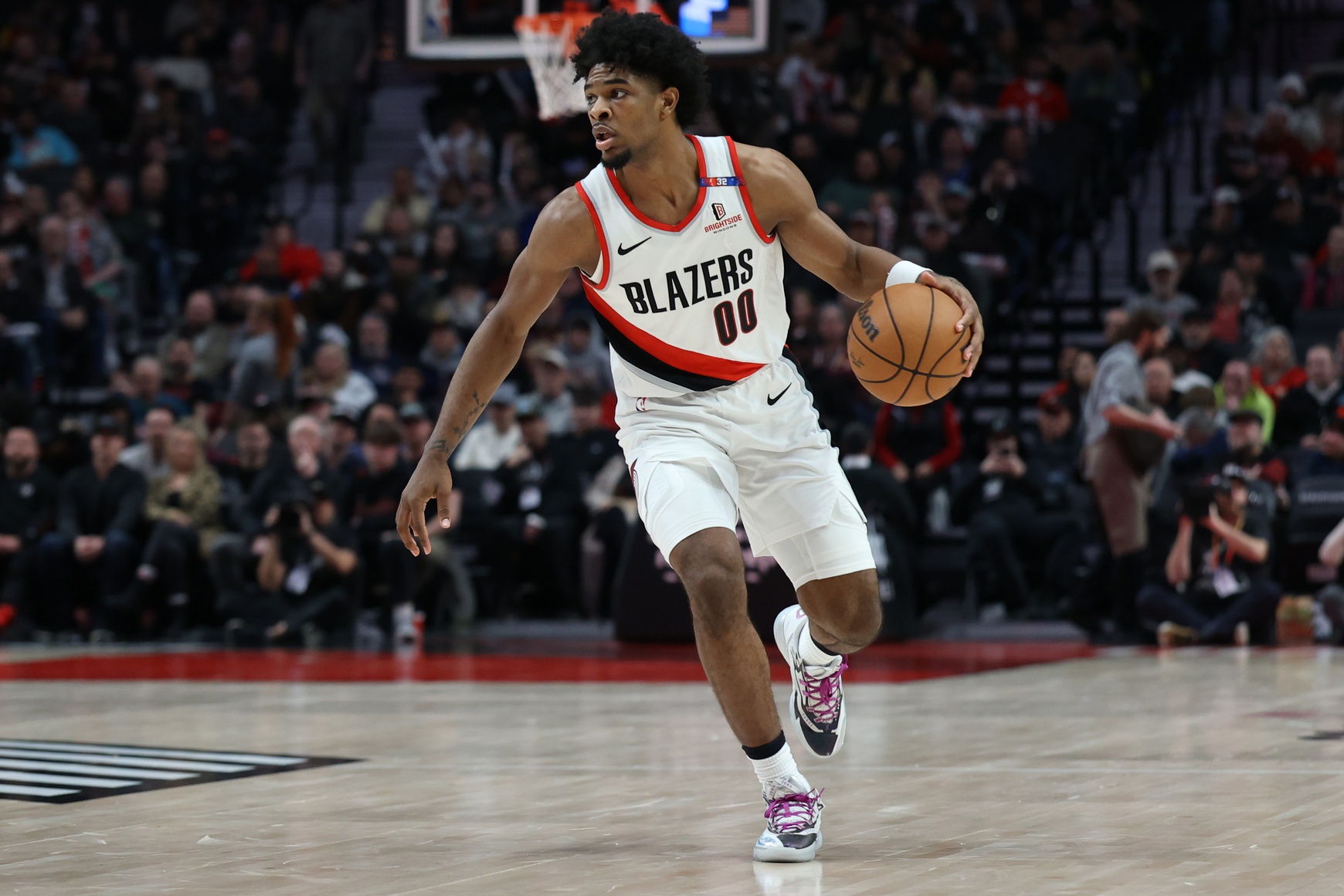 © USA Today Sports
Offseason Approach
Pick a path: Rebuild around youth, or add vets for playoff push
Actual Cap Space
-$47.3 million
Practical Cap Space
-$37.5 million
Projected Luxury Tax Space
$11.4 million
Under Contract (12)
Deni Avdija
Deandre Ayton
Toumani Camara (non-guaranteed)
Sidy Cissoko (two-way)
Donovan Clingan
Jerami Grant
Scoot Henderson
Kris Murray
Duop Reath (non-guaranteed)
Shaedon Sharpe
Anfernee Simons
Robert Williams III
Potential Free Agents (6)
Dalano Banton (unrestricted)
Bryce McGowens (restricted – two-way)
Justin Minaya (restricted – two-way)
Rayan Rupert (restricted – team option)
Matisse Thybulle (unrestricted – player option)
Jabari Walker (restricted)
Dead Cap (0)
Didi Louzada ($268,032)
Projected Signing Exceptions
Non-Taxpayer MLE ($14.1 million)
Bi-Annual Exception ($5.1 million)
Notable Trade Exceptions
Malcolm Brogdon ($6.8 million)
First Round Draft Picks (pre-lottery)
#11
Notable Extension Candidates
Deandre Ayton (veteran extension)
Toumani Camara (veteran extension)
Rayan Rupert (veteran extension)
Shaedon Sharpe (rookie scale extension)
Anfernee Simons (veteran extension)
Matisse Thybulle (veteran extension – if player option is picked up)
Jabari Walker (veteran extension – through June 30)
Robert Williams III (veteran extension)
Analysis
The Portland Trail Blazers were a much-improved team in the second half of the season. After going 13-28 to start the year, the Blazers went 23-18 in the second half of the season.
Normally, we’d celebrate that kind of improvement. Especially since Portland did it on the backs of most of their younger players, which should bode well for the future.
However, there’s a sinking feeling that the extra wins may have cost the Trail Blazers draft position in draft with terrific talent in the top part of the lottery. Maybe the Basketball Gods will reward Portland with some lottery luck, but we won’t know that until the Draft Lottery.
There’s also a worry that the Blazers front office might deem this group closer than they really are. Portland already rewarded general manager Joe Cronin and head coach Chauncey Billups with new contracts. Could moves to chase a postseason spot be next?
More worrisome for Trail Blazers fans, the team could see the second-half improvement as reason to lock into this roster more than they should. Let’s start there, as that is what this offseason is about in Portland.
The Blazers remain a somewhat muddled mix of young players and a handful of mid-career vets. And that’s before you factor in 11-year veteran Jerami Grant, who doesn’t fit either description.
A quick look at things says that Portland should be building around a core of Shaedon Sharpe (who had his best season in Year 3), Scoot Henderson (who was much-improved in Year 2), Toumani Camara (who looks like the kind of Swiss army knife that all good teams have) and Donovan Clingan (who flashed a ton of potential, especially as a rim protector).
Around those four are a whole lot of question marks.
Grant remains a solid, versatile forward, even if this season was a complete mess shooting-wise. Grant spent too many possessions never getting inside the arc. He’s a solid three-point shooter, but half of his shot mix came from behind the arc. Grant isn’t that kind of sniper. That needs to balance back out moving forward. He’s also slipped defensively. Still fairly solid, but not someone who draws the opponent’s best wing anymore.
Deandre Ayton is entering the final year of his contract at $35.5 million. He remains a tantalizing offensive prospect and a better-than-you-think rebounder. But Ayton is still wildly inconsistent. One night Ayton looks like he has it all together. The next night, you barely know he’s on the court.
Anfernee Simons is a good shooter and a solid secondary playmaker. He’s decidedly not a point guard though, which limits him a bit. And his defense keeps him from being mentioned as a top-tier starting shooting guard, despite his playmaking and scoring abilities.
Matisse Thybulle returned late in the season. He showed enough that we’re comfortable saying that he’s a rotation guy again. The volume wasn’t much this year, but it was a third straight year of solid shooting with the Blazers. Defense remains Thybulle’s calling card.
Robert Williams continues to be incredibly exciting…when he plays. The issue of staying on the court carried over to this season for Williams, as he was only able to play 20 games.
Lastly, we have Deni Avdija. Avdija put together arguably his best all-around season. He did more scoring, especially off-the-dribble scoring, then we’ve seen before. Avdija also chipped in with the playmaking, hit the glass and was solid, if unspectacular, on defense.
Why did we call out that group of six players? They’re all under contract for next season with Portland for a combined $134.4 million. That group of six – all solid, but not great – are the reason why the Blazers are sitting just shy of the luxury tax for next season.
Now, that’s not the end of the world. Each player in that group out of Grant, Ayton, Simons, Thybulle, and Williams (we’re excluding Avdija because he could/should be part of the core now) has a tradable contract.
Ayton’s deal is probably the worst in terms of single-season size vs production, but it’s an expiring deal. Some team who needs a center may be willing to gamble on Ayton, especially if it means moving off some money themselves. Centers who are reliably double-double guys don’t grow on trees, and inconsistent as he is, Ayton provides that.
Simons is very tradable as a guard who can shoot and score. At worst, he’s a third-guard on a contender. And he’s probably more valuable than that to a lot of teams who really need offense.
Thybulle has value as a 3&D guy, and he’s also on a very tradable expiring contract. Williams is essentially the big man version of Thybulle, because he’s terrific around the rim on both ends and on a very affordable expiring deal.
Then we have Jerami Grant.
Grant’s deal isn’t nearly as toxic as some have suggested. Sure, he had a down season, but Grant is still a productive player. He’s overpaid, but not shockingly so. The challenge is that another team might use last season’s dip for forecast what’s to come. If so, then the contract becomes an issue.
So, where does that leave Portland? As one of the more interesting teams of the offseason!
This summer is going to be marked by trades. Almost no teams have spending power and the free agent class is fairly weak. If the Trail Blazers decide to lengthen out their rebuild around the younger players, they could cash in by trading any of their vets. They’ve also got the contracts, and some future draft assets, to move if they decide to make some swaps to push things forward this coming season.
If they decide not to move the vets, Portland might still be ok. In the summer of 2026, the Blazers could have as little as $74 million on the books, before extensions for Shaedon Sharpe and Toumani Camara.
Those extensions might be the most important piece of business for the Trail Blazers as far as things go long-term. Sharpe is due for a rookie scale deal, while Camara is extension-eligible, but less likely to ink a new deal.
Sharpe’s upward ascension should have him in the range of signing a four-year, $112 million extension. That reflects his value now, while leaving some room for continued growth. You could even see things pushing a bit higher, if that’s what it takes to get a deal done.
Camara is in a different spot. He’s eligible to sign what we call the Dinwiddie Extension, which allows a team to extend a player on a salary that starts at up to 140% of the Average Player Salary. For next season, that projects to work out to a four-year, $89.3 million contract.
That’s probably right at the tipping point for Camara. He was one of the best defenders of forwards and bigger wings in the league last season, but toiled in the relative obscurity of the Pacific Northwest. He shot it well. Showed that he can create his own shot, and improved as a playmaker for others.
All of that means Camara could delay signing a new deal until the summer of 2026 instead. If that’s the case, expect Portland to decline their team option for 2026-27 to make Camara a restricted free agent. That way, the Blazers can control the process.
Of their free agents, there aren’t any monumental decision-point this summer for the Trail Blazers. The expectation is for Thybulle to opt in. Portland will probably pick up their team option for Rayan Rupert, because there’s still some untapped potential there.
That leaves Dalano Banton and Jabari Walker as the free agents of note. Banton has shown he’s an NBA-level guy and an elite garbage-time scorer. He could be back on a minimum deal to fill out the bench. Same with Walker, who has shown flashes at times, but hasn’t quite put it all together yet. Their places on the roster likely depend on what happens with trades for the veterans.
The Portland Trail Blazers will have a chance to land a rotation player at the draft, despite possibly picking lower than is ideal. They’ll be active in trade talks, because of all of the tradable veterans they have. How it all plays out makes the Blazers one of the most fascinating teams to watch this summer.
Updated Analysis Post-Draft Lottery:
Not a whole lot changed for the Trail Blazers. Per reports from the room where the actual lottery was held, they were one ping pong ball away from getting the first overall pick. That’s a tough break, but no use crying over that. Portland will have slightly more wiggle room under the tax by sliding back to the 11 th pick from the 10 th pick, but will still be in range to draft all the same players.