


.png)


 NEWS
NEWS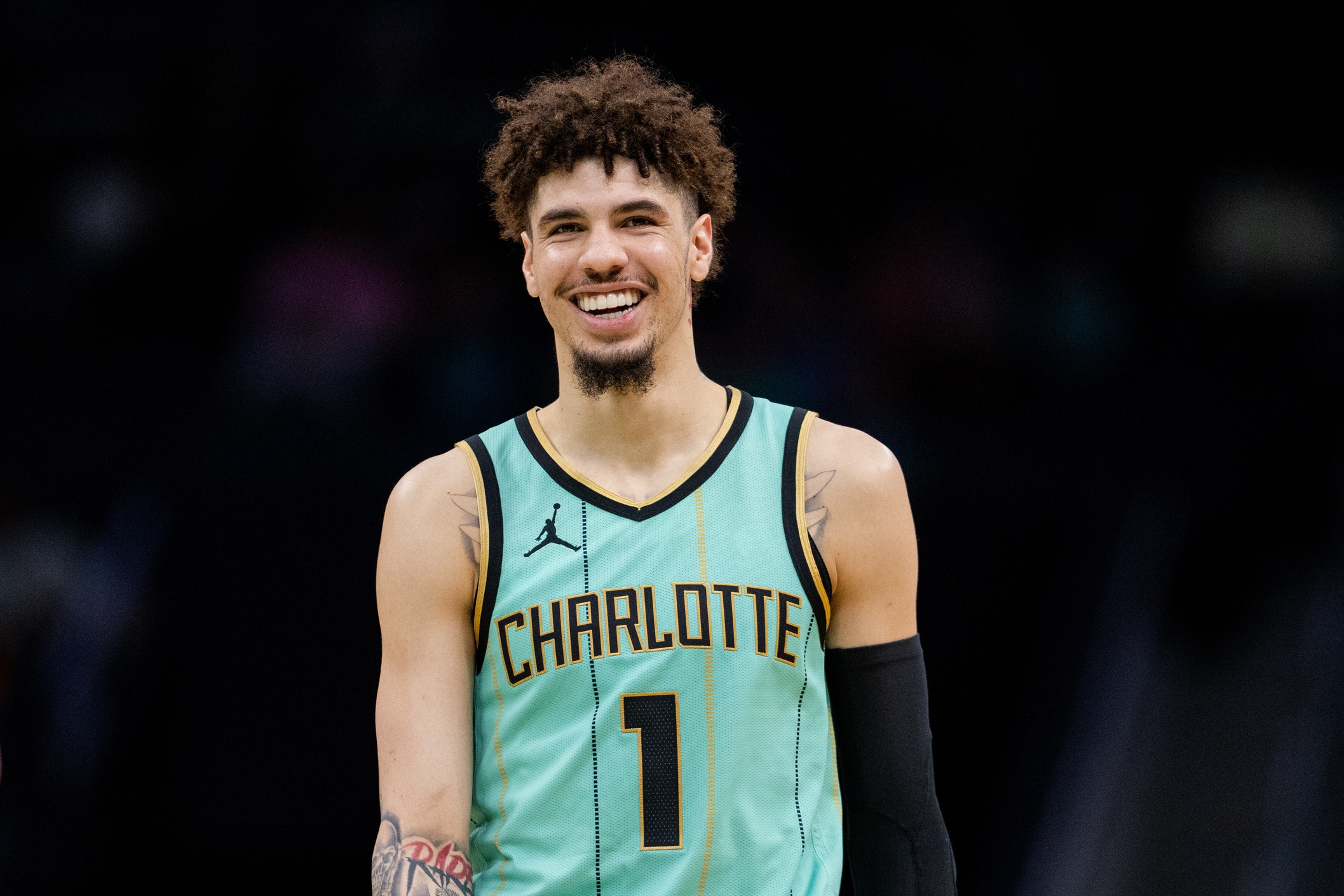 © USA Today Sports
Offseason Approach
Nail the draft pick, try to start winning games
Actual Cap Space
-$25.9 million
Practical Cap Space
-$25.9 million
Projected Luxury Tax Space
$26.6 million
Under Contract (14)
LaMelo Ball
Damion Baugh (two-way)
Miles Bridges
Moussa Diabate (non-guaranteed)
Josh Green
DaQuan Jeffries (non-guaranteed)
Brandon Miller
Jusuf Nurkic
Josh Okogie (non-guaranteed)
Tidjane Salaun
K.J. Simpson (two-way)
Nick Smith Jr.
Grant Williams
Mark Williams
Potential Free Agents (4)
Seth Curry (unrestricted)
Taj Gibson (unrestricted)
Tre Mann (restricted)
Wendell Moore Jr. (restricted – two-way)
Dead Cap (0)
None
Projected Signing Exceptions
Non-Taxpayer MLE ($14.1 million)
Bi-Annual Exception ($5.1 million)
Notable Trade Exceptions
None
First Round Draft Picks (pre-lottery)
#4
Notable Extension Candidates
Josh Green (veteran extension – as of October 23)
Jusuf Nurkic (veteran extension)
Grant Williams (veteran extension)
Mark Williams (rookie scale extension)
Analysis
The Charlotte Hornets season started out with a lot of promise. The team was playing exciting basketball under new head coach Charles Lee. New front office head Jeff Peterson had made some smart, albeit relatively minor, roster moves. The young players were showing a lot of promise. After four games, the Hornets were 2-2.
That was pretty much the highwater mark for Charlotte. The team started losing games pretty rapidly after that.
It wasn’t all bad. Lee somehow got this group to defend at a middle-of-the-pack level for most of the season, before a stark drop off late in the year. Various players turned in solid minutes, around a series of injuries. And that’s kind of where we start for the offseason.
The Hornets still don’t really know what they have. At least they don’t as a full team. And that’s mostly because this group has hardly been together as a full unit.
This summer, that’s going to be where most of the decisions have to start for Charlotte: Deciding who is worth building around and who it’s time to cut loose.
They don’t have any major free agents. Tre Mann is the best of the bunch, but he’s coming off a lost season due to injury. It’s unclear if the Hornets will even tender him his $6.9 million qualifying offer. If they do, Mann should probably sign it. He’s not getting that much in a single year in free agency.
Mann can score, and he’s played well since coming to Charlotte at the 2024 trade deadline. If he’s over the back injury that cost him most of this season, Mann is worth re-signing for backcourt depth. But this needs to be a deal in the range of $5 to $6 million in terms of average annual value. Anything more than that would be overpay, given the lost season and Mann’s short window of strong play.
As far as things go with Seth Curry and Taj Gibson, either or both could return. Or either could move on to be part of the bench with a playoff team. Both are also at the stage where retirements is a possibility too. Curry can still shoot (Did you know he led the NBA in three-point percentage?) and Gibson is still a respected locker room voice. Both are veteran minimum, end-of-bench types at this point.
Because they are sitting on a few re-signed players, former high lottery picks, and another high pick in the 2025 NBA Draft, the Hornets won’t have cap space this summer. That means nailing the draft pick, while also hitting on some trades, are the paths towards improvement this summer.
Charlotte will be hoping to keep Cooper Flagg close by with some lottery luck. Pending that, they’d do well to draft one of the better guards in Dylan Harper, V.J. Edgecombe or Tre Johnson. Ace Bailey is a good player, but there’s a lot of overlap in his game with Brandon Miller. The Hornets don’t need to get silly about skipping over Bailey if he’s still on the board, should their pick move back to say four or five, but one of the guards would be a better fit. It would bring better balance and options to the roster to go with a guard, if the decision is there with the third or fourth pick.
Why is drafting a guard so important? For one, the guard depth is lacking on this team. LaMelo Ball is entrenched as the starter at point guard, but the rest of the position is in flux. Miller is more of a big wing/forward, Josh Green is a 3&D wing, Nick Smith Jr. is still figuring things out and, as covered above, Tre Mann is a free agent and looks like a sixth-man type vs being a regular starter.
Also…is it time to at least consider trading LaMelo Ball?
Yeah, that might be harsh. But we’re now five years into this experience. The Hornets haven’t been good in those five years (hardly all on Ball) and Ball has played one full season during that time. He remains an inefficient shooter and scorer, and he’s shown little improvement on the defensive end of the floor.
The highlights from Ball are incredible. He’s really, really fun to watch. But that’s when you are zipping in and out. If you watch Ball play on a nightly basis, he becomes the occasional highlight, wrapped around bad shots, bad turnovers and bad defense.
To be clear, the Hornets shouldn’t give Ball away. But if the phone rings with reasonable offers, they’re worth considering.
In reality, only Brandon Miller should even approach untouchable status on this roster. And that’s mostly because Miller has great promise and is under team control for a while longer. The Hornets should be open to trading everyone else, if the right deal comes along.
Charlotte tried to move Mark Williams once, and that should be revisited this summer. It’s a shame from the Hornets side that the Los Angeles Lakers voided that deal, because Peterson had done quite well in that deal. It’s unlikely that kind of value will come to Charlotte again, but exploring moving the oft-injured Williams should be on the table. Certainly, that’s something Peterson should be looking at before considering extending Williams.
From there, the rest of the team is grab-bag of known quantities to developing younger players. Miles Bridges and Grant Williams might not have all that much trade value, but it’s worth seeing what’s out there for either player. Same with Josh Green and Jusuf Nurkic. The return won’t be overwhelming for any of the four veterans, but moving them could help bring in some minor assets, as well as freeing up minutes and roster spots for development players.
Both Nick Smith Jr. and Tidjane Salaun flashed potential this year. There’s still a long way to go with both players, but they proved that they are worth investing in. Charlotte also got quality minutes from the two-way ranks from Moussa Diabate and K.J. Simpson, enough so that Diabate got converted to a long-term standard contract. They’re good guys to have around as lower rotation projects.
The above, along with the defensive improvement for a large portion of the season, is a sign that Charles Lee was the right hire as head coach. Jeff Peterson’s moves have all been solid enough, given what he was working with.
Peterson won’t be able to change over large chunks of the roster this summer, but he can start the process. As previously stated, the Hornets have to hit with their draft pick. That will set the stage for what comes next. There are a lot more questions than answers in Charlotte, but the team finally seems to have the right guys in place to answer them.
Updated Analysis Post-Draft Lottery:
The Hornets were the most fortunate of the three teams that had the flattened odds for the first overall pick. While the Utah Jazz and Washington Wizards feel the maximum possible four spots, Charlotte only dropped one spot to the fourth pick from the third pick.
That should have the Hornets in range to select V.J. Edgecombe, Ace Bailey or Tre Johnson. Bailey overlaps with Brandon Miller a bit, but he’s got the most upside of this trio. No matter what, Charlotte should come away with a long-term starting wing or shooting guard.